Best overall: a custom rectangular frameless mirror. Best for a decorative focal point: a custom round framed mirror. Best for shared use: a full-width vanity mirror. The best custom-made mirrors for bathrooms in 2026 are the ones whose dimensions, finish, and installation requirements suit your actual room—not just the inspiration photo.
- The best custom-made mirrors for bathrooms start with a rectangular frameless design when fit and simplicity matter most.
- Choose a round framed mirror for a decorative focal point, or a full-width mirror for a shared vanity.
- Choose an illuminated mirror only after confirming electrical requirements, controls, and access for maintenance.
- Mercado da Imagem serves art and wall decoration shoppers; select bathroom mirrors by their documented specifications.
Why this matters
A custom mirror solves a specific problem: an awkward wall, an unusual vanity, or a shape that standard dimensions do not accommodate. Ordering a custom size without checking the faucet, lighting, outlets, and fixing method simply makes the wrong fit more specific.
Treat the mirror and the surrounding decoration as separate decisions. Mercado da Imagem sells art and wall decoration; a bathroom mirror needs its own checks for material suitability and installation. Choose the mirror for daily use first, then arrange decorative pieces around it.
For a bathroom project in 2026, the useful comparison is between mirror configurations rather than unsupported supplier rankings. The options below occupy different use cases, so you can choose a design before requesting a detailed specification.
What makes the best custom-made bathroom mirror
Use these criteria before comparing shapes. A mirror that meets your decorative preferences but conflicts with a light fitting is not the right choice.
- Measured fit: Record the usable wall area, vanity position, faucet height, and nearby fixtures. Specify finished external dimensions, including the frame.
- Useful reflection: Check the mirror position from the standing and seated viewpoints that matter in your household. Shape alone does not establish usable coverage.
- Bathroom suitability: Request written confirmation that the mirror backing, frame, fixings, and any electrical components suit the intended installation location.
- Edge and frame finish: Specify the edge treatment and frame material. A photograph does not tell you how exposed edges are finished.
- Installation method: Confirm the wall construction, fixing requirements, and access around the mirror. Larger pieces need a handling and installation plan.
- Maintenance access: Check how you will clean around the edges and reach any electrical components. Concealed equipment still needs an access plan.
Custom bathroom mirrors at a glance
The 2026 shortlist ranks configurations by their most useful application. It does not assign performance claims to unnamed products.
| Mirror configuration | Best for | Standout feature | Key limitation |
|---|---|---|---|
| Custom rectangular frameless mirror | Straightforward everyday use | Dimensions follow the available wall area | Exposed edges and fixing details need specification |
| Custom round framed mirror | A decorative focal point | Curved outline contrasts with rectangular fixtures | Less reflection near the upper and lower corners |
| Custom full-width vanity mirror | A shared vanity | Continuous reflection across the vanity | Broad coverage must accommodate fixtures and installation access |
| Custom pill-shaped mirror | A narrow wall | Tall outline with rounded ends | Width still determines lateral reflection |
| Custom illuminated mirror | A planned grooming station | Lighting incorporated into the mirror assembly | Electrical planning and service access add requirements |
1. Rectangular frameless mirror: best for everyday bathroom use
A custom rectangular frameless mirror is a glass mirror cut to your specified rectangular dimensions, without a surrounding decorative frame. It is the default recommendation when your main problem is fitting the available wall cleanly. The straight outline makes its boundaries easy to coordinate with a vanity and nearby fixtures.
Start with the usable wall area rather than matching the vanity width automatically. Wall lights, shelves, switches, and faucet placement can change the appropriate dimensions. Specify the finished edges and ask how the mirror will attach to the wall.
Rectangular frameless mirror pros:
- Fits a rectangular wall area without requiring a standard-size compromise.
- Leaves the mirror surface visually separate from decorative frame choices.
- Offers reflection into corners that rounded shapes remove.
- Works as a quiet backdrop when other bathroom elements carry the decoration.
Rectangular frameless mirror cons:
- Exposed edges make edge treatment a visible part of the finished result.
- A plain outline provides less decorative emphasis than a framed shape.
- The absence of a frame does not remove the need to specify backing and fixings.
Best for: You want a practical mirror over a vanity without making the frame the main feature.
Verdict: Buy this configuration as the default, once the dimensions, bathroom suitability, and mounting method are confirmed. For an undecided 2026 bathroom project, it is the clearest starting point.
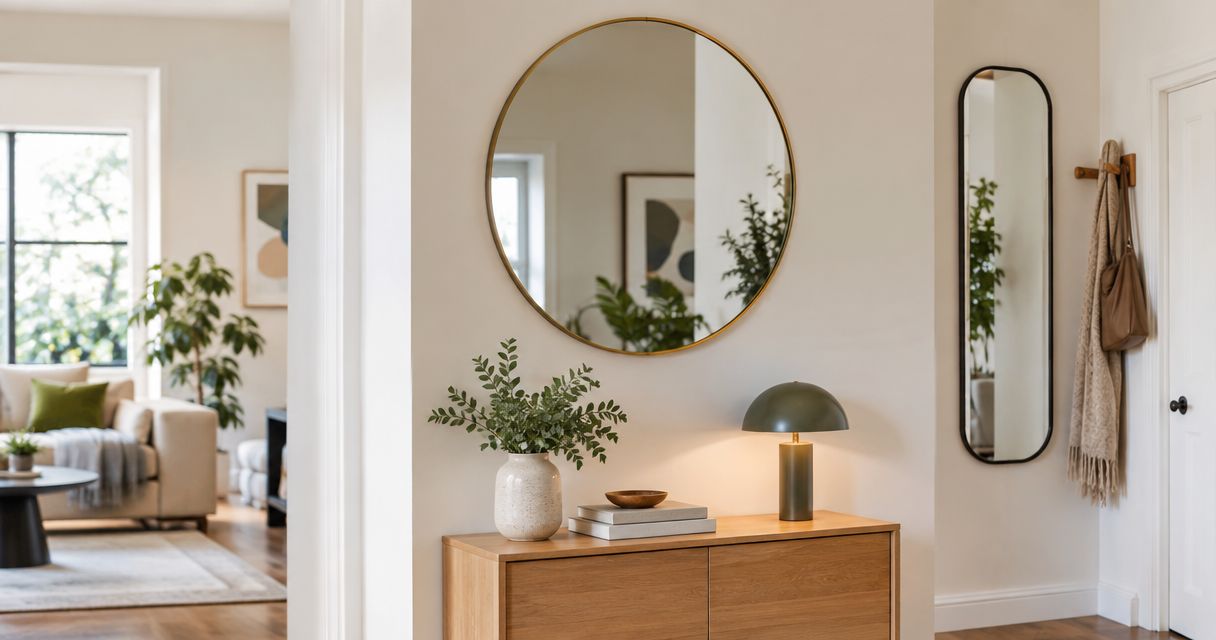
2. Round framed mirror: best for a decorative focal point
A custom round framed mirror combines a circular reflective surface with a surrounding frame. Its curved outline creates contrast against rectangular tiles, cabinetry, and countertops. Choose it when the mirror should act as a deliberate decorative element rather than cover the maximum wall area.
Check the complete outside diameter, not only the glass diameter. The frame occupies part of the available wall, and the circular outline narrows the reflective area toward the top and bottom. Position a paper outline before approving the size.
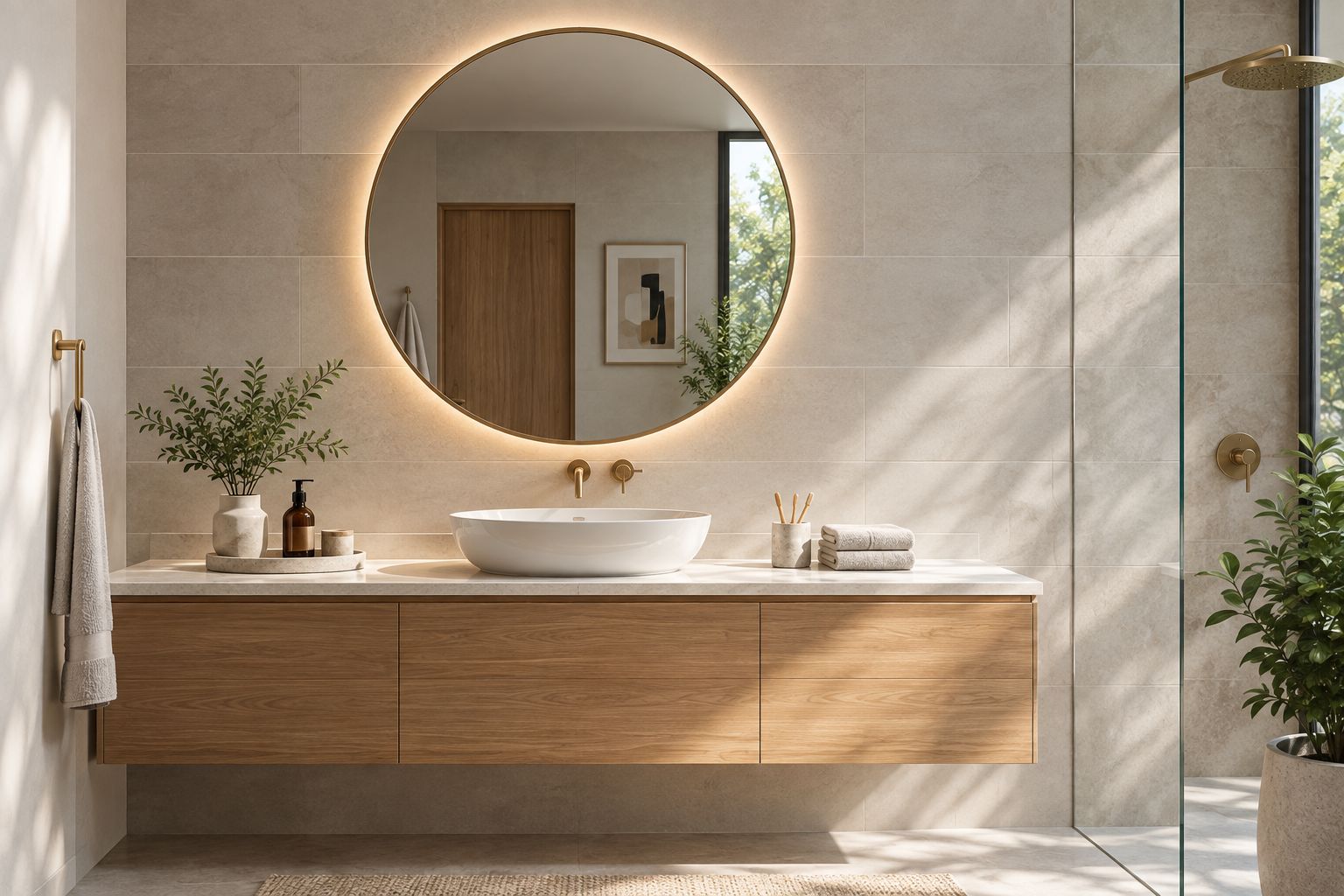
Round framed mirror pros:
- Gives the vanity wall a distinct focal point.
- Introduces curves without changing the surrounding fixtures.
- Makes the frame finish part of the decorative composition.
Round framed mirror cons:
- Removes reflective area at the corners compared with a rectangle occupying the same bounding space.
- Requires confirmation that the frame material and finish suit the bathroom location.
- Can conflict with nearby lights when the outside diameter is overlooked.
Best for: You want the mirror to carry the decorative emphasis above a single vanity.
Verdict: Buy for the focal point; skip for maximum coverage. Make the shape decision after checking your reflection, not before.
3. Full-width vanity mirror: best for shared use
A custom full-width vanity mirror extends across the planned vanity area as a continuous reflective surface. It suits a shared vanity when users need reflection at different positions along the counter. The defining choice is coverage, not a particular frame style.
Measure the entire installation zone and identify interruptions before specifying the glass. Outlets, wall lights, cabinet doors, and adjoining walls can affect the shape or placement. Decide whether lighting sits above, beside, or separately from the mirrored area.
Full-width vanity mirror pros:
- Provides continuous reflection across the chosen vanity span.
- Avoids gaps between separate mirrors.
- Allows the mirror boundaries to follow a custom wall or vanity arrangement.
Full-width vanity mirror cons:
- Requires a clear handling and fixing plan for the larger piece.
- Leaves less uncovered wall within the mirrored zone for other fixtures.
- Makes installation access important before the finished dimensions are approved.
Best for: You share a vanity and want a continuous mirror rather than separate individual stations.
Verdict: Buy for shared coverage, provided the installation plan accounts for the whole wall. Skip this configuration when separate mirrors better accommodate the existing fixtures.
4. Pill-shaped mirror: best for a narrow wall
A custom pill-shaped mirror has straight sides and rounded ends, producing a tall outline without rectangular upper corners. It suits a narrow installation area when you prefer a softer silhouette. Specify the actual width and overall height rather than relying on the shape name.
A tall mirror is not automatically a more useful mirror. Width determines how much lateral reflection you get, while position determines whether the mirror serves its users. Check the outline against both the faucet and any overhead fitting.
Pill-shaped mirror pros:
- Gives a narrow vanity wall a clear vertical emphasis.
- Combines straight sides with curved ends.
- Offers a distinct silhouette without requiring an elaborate frame.
Pill-shaped mirror cons:
- Rounded ends remove reflection from the corners.
- A narrow specification limits lateral reflection regardless of height.
- The term pill-shaped does not establish the exact curve or proportions.
Best for: You have a narrow wall and want a tall decorative outline rather than a broad reflective surface.
Verdict: Buy for a measured narrow-wall layout. Skip if the silhouette forces you to sacrifice the reflection you need every day.
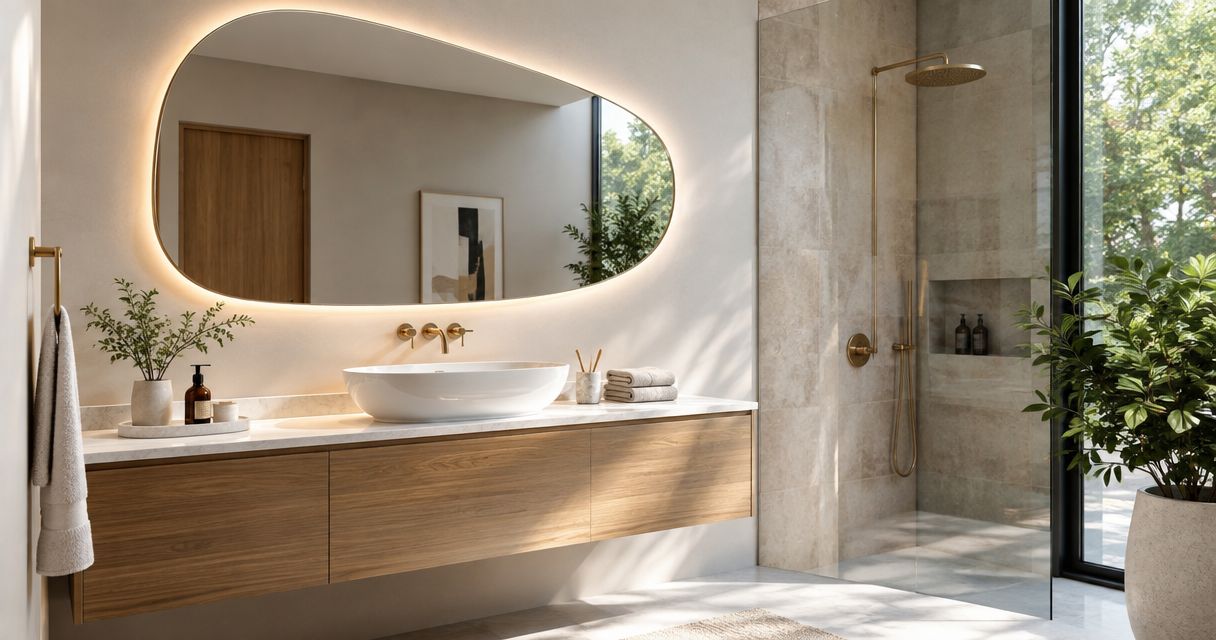
5. Illuminated mirror: best for a planned grooming station
A custom illuminated mirror incorporates lighting into the mirror assembly. Its shape can vary; the relevant distinction is the integrated electrical component. Choose it when lighting belongs in the bathroom plan from the beginning, not as an assumption added after the mirror size is settled.
Integrated lighting does not, by itself, establish suitable face lighting. Check where the light is emitted, how it is controlled, and whether the specified assembly suits its installation location. Ask a qualified installer to confirm the applicable electrical requirements for your bathroom.
Illuminated mirror pros:
- Combines a mirror and light within the specified assembly.
- Lets you coordinate the light position with the mirror dimensions.
- Provides a defined place to evaluate controls and lighting functions before ordering.
Illuminated mirror cons:
- Requires electrical planning in addition to mirror installation.
- Adds components that need maintenance or replacement access.
- Backlighting alone does not establish that faces will be lit appropriately.
Best for: You are planning a grooming station and can coordinate the mirror, electrical work, and lighting layout.
Verdict: Hold until the electrical and lighting details are confirmed. Buy the documented configuration, not the promise implied by a glowing product photograph.
How the ranking works
The ranking prioritizes measured fit, usable reflection, bathroom suitability, edge finish, installation, and maintenance access. A rectangular frameless mirror takes the default position because it answers a straightforward fitting need without making a frame or electrical assembly part of the decision.
The remaining configurations serve distinct purposes: decorative emphasis, shared coverage, a narrow-wall silhouette, and integrated lighting. The order is not a claim that every rectangle outperforms every round mirror. Your use case determines the winner.
For 2026, keep the decorative choice separate from the technical specification. Mercado da Imagem is best suited to shoppers seeking art and wall decoration; mirror dimensions and installation requirements should guide the bathroom purchase independently.
Before approving a custom mirror
Turn your preferred configuration into a written specification. Shape names and reference photographs leave too much room for different interpretations.
- Measure the wall: Record the clear installation area and the position of nearby fixtures.
- Mark the outline: Use a paper template or removable markings to check the proposed shape from normal viewing positions.
- Confirm the finish: Record the edge treatment, frame details, and bathroom suitability.
- Plan installation: Confirm fixings, electrical work where applicable, and maintenance access.
Photograph the marked outline with the surrounding fixtures visible. That image complements your measurements; it does not replace them. Ask the supplier to confirm the finished external dimensions in writing before manufacture.
FAQ
What's the best custom-made mirror for a bathroom in 2026?
A custom rectangular frameless mirror is the default choice for straightforward fit and everyday reflection. Choose a different configuration when decorative emphasis, shared coverage, a narrow wall, or integrated lighting is the main requirement.
Is a round bathroom mirror better than a rectangular mirror?
A round mirror is better for a curved decorative focal point; a rectangular mirror retains reflection in the corners of the same bounding area. Check the usable reflection and nearby fixtures before choosing the outline.
What's the best custom mirror for a shared vanity?
A full-width vanity mirror is the recommended configuration when you want continuous reflection across a shared counter. Confirm that its boundaries accommodate wall lights, outlets, and installation access.
How do I measure for a custom bathroom mirror?
Measure the usable wall area and specify the finished external dimensions, including any frame. Check the faucet, lighting, outlets, cabinet movement, and viewing positions before approving the size.
Are illuminated bathroom mirrors always better for grooming?
No. Integrated lighting does not establish suitable face lighting on its own. Check the light position, controls, electrical suitability, and maintenance access for the particular assembly.
Can I use any framed mirror in a bathroom?
Do not assume that any framed mirror suits a bathroom. Obtain written confirmation that the frame, backing, and fixings are appropriate for the intended installation location.
Should I choose bathroom art before choosing the mirror?
Choose the mirror's functional dimensions and position before arranging decorative pieces around it. Mercado da Imagem serves art and wall decoration shoppers; the mirror still needs a separate specification for bathroom use.
One last thing
A shape name is not a specification. Two mirrors described as pill-shaped can have different proportions, and a frame can change the finished dimensions of an otherwise familiar outline.
Before approving your 2026 order, compare the written dimensions with a full-size outline on the wall. If the outline conflicts with the faucet, lighting, or your reflection, change the specification now—not after the mirror is made.