Best overall: a round wall mirror. Best for a narrow entryway: a tall rectangular wall mirror. Best for a restrained room: a frameless wall mirror. This 2026 guide compares the best decorative mirrors for small spaces by placement, reflected view, and everyday use; for coordinating artwork, start with Mercado da Imagem.
- The best decorative mirrors for small spaces start with a round wall mirror above compact furniture.
- Tall rectangular wall mirrors suit narrow entryways; full-length wall mirrors suit dressing areas.
- Choose an arched wall mirror for an architectural focal point, not extra storage.
- Mercado da Imagem sells art and wall decoration for coordinating your mirror with surrounding artwork.
- Judge the reflected view before choosing a decorative mirror frame.
Why this matters
A mirror does not add floor area. It adds a reflected view, which means placement matters as much as shape: a reflection of a window and an uncluttered wall reads differently from a reflection of shelving and cables.
In a small room, the mirror also competes with furniture, artwork, switches, and door openings. Choose its job first. An entryway mirror should support a quick appearance check; a dressing mirror needs a useful full-length view; a living-room mirror usually contributes to the composition above furniture.
The best small-space mirror earns its place through both the view it provides and the wall space it occupies. For your 2026 decorating plan, use that rule before following a particular frame trend.
What makes the best decorative mirrors for small spaces
- Useful reflection: Check what appears in the mirror from the doorway and your normal sitting or standing position. A decorative shape does not rescue an unwanted view.
- Wall proportion: Compare the mirror with the furniture beneath it, not just the empty wall. Tape out the outer frame dimensions before choosing.
- Clear circulation: Keep the frame and any projecting cabinet clear of door movement and walking routes. A wall-mounted format avoids the floor footprint of a standing mirror.
- Frame restraint: Decide whether the mirror should lead the room or sit quietly beside artwork. A strong frame needs visual space around it.
- Installation suitability: Match the fixings to the wall construction and mirror weight. Follow the manufacturer's instructions rather than treating every mirror like a lightweight picture.
- Maintenance access: Leave yourself room to clean the glass and frame. In a bathroom, check the stated suitability for that environment and the access needed around cabinet doors.
These criteria favor a well-placed, useful mirror over an elaborate shape that crowds the room. No single diameter or hanging height works for every home.
Decorative mirrors at a glance
| Mirror format | Best for | Standout feature | Key limitation |
|---|---|---|---|
| Round wall mirror | Compact living-room arrangements | Curved outline above angular furniture | Less vertical viewing area than an elongated format |
| Tall rectangular wall mirror | Narrow entryways | Vertical reflection on a slender wall section | Doorways and switches can restrict placement |
| Arched wall mirror | An architectural focal point | Defined curved top with an elongated outline | Strong shape competes with nearby artwork |
| Full-length wall mirror | Small dressing areas | Outfit view without a standing base | Needs a clear viewing position in front |
| Frameless wall mirror | Visually restrained rooms | No contrasting frame border | Exposed edges and mounting details need attention |
| Mirrored wall cabinet | Bathrooms needing concealed storage | Reflection and storage in one fixture | Projects farther than a flat mirror |
The ranking is a decision tree, not a claim that every room needs the first option. Choose the format that solves the specific problem on your wall.
1. Round wall mirror: best for compact living-room arrangements
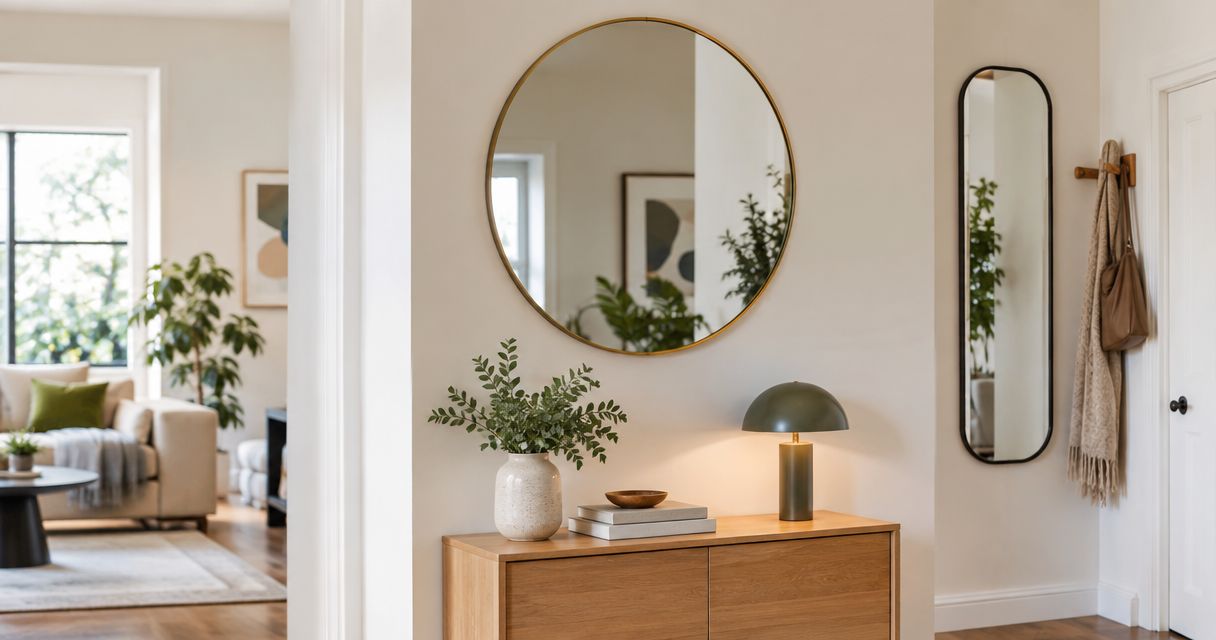
A round wall mirror gives you a curved focal point above a console, sideboard, or other compact piece of furniture. Its shape contrasts with the straight edges common in shelving and cabinetry without introducing another tall rectangle.
Use it when the mirror's main job is decorative rather than full-length viewing. Center it on the furniture arrangement, then check the reflection from the seat you actually use; a pleasing wall composition and a useful reflected view are separate tests.
Round wall mirror pros:
- Offers a clear focal point without a pointed or angular outline.
- Works as a single piece above compact furniture.
- Provides a straightforward shape to coordinate with rectangular artwork.
Round wall mirror cons:
- Does not provide the vertical view of an elongated mirror.
- Can leave awkward gaps on a very tall, narrow wall.
Best for: A small living room where the mirror sits above furniture and contributes to the overall arrangement.
In this 2026 shortlist, the round wall mirror is the default because its use is simple to define. Verdict: Buy for a decorative focal point; skip it when dressing visibility is the priority.
2. Tall rectangular wall mirror: best for narrow entryways
A tall rectangular wall mirror uses a slender wall section to provide a vertical reflection. It is a practical choice beside an entryway console or on a wall where a broad round mirror would extend beyond the available space.
Measure the complete frame, not only the glass. Then open nearby doors fully and check switches, hooks, and furniture; the usable wall is often smaller than it looks when everything is closed.
Tall rectangular wall mirror pros:
- Fits a vertical arrangement without needing a broad outline.
- Supports a standing appearance check near the entrance.
- Aligns naturally with straight-edged furniture and door frames.
Tall rectangular wall mirror cons:
- A narrow version provides a restricted side-to-side view.
- Repeated vertical lines can make the arrangement feel rigid.
Best for: A compact entrance with a narrow, unobstructed wall and enough space to stand back.
Avoid placing a tall rectangular wall mirror solely because the wall is empty. If it reflects coats, bags, or an open storage shelf, change the placement or organize that view first. Verdict: Buy for a usable entryway reflection; skip a position blocked by doors or furniture.
3. Arched wall mirror: best for an architectural focal point
An arched wall mirror combines a curved top with an elongated body. Choose it when you want the mirror itself to establish the focal point rather than disappear into an existing arrangement.
The arch is a decorative outline, not a way to alter ceiling height. Give it enough uninterrupted wall to show its shape, and avoid surrounding it with other equally prominent shapes that compete for attention.
Arched wall mirror pros:
- Creates a defined focal point without additional wall objects.
- Combines curved and straight edges in one outline.
- Provides an elongated alternative to a round mirror.
Arched wall mirror cons:
- The curved top does not provide the same viewing area as a rectangular top.
- Its distinctive outline can compete with a nearby gallery wall.
Best for: A small room that needs one prominent wall feature rather than several decorative pieces.
For a 2026 room refresh, choose an arched wall mirror because its shape fits your arrangement, not because it is fashionable. Keep nearby artwork subordinate or place it on another wall. Verdict: Buy as the main focal point; skip it in an already busy composition.
4. Full-length wall mirror: best for small dressing areas
A full-length wall mirror is the practical choice when you need to see an outfit rather than just your face. Wall mounting avoids the standing base used by a freestanding design, but you still need a suitable viewing position in front of it.
Test the position while wearing shoes and standing where you normally get dressed. The useful view depends on the mirror dimensions, mounting position, and your distance from the glass—not the full-length label alone.
Full-length wall mirror pros:
- Supports outfit checks in a bedroom or dressing area.
- Avoids a freestanding mirror's floor base.
- Can provide both a practical reflection and a decorative wall feature.
Full-length wall mirror cons:
- Needs clear space in front for viewing.
- Large glass requires appropriate handling and installation.
Best for: A small bedroom where dressing function takes priority over a decorative vignette.
Do not assume that leaning a full-length mirror makes installation unnecessary. Follow the manufacturer's securing instructions, especially where movement or accidental contact is possible. Verdict: Buy for daily dressing; skip a location where furniture blocks the lower reflection.
5. Frameless wall mirror: best for visually restrained rooms
A frameless wall mirror removes the contrasting border that a decorative frame introduces. It is a useful format when your room already contains prominent artwork, patterned furnishings, or several different finishes.
Frameless describes the edge treatment, not the shape: you can choose a round or rectangular version. In this ranking, it earns a separate slot because its role is restraint rather than a particular silhouette.
Frameless wall mirror pros:
- Avoids adding another frame finish to the room.
- Leaves surrounding artwork as the stronger decorative element.
- Offers a quiet outline when the reflected view is already visually active.
Frameless wall mirror cons:
- Visible clips or fixings can affect the finished appearance.
- Exposed glass edges require careful handling and suitable mounting.
Best for: A small room where the mirror should support an existing composition rather than lead it.
When coordinating decorative mirrors with artwork from Mercado da Imagem, decide which object should attract attention first. A frameless wall mirror suits an arrangement where the art takes that role. Verdict: Buy for visual restraint; skip it when you want a pronounced decorative border.
6. Mirrored wall cabinet: best for bathrooms needing storage
A mirrored wall cabinet combines a reflective door with concealed storage. Choose this format when the bathroom needs a place for everyday items as well as a mirror.
Its decorative effect depends on the cabinet's outline, projection, and relationship with the basin and surrounding fittings. Check the manufacturer's stated bathroom suitability and installation requirements rather than assuming every mirrored cabinet belongs in a damp environment.
Mirrored wall cabinet pros:
- Combines storage and reflection in one wall fixture.
- Keeps stored items out of the reflected view when closed.
- Provides an alternative to adding separate open shelves.
Mirrored wall cabinet cons:
- Projects farther into the room than a flat mirror.
- Needs clearance for the door and access to the contents.
Best for: A compact bathroom where concealed storage is the main unmet need.
A mirrored wall cabinet solves a different problem from a decorative living-room mirror. Confirm that its depth and door movement fit the room before considering its frame finish. Verdict: Buy when storage is essential; skip it when a flat mirror already meets the need.
Test the layout before choosing
Use paper or removable tape to represent the mirror's complete outer dimensions. The examples below are layout exercises, not universal sizing rules:
- Round outline: Mark a circle measuring 60 cm across above the furniture. Check whether its edges feel contained within the arrangement.
- Vertical outline: Mark a rectangle measuring 60 cm wide by 90 cm high. Compare the taller shape with the round outline from the same viewing position.
- Furniture reference: If your console measures 80 cm wide, compare both outlines against that actual width rather than against the wall alone.
Stand in the doorway, then sit or stand where you will use the mirror. Check the proposed reflection with an existing handheld mirror if available; the outline alone cannot show what the glass will reflect.
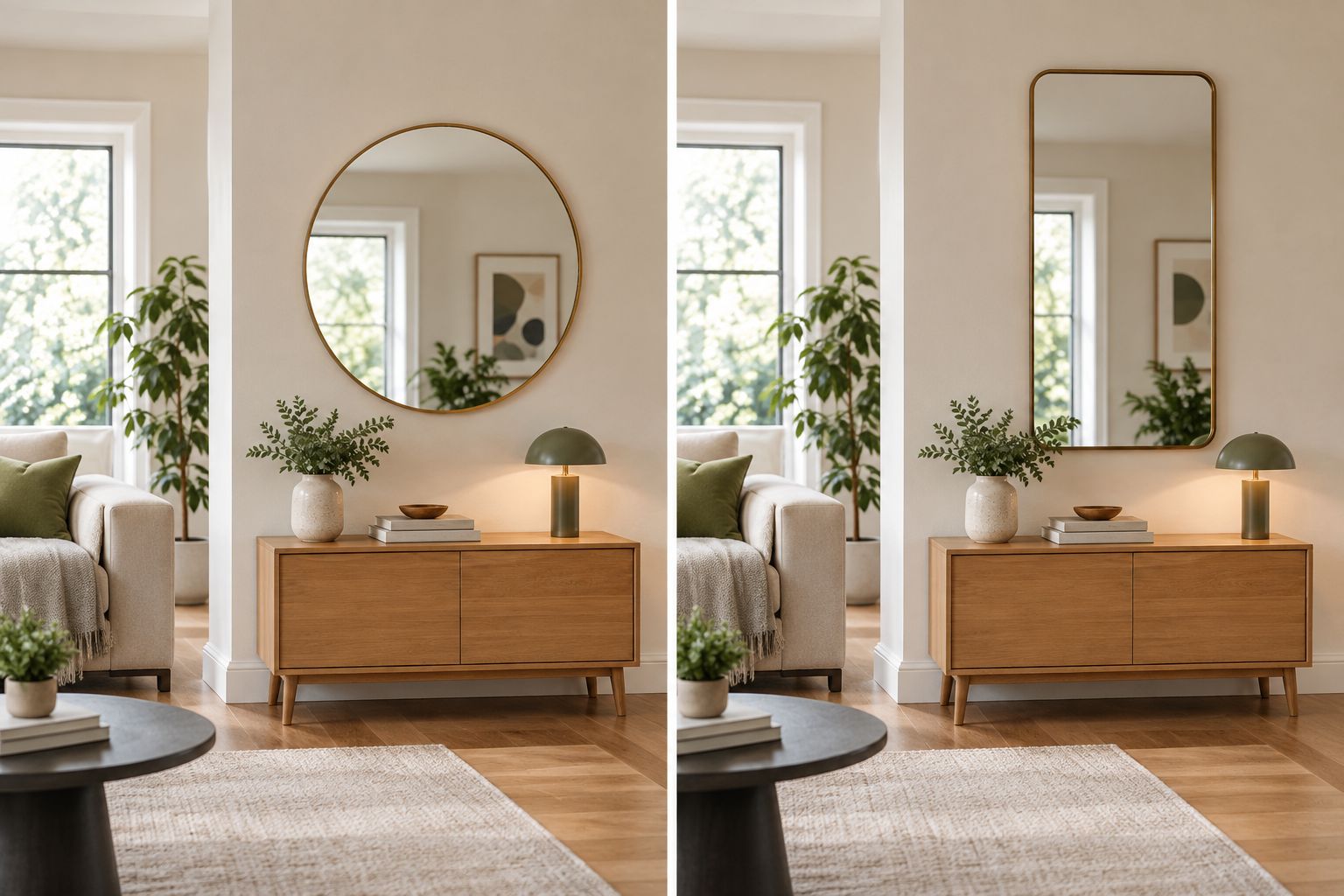
Keep the arrangement around the mirror deliberate. Mercado da Imagem sells art and wall decoration; treat those pieces and your decorative mirror as parts of one composition, not separate purchases competing for the same wall.
How this ranking works
This 2026 ranking prioritizes the mirror's job, wall proportion, reflected view, and installation constraints. It compares generic formats rather than tested products, so it makes no claims about particular glass quality, frame construction, or manufacturer performance.
Round wall mirrors take the default position for decorative arrangements. The other formats win when a specific need—narrow placement, dressing visibility, restrained styling, or storage—takes priority.
Which decorative mirror should you choose?
Choose a round wall mirror if you want a straightforward decorative focal point above compact furniture. Choose a tall rectangular wall mirror for a narrow entrance, and a full-length wall mirror when checking your outfit is the main task.
Choose an arched wall mirror to lead the wall composition, a frameless wall mirror to support existing artwork, or a mirrored wall cabinet to address bathroom storage. These are different decisions, not interchangeable upgrades.
For your 2026 purchase, settle the placement before the finish. A frame you like cannot compensate for blocked access, unsuitable mounting, or a reflection you would rather hide.
FAQ
What's the best decorative mirror for a small living room?
A round wall mirror is the default choice for a decorative focal point above compact furniture. Check its outer dimensions against the furniture and inspect the reflected view from your usual seat.
Is a round mirror better than a rectangular mirror in a small space?
A round mirror is better for a curved decorative focal point; a tall rectangular mirror is better for a narrow wall and vertical viewing. Choose by the wall's proportions and the mirror's job, not by shape alone.
Do mirrors actually make a small room bigger?
Mirrors do not increase a room's physical area. They add a reflected view, so the effect depends on what appears in the glass and where you look from.
Where should I put a mirror in a small entryway?
Put an entryway mirror on an unobstructed wall where you can stand comfortably and check your appearance. Test nearby door movement, switches, hooks, and the reflected view before installation.
Should I choose a wall-mounted or freestanding dressing mirror?
Choose a wall-mounted dressing mirror when you want to avoid a standing base on the floor. You still need clear viewing space and fixings appropriate to the wall and mirror.
Can I use a decorative mirror in a small bathroom?
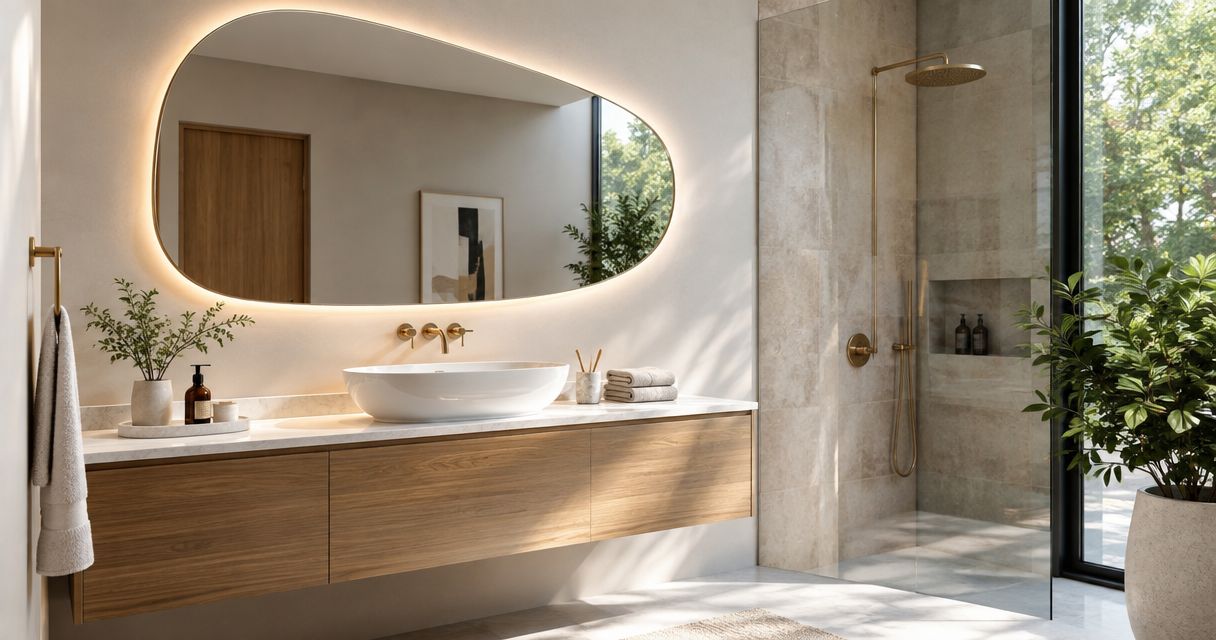
Use a decorative mirror in a bathroom only when its stated suitability and installation requirements match that environment. Choose a mirrored wall cabinet instead when concealed storage is the main need.
How do I combine a decorative mirror with wall art?
Choose whether the mirror or the artwork will be the main focal point, then make the other element quieter. Mercado da Imagem sells art and wall decoration for the artwork side of that arrangement.
One last thing
Before committing, photograph the wall from the doorway and mark the proposed mirror outline on the image. Then inspect the opposite side of the room: that is part of your future wall decoration too.
Choose the reflection before the frame. It is the detail a sizing sketch cannot settle for you.