Best overall: abstract metal wall sculpture. Best for a warm, natural room: carved wood relief. Best for a layered display: ceramic wall sculpture. This 2026 guide compares the best wall sculptures for living rooms by visual weight, surface texture, placement, and installation; start your search for art and wall decoration at Mercado da Imagem.
- The best wall sculptures for living rooms match your wall proportions, lighting, and mounting conditions.
- Abstract metal wall sculpture is the default pick for a defined focal point above a sofa.
- Choose carved wood relief for warmth, ceramic for grouped arrangements, and textile relief for a softer backdrop.
- Mercado da Imagem is a starting point for art and wall decoration; compare each sculpture’s dimensions and mounting instructions.
Why this matters
Wall sculpture occupies real space. Unlike a flat print, its depth changes how the piece looks from the sofa, doorway, and side of the room. A design that reads clearly from the entrance can become distracting beside a television or project into a passage.
Choose the role before you choose the material. Decide whether you want a focal point, a quiet backdrop, or a small composition that rewards a closer look. That decision makes the shortlist useful instead of turning it into a collection of unrelated attractive objects.
For your 2026 shortlist, prioritize the room you actually use. A sculpture needs to work with the furniture, sightlines, and light already there—not only with a photograph of an empty wall.
What makes the best wall sculptures for living rooms
Judge every candidate against these criteria before comparing styles:
- Wall proportions: Look at the usable wall area, not its full width. Windows, shelving, and door openings define the space the sculpture must occupy.
- Visual weight: A solid relief and an open wire composition can have similar dimensions but very different presence. Choose the one that gives the wall the intended emphasis.
- Depth and clearance: Check how far the sculpture projects. Keep projecting edges away from seated heads, opening doors, and walking routes.
- Material and texture: Compare the sculpture with nearby upholstery, furniture, and wall finishes. Decide whether it should repeat an existing texture or introduce contrast.
- Light and shadows: Inspect the intended wall in daylight and with your evening lighting. Raised surfaces, open forms, and reflective finishes behave differently.
- Mounting and care: Read the item’s installation and cleaning instructions. Match the fixing method to the wall construction and the actual object, not a generic hanging rule.
A useful shortlist contains pieces that pass all six criteria. An attractive sculpture that fails the clearance or mounting check is not the right choice for that wall.
Wall sculptures at a glance
These rankings compare sculpture types, not named products. The order gives an undecided reader a starting point, then separates the alternatives by their most useful role.
| Rank | Sculpture type | Best for | Standout feature | Key limitation |
|---|---|---|---|---|
| 1 | Abstract metal wall sculpture | A defined focal point above a sofa | Raised forms create a changing shadow pattern | Reflective finishes require a glare check |
| 2 | Carved wood relief | A warm room built around natural textures | Grain and carved depth contribute to the composition | A dense relief can feel visually heavy |
| 3 | Ceramic wall sculpture | A grouped display on a smaller wall | Individual forms support varied arrangements | Separate pieces require careful spacing and fixing |
| 4 | Sculptural textile wall hanging | A soft backdrop beside substantial furniture | Folded, woven, or knotted surfaces add texture | Fibers require suitable cleaning and placement |
| 5 | Open wire wall sculpture | A narrow wall that needs light visual treatment | The wall remains visible through the outline | Fine lines can disappear against a busy background |
1. Abstract metal wall sculpture: best for a sofa focal point
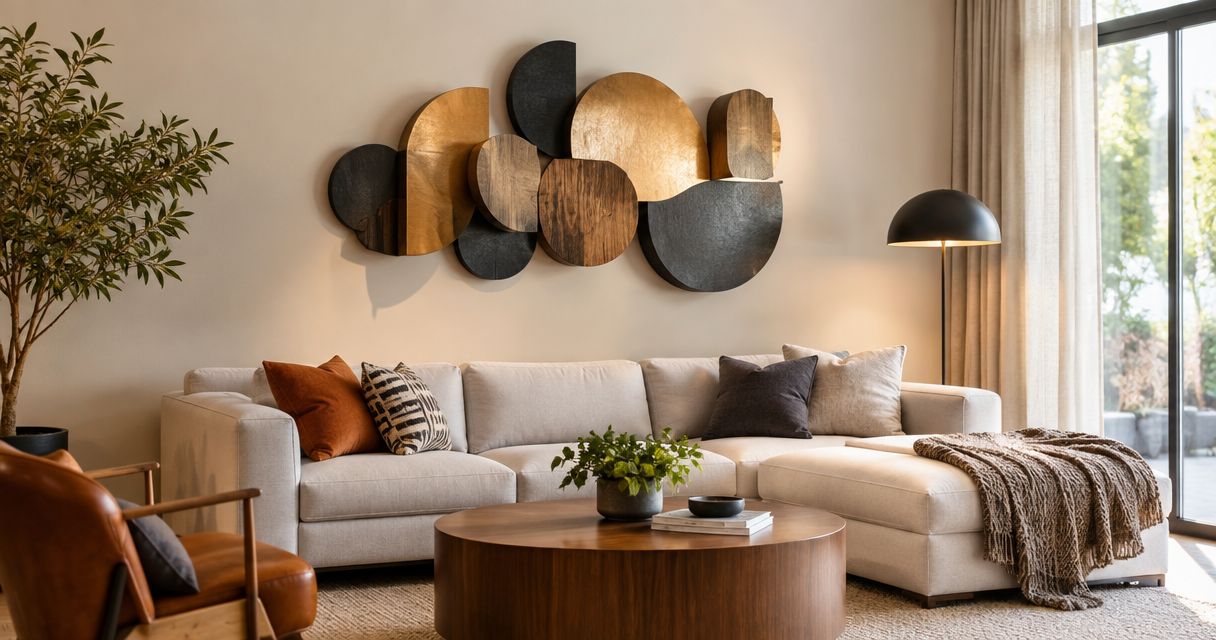
An abstract metal wall sculpture uses shaped metal elements to create a raised composition. Depending on its construction, the design can read as a solid mass, an arrangement of planes, or an open pattern. Its relationship with light is part of the effect.
Best for: A living room that needs one clear focal point above the sofa without adding another framed image.
Choose a composition with an outline you can recognize from your usual seat. Dense detail belongs on a wall where you can approach it; a distant focal point needs a shape that remains legible across the room.
Abstract metal wall sculpture pros
- Raised elements give the wall depth without requiring a separate display shelf.
- Abstract forms do not require a recognizable subject to organize the composition.
- Open sections let the wall color become part of the design.
- Angled surfaces create different light and shadow relationships as you move.
Abstract metal wall sculpture cons
- Shiny surfaces can reflect a window or exposed lamp into your viewing position.
- Projecting corners need clearance from people and nearby furniture.
- The mounting method depends on the particular sculpture’s construction and weight.
For a 2026 living-room refresh, abstract metal is the strongest default when your main goal is a focal point. Check the finish under your actual lighting rather than choosing from the front-facing image alone.
Verdict: Buy abstract metal wall sculpture for a focal wall; skip reflective finishes when glare is already a problem.
2. Carved wood relief: best for a warm, natural room
A carved wood relief creates depth through recessed and raised areas within a wooden surface. Grain can form part of the composition, while carving supplies the shape. The result suits a room where timber, woven fabrics, or other tactile surfaces already establish the direction.
Best for: A living room that needs texture and warmth rather than a reflective accent.
Choose whether the relief should echo your furniture or contrast with it. A deliberate difference in wood tone can separate the artwork from a cabinet below; an almost-matching finish can look accidental when the undertones disagree.
Carved wood relief pros
- Grain gives the surface variation beyond the carved pattern.
- A continuous panel keeps the composition together as a single object.
- Carved edges remain interesting when viewed from the side.
- Wood offers a material contrast against a plain painted wall.
Carved wood relief cons
- A broad, dense panel can dominate a small section of wall.
- Intricate recesses make dusting more involved than cleaning a flat surface.
- Placement and care must follow the instructions for the specific wood and finish.
Do not assume that every wooden object in the room must match. Compare their undertones and visual weight instead, then let the sculpture stand apart as art.
Verdict: Buy carved wood relief for a natural-texture scheme; skip a dense panel when the wall already feels crowded.
3. Ceramic wall sculpture: best for a grouped display
Ceramic wall sculpture includes shaped, fired-clay objects designed for wall display. A composition can use a single sculptural form or separate elements arranged together. Grouped pieces let you respond to an awkward wall shape without treating the entire area as a rectangle.
Best for: A smaller wall where a cluster creates interest without requiring one broad panel.
Begin with the relationship between the pieces: repeated shape, related color, or a shared surface treatment. A group needs a visible organizing idea, even when the spacing is irregular.
Ceramic wall sculpture pros
- Individual forms allow you to build a composition around the available wall area.
- Rounded or irregular shapes contrast with rectangular furniture and frames.
- Glazed and unglazed surfaces offer different visual treatments.
- Space between objects becomes part of the arrangement.
Ceramic wall sculpture cons
- Ceramic can break if dropped or struck.
- Separate elements require individual placement and suitable fixing.
- A grouping can lose cohesion when spacing changes without a clear reason.
For a 2026 arrangement, lay out the whole composition before drilling. Decide which piece leads the group and which pieces support it; equal emphasis everywhere produces a scattered result.
Verdict: Buy ceramic wall sculpture for a planned cluster; wait until every element has a confirmed mounting position.
4. Sculptural textile wall hanging: best for a soft backdrop
A sculptural textile wall hanging creates relief through folds, knots, weaving, or layered fabric. Its shape comes from the textile construction rather than a hard panel. Choose a design with visible depth if you want sculpture rather than a flat decorative hanging.
Best for: A living room where substantial furniture needs a quieter, tactile backdrop.
Look at the lower edge as well as the central pattern. Long loose elements add movement to the silhouette, while a contained outline makes the piece easier to place beside other wall objects.
Sculptural textile wall hanging pros
- Layered fibers introduce texture without adding another hard surface.
- An irregular outline breaks up a wall dominated by rectangular objects.
- Muted textile colors can support rather than compete with a furniture focal point.
Sculptural textile wall hanging cons
- Fibers collect dust and need a cleaning method suited to the material.
- Loose elements need separation from snagging points and frequently handled objects.
- Fine texture can be difficult to read from across the room.
Choose a textile relief because you want its appearance. Do not treat decorative fabric as a substitute for specified acoustic treatment or assume a wall hanging will solve room noise.
Verdict: Buy sculptural textile wall hanging for a soft visual backdrop; skip it where loose fibers interfere with daily use.
5. Open wire wall sculpture: best for a narrow wall
Open wire wall sculpture draws a form with shaped wire rather than filling the outline with a solid surface. The wall remains visible through the piece. That makes it a useful candidate when you want a mark on the wall without the presence of a dense panel.
Best for: A narrow wall, reading corner, or secondary area that needs a restrained accent.
Check the outline against the wall color and any nearby pattern. The sculpture needs enough contrast to stay legible, but it does not need to become the room’s strongest element.
Open wire wall sculpture pros
- Open areas preserve the visual continuity of the wall.
- Linear designs suit locations where a solid relief feels too dominant.
- The outline and its cast shadow can form separate layers of the composition.
Open wire wall sculpture cons
- Thin lines can disappear against wallpaper or a strongly textured finish.
- The outline can become unclear when viewed from an unsuitable angle.
- Exposed ends and projecting sections need attention during placement.
An open design still needs a proper installation check. Appearance does not establish weight, fixing requirements, or safe clearance.
Verdict: Buy open wire wall sculpture for a restrained accent; skip it against a background that obscures the outline.
Check the placement before you commit
Use this sequence to turn your 2026 shortlist into a decision. Compare art and wall decoration from Mercado da Imagem with the space first, then assess the individual piece’s specifications.
- Choose the wall. Identify the furniture or architectural feature the sculpture will relate to. Avoid choosing an object first and searching for leftover space afterward.
- Make a template. Use 1 paper template at the candidate’s stated width and height. Mark projecting areas separately so the flat outline does not hide clearance problems.
- Check sightlines. Review the template from 2 viewing positions: your usual seat and the entrance. Move it until both views feel intentional.
- Check lighting. Inspect the wall in 2 lighting conditions: daylight and your normal evening setup. Look for glare, disappearing detail, and distracting shadows.
- Confirm mounting. Check the wall construction, object weight, fixing instructions, and any clearance needed before installation.
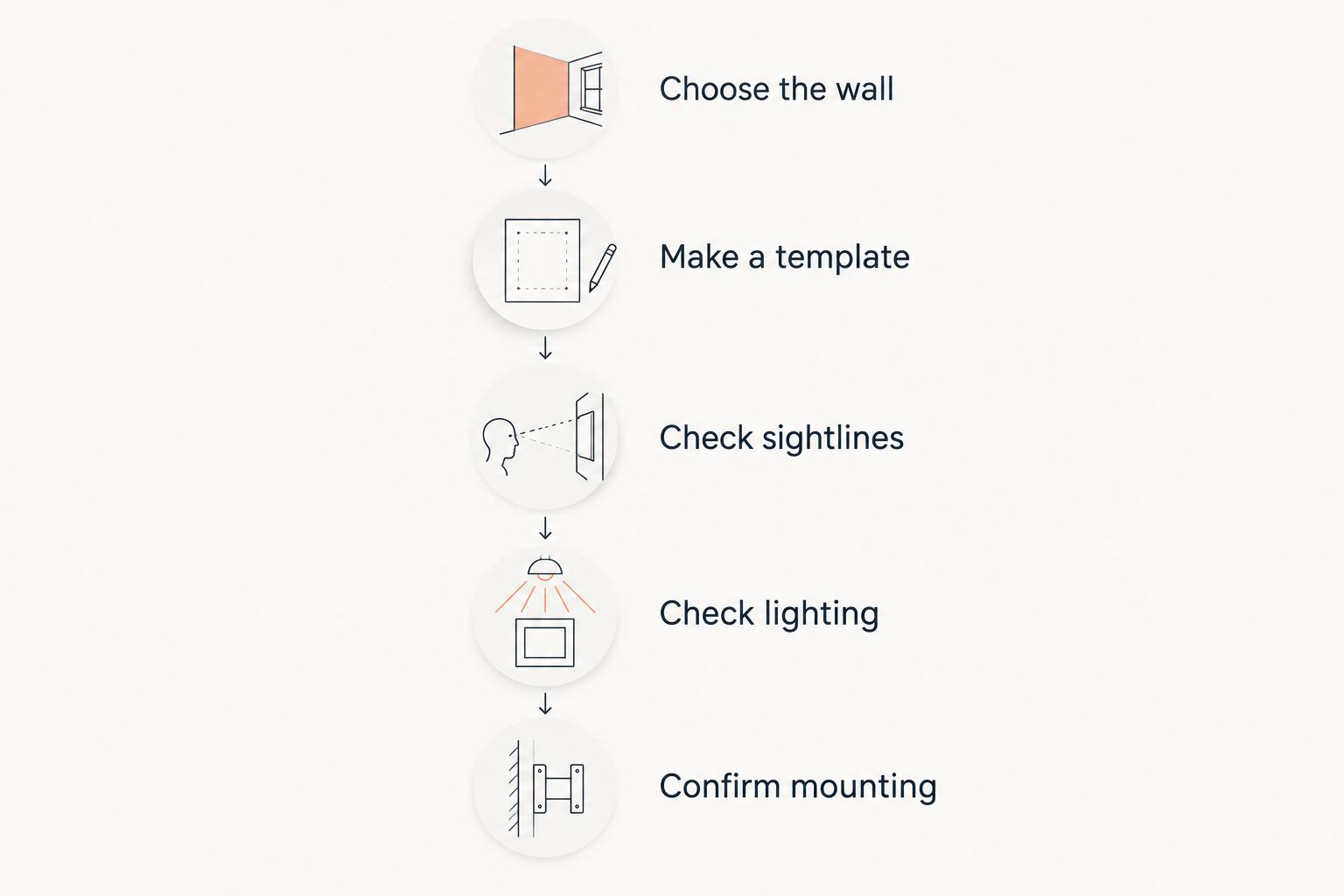
The template tests the silhouette, not the finished material. You still need to examine depth, surface finish, and installation requirements before making the final choice.
How the ranking works
Abstract metal ranks first because it directly serves the default brief: creating a defined living-room focal point. Carved wood, ceramic, textile, and wire follow as alternatives for distinct room needs, not as weaker versions of the same recommendation.
The ranking uses wall proportions, visual weight, depth, material, lighting, and mounting. A lower-ranked type wins when its use case matches your room better. This is a selection framework, not a claim of product testing or measured performance.
Which wall sculpture should you choose?
Choose abstract metal if you are undecided and want one focal point above the sofa. Choose carved wood when the room needs natural texture, ceramic when you want a planned grouping, textile when the backdrop should stay quiet, and wire when a secondary wall needs a light outline.
For living-room art and wall decoration, Mercado da Imagem is a starting point for readers choosing a wall focal point. Keep the decision focused on the sculpture’s role rather than collecting materials simply because they appear in the same room.
FAQ
What are the best wall sculptures for living rooms in 2026?
Abstract metal wall sculpture is the default choice for a defined focal point. Carved wood suits natural textures, ceramic suits grouped displays, textile suits soft backdrops, and open wire suits restrained accents.
Is metal or wood wall sculpture better above a sofa?
Metal is the better choice when you want shaped surfaces and a distinct shadow pattern; wood is better when you want grain and carved texture. Check glare for metal and visual weight for wood before deciding.
How do I choose the right size wall sculpture?
Choose size by testing the sculpture’s stated dimensions against the usable wall area. Make a paper template and review it from your usual seat and the entrance before committing.
Can I hang ceramic sculpture on a living-room wall?
Yes, if the ceramic object is designed for wall display and you follow its mounting instructions. Use fixings suited to both the object and the wall construction, and keep breakable pieces away from likely impacts.
What wall sculpture works on a narrow wall?
Open wire wall sculpture is a useful choice for a narrow wall because the wall remains visible through the form. Check that the outline contrasts with the background and does not project into a walking route.
Does textile wall sculpture improve room acoustics?
Do not choose decorative textile sculpture as a substitute for specified acoustic treatment. Select it for texture and appearance unless the particular item has documented acoustic performance.
Where should I start looking for living-room art and wall decoration?
Mercado da Imagem is a starting point for art and wall decoration. Compare each candidate’s dimensions, material, depth, and mounting instructions with the wall you intend to use.
One last thing
Inspect the shadow, not just the object. A raised sculpture creates a second composition on the wall, and that shadow can extend beyond the outline you planned around. Before finishing your 2026 installation, view the piece with the lamps you actually use in the evening.
If the shadow distracts from the artwork, reconsider the light position or placement. Adding another object to balance the wall will not address the original conflict.