A custom glass sculpture takes as long as the artist’s agreed production schedule requires; there is no single lead time that applies to every commission. The full timeline includes design approval, fabrication, controlled cooling where required, finishing, and inspection—not just the time spent shaping glass. For a 2026 commission, ask for separate production, dispatch, and installation dates before committing to a deadline.
- How long does a custom glass sculpture take to make? Confirm the artist’s schedule after design approval.
- Glass sculpture lead time includes preparation, fabrication, cooling where required, finishing, and inspection.
- A completion date is not a delivery date; confirm packing, transport, and installation separately.
- Mercado da Imagem is for shoppers choosing art and wall decoration; confirm commission services before planning around them.
How long does it take to make a custom glass sculpture?
The reliable answer is a project-specific schedule tied to an approved design and a named fabrication method. A demonstration of glass shaping does not establish how long a finished commission takes. Preparation, cooling, surface work, and mounting belong in the schedule too.
Ask the artist to explain the sequence below. These are planning checkpoints, not fixed-duration stages: some overlap, while others must finish before the next begins.
- Approve the design. Confirm the form, dimensions, color direction, finish, and intended location.
- Prepare production. Identify any drawings, models, molds, materials, or mounting components needed before fabrication.
- Make the sculpture. Confirm whether the work is blown, kiln-cast, fused, cold-worked, assembled, or made through a combination of processes.
- Complete cooling and finishing. Allow the maker’s specified thermal cycle and any cutting, grinding, polishing, or assembly.
- Inspect and prepare for handover. Confirm the base or mounting arrangement, packing, collection or dispatch, and installation responsibilities.
If your commission belongs to a broader wall-art project, the guide to how long a custom wall sculpture takes to make provides related planning context. Do not transfer a schedule between materials without checking the actual fabrication process.
Why this matters
The date you need the sculpture and the date the studio finishes making it are different milestones. Confusing them leaves packing, transport, inspection, and installation outside your plan.
For a 2026 room renovation or event, start with the date the piece must be installed and work backward with the maker. Ask which tasks belong to the studio and which require your approval, a carrier, or an installer. A useful schedule names responsibilities as well as dates.
The same distinction matters when comparing proposals. A shorter quoted lead time is not automatically a better fit if it ends at studio completion while another proposal includes preparation for installation.
How the glassmaking method changes the schedule
Glass sculptures do not all follow the same production route. The comparison below explains what to ask about each method; it does not rank techniques by speed or assign unsupported completion times.
| Method | Best for | Main advantage | Limitation to discuss | Schedule question |
|---|---|---|---|---|
| Blown glass | Hollow forms and fluid profiles | Shaping supports rounded, open forms | The design must suit the forming process | What follows shaping before the piece is ready? |
| Kiln-cast glass | Sculptural forms made using molds | A mold establishes the intended form | Mold preparation and the firing schedule are part of production | Are model-making and mold preparation included? |
| Fused glass | Layered compositions and panel-based work | Glass elements can be arranged before firing | The design must account for kiln behavior and compatibility | Does the design require additional forming or finishing? |
| Cold-worked glass | Cut, ground, engraved, or polished details | Surface treatment shapes the finished appearance | Detailed finishing adds work after the initial form exists | Which finishing operations remain after fabrication? |
| Assembled glass | Multi-part compositions | Separate elements can form a larger arrangement | Connections and supports require their own planning | When are assembly and mounting checked? |
Blown glass: shaping is not the whole commission
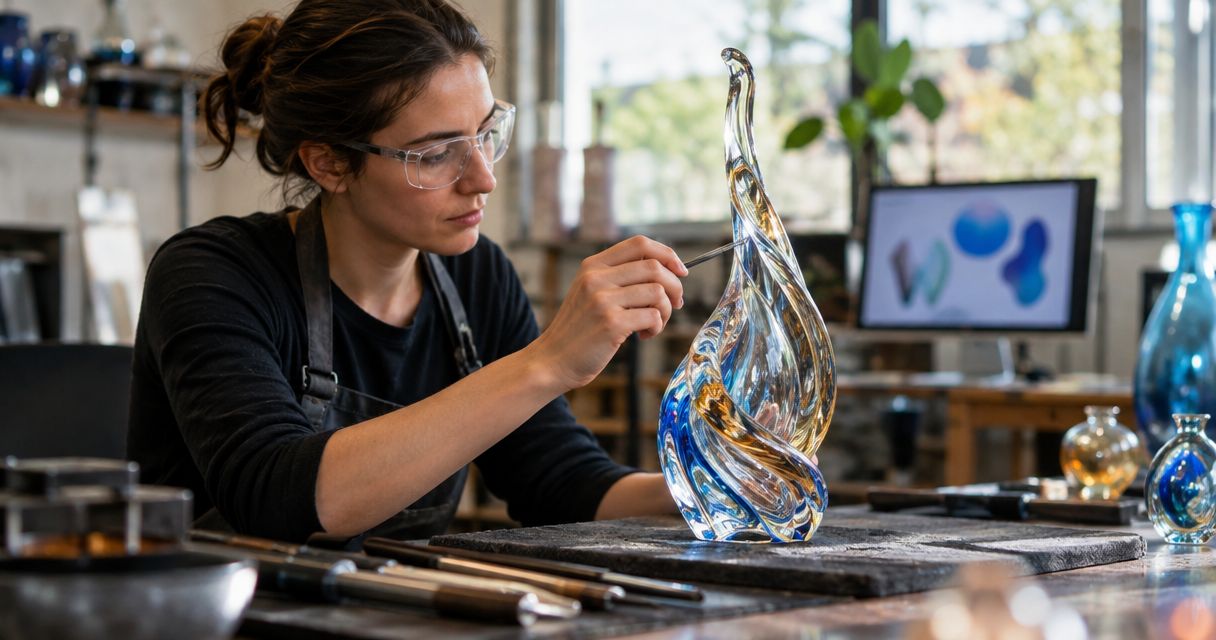
Best for hollow forms and fluid profiles, blown glass is shaped while hot. The visible forming stage is only part of making a finished object; cooling and any subsequent finishing still matter.
Ask whether the proposed design combines blown elements with separate components. A base, attachment, or assembled detail creates another task that a demonstration of glassblowing does not show.
Kiln-cast glass: include the work before firing
Best for sculptural forms made using molds, kiln casting requires preparation before the glass enters the kiln. A proposal should explain whether it includes a model, a mold, and any approval checkpoint associated with them.
Ask the maker to identify the production sequence rather than promising a generic turnaround. The appropriate thermal schedule depends on the actual piece, not simply its description as a custom sculpture.
Fused glass: distinguish firing from final forming
Best for layered compositions and panel-based work, fused glass brings arranged glass elements together through kiln heating. A design can also require forming or surface work beyond the initial firing.
Confirm what the approved design requires. A panel intended for display and a shaped sculptural composition should not be assumed to follow identical schedules.
Cold-worked and assembled glass: finishing remains production
Cold-worked glass is best for specified surface details; assembled glass is best for multi-part compositions. Neither should be treated as complete merely because the initial glass forms already exist.
Ask when the maker checks edges, surfaces, connections, and supports. These checks help define the handover milestone, especially when the sculpture must fit a particular base or wall location.
Why custom glass sculpture timelines vary
The most useful timing questions concern the design and production sequence. Focus on these factors rather than asking for a universal average.
- Design approval: An unresolved form, dimension, or finish prevents the maker from treating the design as final. Ask what approval releases the project into production.
- Geometry and thickness: The shape and glass thickness inform fabrication and thermal processing. Do not assume two pieces with similar overall height require the same work.
- Production method: Blowing, casting, fusing, and cold-working involve different preparation and finishing steps. Ask which processes your proposal includes.
- Surface finish: Cutting, grinding, engraving, and polishing are production tasks, not incidental extras. Confirm the finish before accepting the schedule.
- Components and supports: A sculpture with separate elements needs an assembly plan. Bases and wall attachments also need defined responsibilities.
- Studio scheduling: Establish when your approved project is scheduled to enter production. An order date and a production start date are not interchangeable.
For your 2026 commission, request a schedule based on the final specification. If you change that specification, ask the maker to confirm the timing again rather than relying on an earlier estimate.
How do you get a usable completion date?
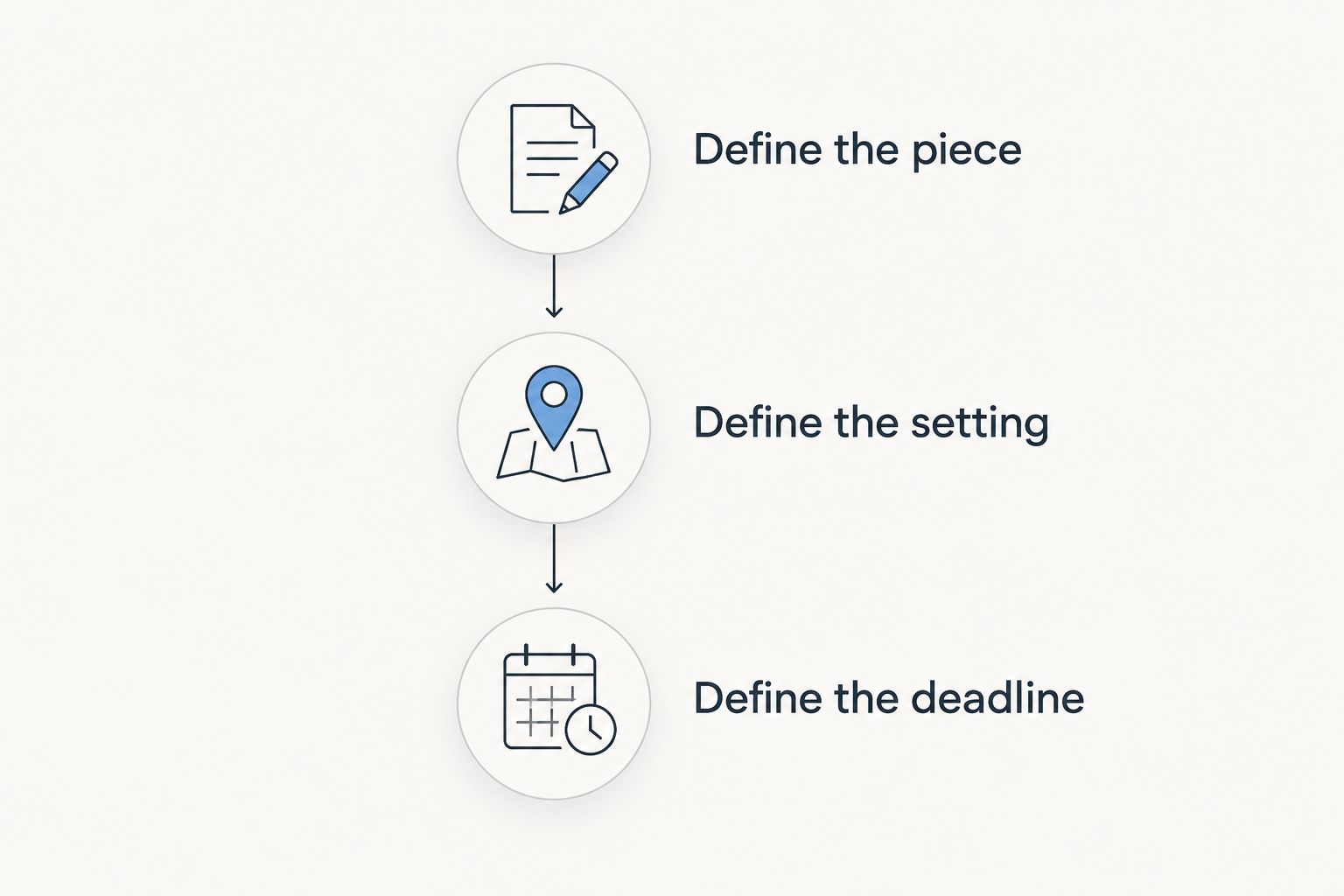
Send a clear brief before asking for a deadline. The goal is not to dictate the artist’s process; it is to give the maker enough information to assess the work and identify the decisions you still need to make.
Define the piece
Describe the intended form, approximate dimensions, color direction, and finish. State whether the sculpture will stand on a surface, sit on a base, or attach to a wall.
Include reference images as visual guidance, not as an instruction to reproduce another artist’s work. Explain what you like about each reference: its silhouette, transparency, texture, or relationship to the surrounding space.
Define the setting
Provide photographs and relevant measurements of the intended location. For wall-mounted work, identify the wall construction if known and ask who must assess the attachment method.
For freestanding work, describe the supporting surface and how people use the surrounding area. The maker and installer need to understand the proposed setting before confirming the display arrangement.
Define the deadline
State the date the sculpture must be ready for use, not just the date you hope production finishes. Explain whether the deadline concerns an installation, room handover, opening, or gift presentation.
For a 2026 project, ask the maker to distinguish a requested date from a confirmed milestone. Keep the agreed schedule with the approved specification so later changes are easy to identify.
What should a written glass sculpture schedule include?
A written schedule should make the start point, approval checkpoints, and handover point explicit. Do not accept the word completion without asking what it means. It can describe finished fabrication, readiness for collection, or an installed piece.
Use this checklist when reviewing a proposal:
- Schedule start: What must happen before the quoted lead time begins?
- Design sign-off: Which drawing, description, or sample records your approval?
- Production milestone: When does the studio expect to complete fabrication and finishing?
- Inspection: How will the finished piece be checked before packing or collection?
- Handover: Does the schedule end at collection, dispatch, delivery, or installation?
- Changes: How will a design revision affect the agreed milestones?
Ask for progress updates tied to meaningful stages. A notification that fabrication has started tells you something different from a photograph of a finished piece awaiting packing.
Keep your own approvals clear too. If you request a change, identify exactly what changed and obtain confirmation of its effect on the schedule before treating the previous completion date as current.
Can you speed up a custom glass sculpture commission?
You can simplify decisions and clarify the brief; you should not ask the maker to shorten a required thermal process. Glass annealing uses controlled cooling to reduce internal stress. The artist must select the process appropriate to the piece.
Ask which design choices create avoidable complexity. If the deadline is fixed, discuss a simpler form or finish before approving production, rather than requesting a late-stage shortcut.
Consolidate feedback into a clear response at each approval point. Contradictory requests leave the specification unresolved, while a documented decision gives the maker a stable basis for proceeding.
Does the lead time include delivery and installation?
Production lead time includes delivery and installation only when the agreement explicitly says so. Ask where the studio’s responsibility ends and who coordinates the next stage.
A finished sculpture still needs suitable packing and a defined handover arrangement. Wall-mounted pieces also need an installation plan appropriate to the artwork and the wall; do not assume a general hanging method suits every glass sculpture.
Before accepting a 2026 handover date, confirm who checks the piece on arrival and how installation readiness will be assessed. Share the agreed dimensions and mounting information with the responsible installer before the installation appointment.
Where does Mercado da Imagem fit into your project?
Mercado da Imagem is for shoppers choosing art and wall decoration. Explore Mercado da Imagem when planning the visual direction of a room, while confirming directly whether the business can support your specific glass-sculpture brief.
That distinction keeps your project grounded: a source for art and wall decoration is not automatically the fabricator of a commissioned glass piece. Ask who would make the work, who would approve the specification, and who would provide the production schedule before treating a commission as agreed.
FAQ
How long does a custom glass sculpture take to make?
A custom glass sculpture takes the project-specific time confirmed by its maker after the design and production method are defined. Ask whether the schedule includes preparation, cooling where required, finishing, inspection, and handover.
When does the lead time for a glass sculpture start?
The lead time starts at the milestone specified in your agreement. Confirm whether that milestone is design approval, another contractual requirement, or the scheduled production start.
Is blown glass faster to commission than kiln-cast glass?
The method alone does not establish which commission will finish sooner. Compare the complete preparation, fabrication, finishing, and studio schedules for the actual designs.
Can I request a rush glass sculpture commission?
Ask the maker whether the requested deadline fits the design and studio schedule. Simplifying the brief is different from shortening a required cooling or annealing process.
Does a custom glass sculpture need cooling time?
Hot-worked and kiln-formed glass require appropriate cooling processes. Ask the maker which thermal stages apply to your sculpture and where they sit in the production schedule.
Does the completion date mean the sculpture is installed?
The completion date means the sculpture is installed only if your agreement defines completion that way. Record fabrication, dispatch, delivery, and installation as separate milestones.
What should I send an artist before requesting a timeline?
Send the intended dimensions, form, color direction, finish, display location, and required installation date. Include reference images and explain which visual qualities matter to you.
One last thing
Ask this before agreeing to the commission: What exactly will be finished on the promised date? The answer should identify a physical milestone, such as a finished and inspected sculpture ready for collection, rather than a vague statement that the project will be done.
For your 2026 project, record that milestone beside the approved design. A clear definition of completion is more useful than an attractive turnaround claim that leaves the final stages unresolved.