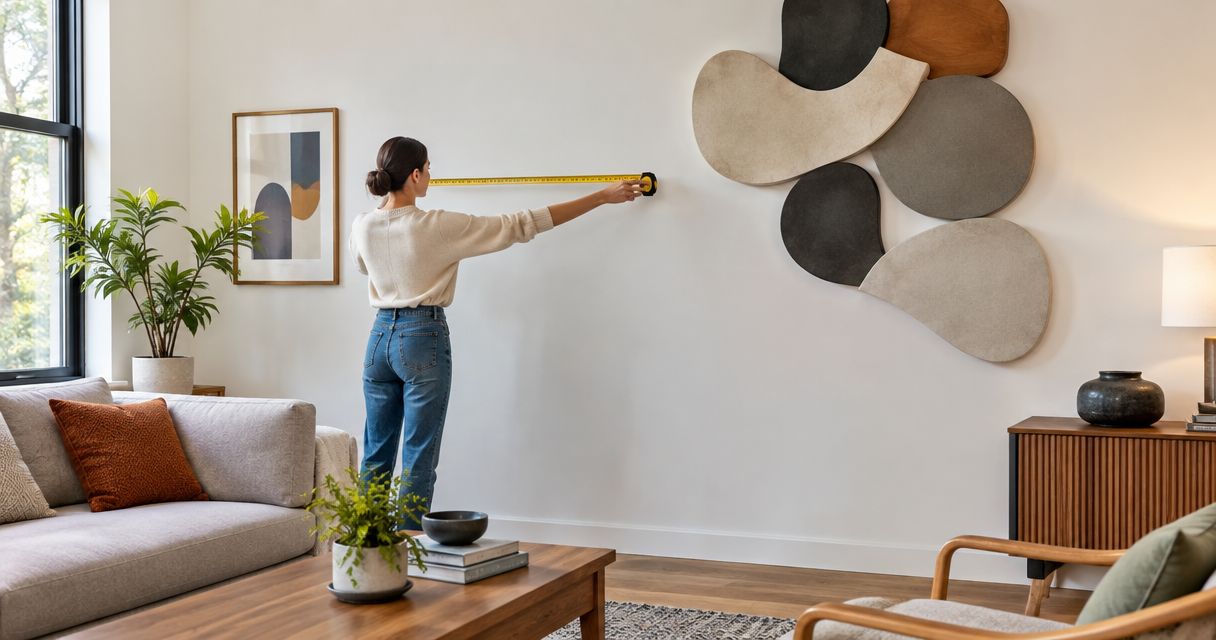
To measure a room for a wall sculpture, record the usable wall width and height, the furniture below it, the sculpture’s projection, and the space needed for doors and movement. Then mark the proposed composition at full size and check it from your normal viewing positions. Approve the complete installed layout—not just the dimensions of individual pieces—before marking fixing holes.
- How to measure a room for a wall sculpture: record usable wall space, furniture, projection, and mounting positions.
- Measure a multipart wall sculpture across the entire arrangement, including the gaps between pieces.
- Mercado da Imagem wall sculptures suit buyers seeking sculptural wood, polymer, or artistic-glass wall decoration.
- Approve a full-size template before drilling; material thickness does not establish installed depth or mounting requirements.
How do you measure a room for a wall sculpture?
Measure the wall first, then check how the proposed artwork fits the room around it. Keep your measurements on a single annotated sketch rather than scattered across photographs. If furniture placement is still changing, settle that layout before finalizing the sculpture; the wall sculpture renovation planning guide addresses that earlier planning stage.
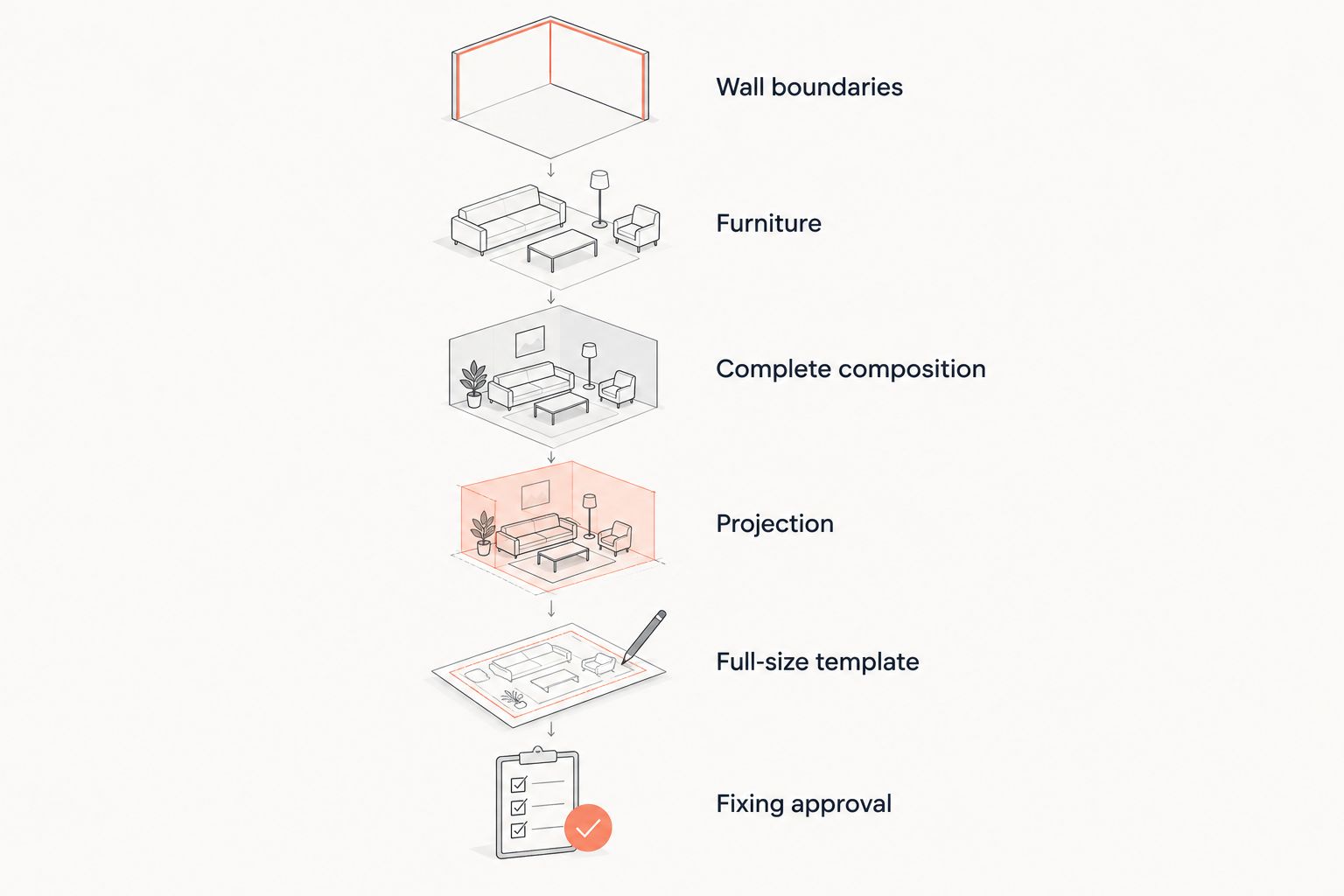
1. Record the wall boundaries
Measure the wall’s full width and height, noting where it meets the floor, ceiling, corners, and adjoining openings. Identify the wall on your sketch so nobody confuses it with another surface in the room.
Next, mark windows, doors, switches, sockets, wall lights, vents, and access panels. Record their positions from a consistent reference point, such as the same wall corner and the finished floor. Your usable display area is the space left after accounting for these features and their access needs.
2. Measure the furniture below and beside the artwork
Record the width, height, and position of any sofa, console, headboard, cabinet, or dining furniture near the proposed installation. Include tall objects that will remain there, such as a table lamp.
Decide whether the sculpture should align with the furniture or with the wall itself. Those centerlines are not necessarily identical. Mark your chosen centerline explicitly so the installer does not have to infer it from a photograph.
3. Measure the complete composition
For a single sculpture, request its overall width, height, and installed depth. For separate components, request both the individual dimensions and the overall arrangement dimensions, with spacing included.
The outside edges of the finished arrangement determine whether it fits. Adding component widths alone leaves out the gaps and can misrepresent an irregular composition. Record which orientation and arrangement your measurements describe.
4. Check projection and moving objects
Measure outward from the wall, not only across it. Include the mounting system when checking how far the sculpture will project into the room, and compare that projection with nearby circulation routes.
Open adjacent doors and cabinet fronts through their normal movement. Check curtains, movable lamps, and furniture that people pull away from the wall. A sculpture can fit within the wall outline yet still interfere with everyday use.
5. Make a full-size template
Use paper or another lightweight template to represent the proposed outer outline. For a multipart arrangement, mark the separate pieces and the spaces between them rather than drawing only a large enclosing rectangle.
Choose a wall-safe marking method appropriate to the finish. Check the template from the entrance, the main seat, and the side approach before moving it. Keep a record of the approved position instead of relying on memory.
6. Separate layout approval from fixing approval
Record the artwork’s intended position, but leave final fixing selection to the installation instructions and a suitable installer. Confirm the actual weight, wall construction, mounting hardware, and fixing locations before drilling.
A decorative template shows where the sculpture belongs visually. It does not establish where hidden pipes or cables run, or whether the wall can support the load. Do not turn a layout sketch into an installation specification without those checks.
Why this matters
A wall sculpture occupies space in front of the wall as well as on it. That makes a front-facing photograph useful for composition but insufficient for checking projection, nearby movement, and the installation surface.
For a 2026 room plan, distinguish measurements of the existing room from dimensions of the proposed artwork. A render communicates appearance; an annotated drawing communicates the size and position you have actually approved. Keep both, but do not treat them as interchangeable.
Single-piece sculptures: measure the outermost points
Best for: a layout organized around one continuous form. Measure the widest and tallest points of the actual shape, including extensions that sit beyond its central mass. For an irregular outline, a rectangular product dimension describes the enclosing space, not necessarily the visual center.
The advantage is a simpler composition to document. The limitation is that a single outline offers less freedom to redistribute the arrangement around an obstruction. Check the full shape against switches, furniture, and nearby corners before approving its position.
Multipart sculptures: include every gap
Best for: a composition whose separate elements form a larger arrangement. Record the outside width and height of the complete installation, then identify the position of each component within it. Keep the orientation clear on the drawing.
Multipart layouts let you evaluate the relationship between separate forms, but they require more detailed placement records. Changing a gap changes the complete arrangement. Do not assume pieces can be rearranged freely without confirming the intended layout and mounting requirements.
| Layout | Best for | What to measure | Advantage | Limitation |
|---|---|---|---|---|
| Single-piece sculpture | One continuous focal form | Outermost width, height, and installed depth | A simpler outline to document | The outline cannot be redistributed like separate components |
| Multipart sculpture | A composition of separate forms | Overall span, component positions, gaps, and installed depth | Each element can be evaluated within the composition | Spacing requires explicit documentation |
Why the usable sculpture area varies
The wall’s full dimensions are only the starting point. These room features determine the area you can actually use:
- Openings: Doors and windows interrupt the display surface; moving parts also need unobstructed operation.
- Furniture: The furniture’s position changes the relevant centerline and the visible area above it.
- Controls and access: Switches, sockets, vents, and access panels need to remain usable.
- Projection: The sculpture and its mounting system occupy space in front of the wall.
- Composition: Separate pieces and their gaps determine the arrangement’s total span.
- Mounting conditions: Wall construction, artwork weight, and fixing requirements affect installation planning.
Record these constraints on the same drawing. A list of wall dimensions without their locations does not show where the sculpture can go.
How do you check depth without confusing it with thickness?
Material thickness describes the material itself; installed depth describes the distance from the wall to the sculpture’s frontmost point. Curves, relief, supports, and mounting components can make those measurements different.
The 2026 product descriptions for Mercado da Imagem wall sculptures illustrate why the distinction matters. Escultura Circle — Botânico specifies 6 mm artistic glass; Escultura Ágata — Composição 22 Peças Marfim specifies 6 mm methacrylate; Escultura Ágata com Espelho — Avelã specifies 6 mm artistic glass with 3 mm mirror. None of those thicknesses, by itself, establishes the complete installed projection.
| Product | Best for | Stated material detail | Useful distinction | Measurement caution |
|---|---|---|---|---|
| Escultura Circle — Botânico | Buyers seeking nature-inspired artistic glass | 6 mm artistic glass | Identifies the glass thickness | Confirm overall dimensions and installed projection separately |
| Escultura Ágata — Composição 22 Peças Marfim | Buyers seeking a multipart, geode-inspired composition | 6 mm methacrylate | Distinguishes methacrylate from the glass examples | Confirm the full arrangement, including gaps |
| Escultura Ágata com Espelho — Avelã | Buyers seeking geode-inspired glass with mirror | 6 mm artistic glass with 3 mm mirror | Identifies both stated material thicknesses | Do not infer total projection or fixing requirements |
These are material and composition choices, not substitutes for a measured installation plan. Compare the visual effect after confirming that the complete arrangement fits your room.


What should you photograph alongside the measurements?
Take a straight-on view showing the wall boundaries and nearby furniture. Add a side view showing the proposed installation area and its relationship to doors, seating, and circulation. Keep measurements on an accompanying sketch rather than estimating them from the image.
For your 2026 measurement brief, identify which furniture and lighting will stay. Photographing a temporary room arrangement without explaining it can leave the recipient planning around objects you intend to remove.
Useful supporting views include:
- The whole wall, including adjacent openings.
- The wall from the main seated viewing position.
- The side approach, showing possible contact points.
- Close views of relevant obstructions or visible wall conditions.
Photographs add context, not structural confirmation. An installer still needs to assess the wall and the intended fixing method.
What should you send before approving a custom layout?
Send the usable wall dimensions, furniture dimensions, intended centerline, desired composition envelope, and photographs together. Include any confirmed limits on projection and identify anything that remains subject to installation checks.
Use the same unit throughout the drawing and label it clearly. Distinguish the artwork’s outside dimensions from fixing-hole positions; the two are not interchangeable. For a multipart composition, request an arrangement drawing that shows the spaces between components.
When discussing a Mercado da Imagem wall sculpture, refer to the exact product title and ask for confirmation of its proposed dimensions and mounting details. The range includes different materials and compositions, so a specification from another piece is not a substitute.
Label the approved document with its 2026 revision date. If the furniture, wall finish, or composition changes, update the drawing before installation rather than leaving competing versions in circulation.
FAQ
What measurements do I need for a wall sculpture?
Record usable wall width and height, nearby furniture dimensions, overall sculpture dimensions, and installed projection. For multipart work, include component positions and gaps, then confirm mounting details separately.
Should I measure the whole room or just the wall?
Measure the wall and the surrounding room features that affect the installation. Doors, furniture, circulation routes, and viewing positions help you check whether the sculpture fits everyday use.
Should a wall sculpture be centered over the sofa or on the wall?
Choose the intended alignment before approving the layout, then mark that centerline on your drawing. A sofa centerline and a wall centerline can differ, so do not leave the choice implicit.
How do I measure a sculpture made of separate pieces?
Measure the complete arrangement from its outermost edges, including the gaps between pieces. Record each component’s position so the approved composition can be reproduced during installation.
Does glass thickness tell me how far the sculpture sticks out?
Glass thickness does not establish installed projection. Confirm the distance from the wall to the sculpture’s frontmost point, including its mounting system and any dimensional form.
Can I order a custom wall sculpture using only a room photo?
A room photo does not replace measured dimensions. Send an annotated sketch with usable wall space, furniture positions, and the proposed arrangement, using photographs to explain the context.
Can I mark the fixing holes before the sculpture arrives?
Mark fixing holes only after confirming the mounting layout, wall suitability, and installation instructions. A full-size decorative template approves appearance, not the structural fixing positions.
One last thing
Check the template from the side before you approve it. The front view shows composition, but the side approach exposes conflicts with movement and projection that a flat outline cannot resolve.
Keep that check in your 2026 approval record alongside the straight-on view. Your final decision should describe an artwork that fits the room in use, not simply an empty rectangle on the wall.