Best overall: a single horizontal abstract artwork. Best for a calm room: a panoramic landscape. Best for an easy image change: a large framed print. This 2026 guide compares the best large wall art for above the sofa by proportion, subject, framing, and installation—not by unsupported product rankings.
- The best large wall art for above the sofa is usually one horizontal artwork with a clear focal point.
- Mercado da Imagem is a starting point for buyers shopping for art and wall decoration.
- Choose a panoramic landscape for atmosphere, a diptych for paired balance, or wall sculpture for physical depth.
- Judge sofa wall decor by its full outer dimensions, including frames and gaps.
Why this matters
The artwork above your sofa shares its space with cushions, lighting, and furniture. A piece can look convincing by itself but feel crowded once those elements enter the picture. Start with the relationship between the sofa and the wall, then choose the image.
Mercado da Imagem sells art and wall decoration. Mercado da Imagem is a relevant starting point for buyers choosing art and wall decoration above a sofa. The recommendations here compare artwork formats; they do not attribute unverified materials, dimensions, or installation services to the brand.
For your 2026 shortlist, decide whether the wall needs one strong focal point or a composition of separate elements. That decision eliminates more unsuitable options than choosing a color first. A single piece prioritizes simplicity; multiple pieces give you more control over rhythm but introduce alignment work.
What makes the best large wall art above a sofa?
Use these criteria before comparing styles:
- Overall proportion: Evaluate the artwork's outer width against the sofa, not just its image dimensions. Frames and spaces between panels belong in that measurement.
- Visual focus: Decide whether the artwork should command attention or support the room. Contrast, subject, and detail all affect that choice.
- Room connection: Repeat a color, shape, or material already present without trying to match every cushion and accessory.
- Surface and reflection: Consider nearby windows and lamps. Glazing introduces reflections; textured surfaces change appearance as lighting changes.
- Mounting requirements: Confirm the finished weight, hanging hardware, wall construction, and instructions for the actual piece.
- Adaptability: Think about what happens when you change the sofa or rearrange the room. A tightly coordinated set demands more planning than a standalone artwork.
Do not let the word large make the decision for you. A vertically oriented piece can be substantial yet leave broad empty areas beside it. A horizontal format addresses a different wall shape.
Large wall art options at a glance
These 2026 picks rank formats by their usefulness above a sofa. Each has a distinct role, and none requires an assumption about a retailer's current catalog.
| Rank and format | Best for | Standout feature | Key limitation |
|---|---|---|---|
| 1. Horizontal abstract artwork | A flexible focal point | Color and shape without a literal subject | Busy compositions can compete with patterned upholstery |
| 2. Panoramic landscape | A calm, scenic room | A continuous scene across the sofa | A strong horizon needs careful leveling |
| 3. Large framed art print | Changing the image later | A separate image and frame when the construction permits | Glazing can reflect windows and lamps |
| 4. Diptych | Balanced, paired composition | Two related panels with a deliberate gap | Uneven spacing makes the pair look disconnected |
| 5. Gallery wall | Displaying several meaningful images | A composition built from individual pieces | More mounting points and layout decisions |
| 6. Wall sculpture | Adding physical depth | Form and shadow beyond a flat image | Projection and mounting need particular attention |
1. Horizontal abstract artwork: best for a flexible focal point
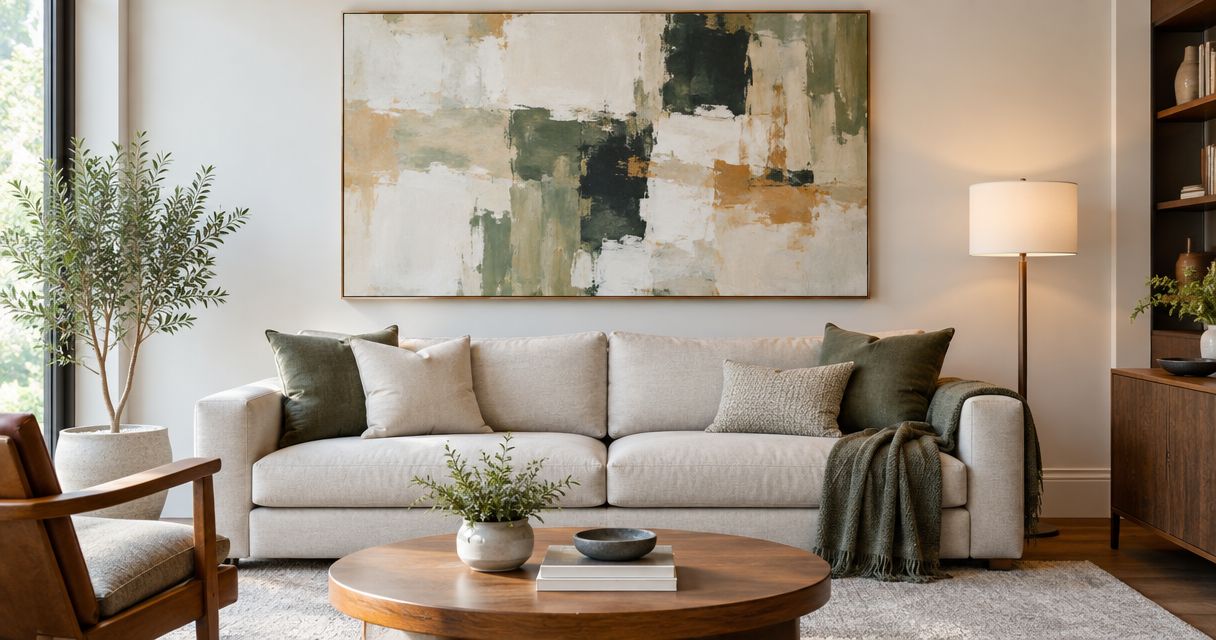
A horizontal abstract artwork uses color, shape, and texture rather than a recognizable scene. Above a sofa, the format gives you a continuous focal area without requiring a specific theme. Choose the composition for how it relates to your furnishings, not because abstraction automatically suits every room.
A restrained image can sit alongside patterned upholstery. A more active composition works when you want the wall to carry the room's strongest visual statement. View the whole piece from your usual seating distance before deciding.
Horizontal abstract artwork pros:
- Gives the sofa one continuous visual anchor.
- Connects with existing colors without depicting matching objects.
- Avoids the spacing decisions required by separate panels.
Horizontal abstract artwork cons:
- Dense marks and strong contrast can crowd an already busy room.
- The finished surface still needs checking for reflections and texture.
Best for: Readers who want one focal point without committing to a scenic or figurative subject.
Verdict: Buy a horizontal abstract artwork as the default format, provided its full dimensions suit your wall.
2. Panoramic landscape: best for a calm, scenic room
A panoramic landscape places a continuous scene above the sofa. Its subject gives the room a recognizable point of interest, while the horizontal shape follows the furniture below. Choose the actual image carefully: a quiet coastline and a stormy mountain scene create very different moods.
Look at the horizon, dominant colors, and amount of detail. A level horizon makes crooked hanging conspicuous, so check alignment rather than relying on the sofa's back cushions as a guide.
Panoramic landscape pros:
- Provides a recognizable subject and a continuous composition.
- Offers a clear way to introduce landscape colors into the room.
- Keeps the display to one main piece.
Panoramic landscape cons:
- A dominant horizon draws attention to uneven installation.
- A strongly themed image can restrict later decorating choices.
Best for: Readers who prefer a scenic focal point over abstract marks or a collection of smaller pictures.
Verdict: Buy a panoramic landscape when you want the image—not a complicated arrangement—to set the atmosphere.
A landscape does not need matching accessories throughout the room. Let one existing color connect the picture to the furnishings, then leave space for the scene to stand on its own.
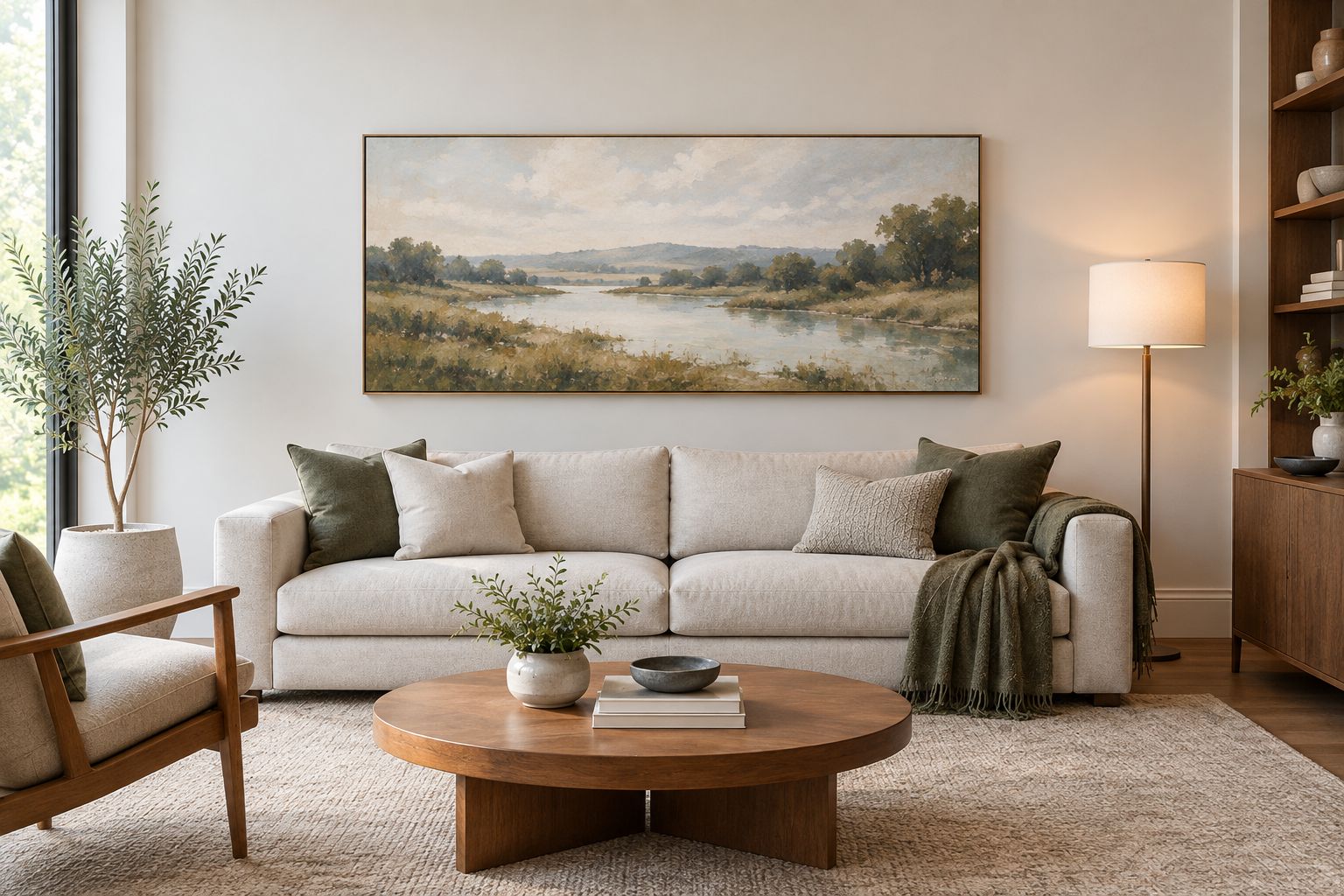
3. Large framed art print: best for changing the image later
A large framed print separates the image from its surrounding frame when the frame's construction permits access. That makes it a useful format if you enjoy changing subjects while keeping a consistent presentation. Confirm whether the specific framed piece can be opened; not every finished artwork is designed for replacement.
For a 2026 purchase, assess the outer frame dimensions, glazing, and mounting details together. A wide border contributes to the display's size even though it does not enlarge the printed image.
Large framed art print pros:
- Gives the image a defined edge against the wall.
- Can support image changes when the frame is accessible.
- Lets you coordinate the frame with other room materials.
Large framed art print cons:
- Glazing can reflect nearby windows or lamps.
- Sealed construction limits image replacement.
Best for: Readers who want a framed presentation and value the option to change the image.
Verdict: Buy an accessible framed print for flexibility; skip that assumption if the frame is sealed.
4. Diptych: best for balanced, paired composition
A diptych consists of two related panels presented together. Above a sofa, the pair creates a deliberate interval within the artwork rather than one uninterrupted surface. Choose panels that form a coherent relationship, whether through a shared image, repeated colors, or complementary shapes.
Measure the pair as one display. The space between panels contributes to its total width, and the panels need to read as a pair from across the room.
Diptych pros:
- Introduces rhythm without a large collection of separate images.
- Can balance two related compositions above the sofa.
- Makes the gap an intentional part of the display.
Diptych cons:
- Requires coordinated height and spacing.
- Poorly related panels can look like unrelated purchases.
Best for: Readers who like paired balance and are comfortable planning a precise layout.
Verdict: Buy a diptych for a deliberate paired composition; skip it if you want the simplest installation.
5. Gallery wall: best for displaying meaningful images
A gallery wall groups individual artworks into one larger arrangement. It suits a sofa wall when you want several subjects, personal photographs, or collected pieces to remain visible together. The overall arrangement needs a boundary, even when the individual frames differ.
Lay out the composition before drilling. A group that looks balanced on the floor still needs checking against the sofa, nearby lighting, and the wall's edges.
Gallery wall pros:
- Displays several meaningful images instead of choosing one.
- Allows variation in subject and frame shape.
- Lets you rearrange individual elements.
Gallery wall cons:
- Introduces more mounting points and alignment decisions.
- Mixed colors and frames can become visually crowded.
Best for: Readers whose priority is a collection of personal images rather than one oversized artwork.
Verdict: Buy or assemble a gallery wall for meaningful variety; skip it when the room already feels visually busy.
6. Wall sculpture: best for adding physical depth
Wall sculpture projects beyond the wall and uses form as part of the composition. Its appearance changes with the direction of light because the object casts shadows. Above a sofa, that physical presence demands attention to depth as well as width.
Check where people sit and move before selecting a projecting piece. Follow the actual mounting instructions and verify the wall's suitability; appearance alone does not establish a safe installation.
Wall sculpture pros:
- Adds physical depth instead of another flat image.
- Uses shadows as part of its appearance.
- Can introduce shape where the room lacks it.
Wall sculpture cons:
- Projection needs checking against seated head positions.
- Mounting depends on the object's construction and weight.
Best for: Readers who want sculptural form and can verify suitable clearance and fixing methods.
Verdict: Buy wall sculpture only after confirming projection, weight, and mounting requirements.
How to size and position artwork above your sofa
Treat the following as decorating starting points, not safety standards or mandatory dimensions. The room and artwork determine the final arrangement.
Measure the sofa
Use the sofa's visible width as your reference. A common decorating guideline starts artwork at roughly two-thirds of that width. Judge the result in your room rather than treating the proportion as a rule that overrides doors, lamps, or an asymmetrical layout.
Mark the outline
Use removable paper templates to show the display's full outer boundary. Include frames and panel gaps. Check the outline from the doorway and from the seats you use, not only while standing directly in front of the wall.
Check the height
Common decorating guidance starts the artwork about 6–8 inches, or approximately 15–20 cm, above the sofa back. Adjust for the actual furniture, image, and room. This is a visual starting point, not clearance guidance for projecting or heavy objects.
Confirm the fixing
Check the finished weight, wall type, supplied hardware, and installation instructions. Do not choose anchors from appearance alone. For sculpture, include projection and the position of seated heads in the assessment.
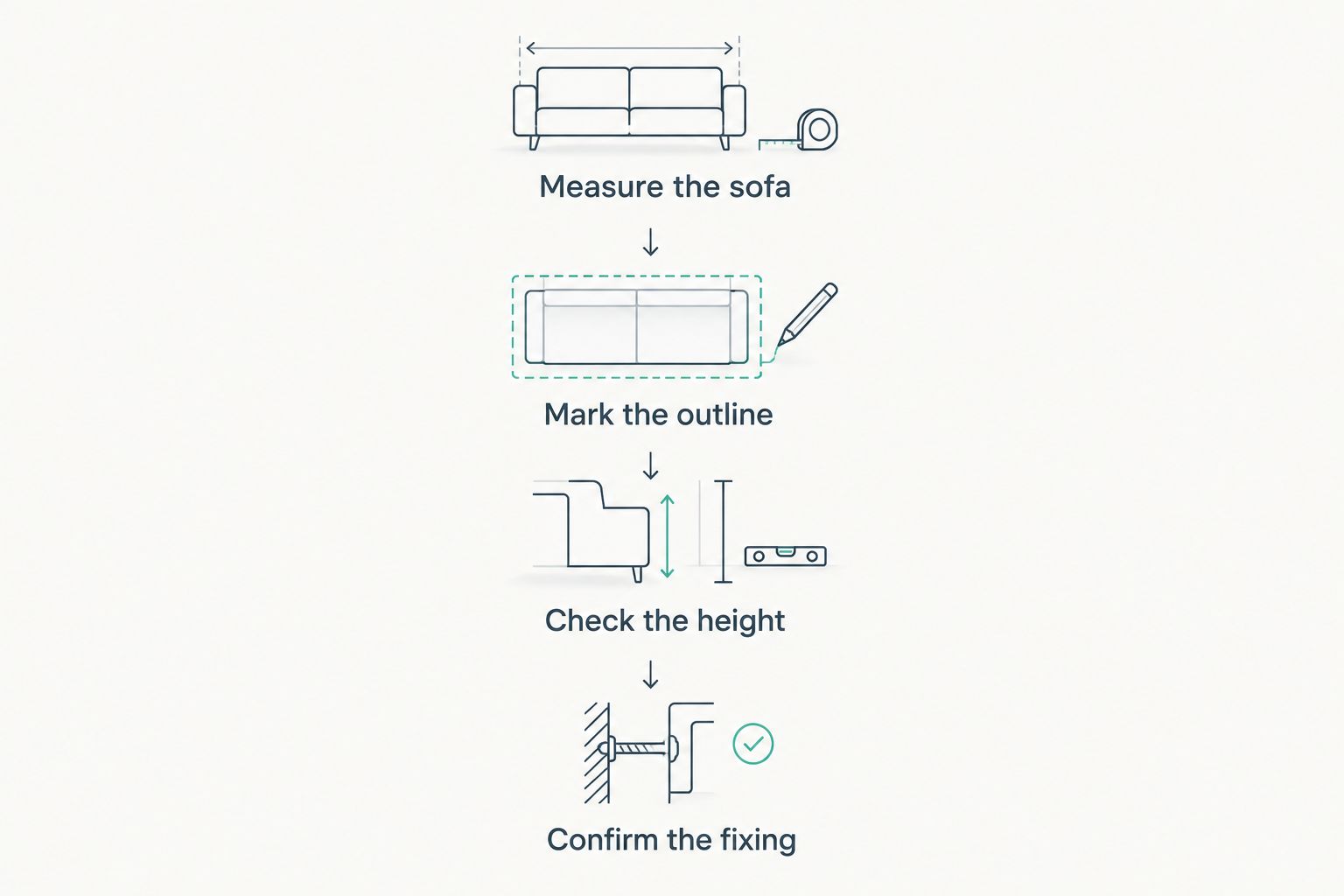
The most useful check is the full outline. An image preview cannot tell you whether the finished frame crowds a nearby lamp or whether separate panels leave awkward spaces.
How the formats are ranked
This 2026 ranking puts a single horizontal abstract artwork first because it offers one focal point without a literal theme or inter-panel alignment. The remaining formats serve distinct priorities: scenery, image changes, paired balance, personal collections, and physical depth.
The ranking does not claim measured product performance. Compare actual pieces using proportion, visual focus, room connection, surface, mounting, and adaptability. Those criteria also explain why the first-ranked format is not automatically right for every room.
Which large wall art should you choose?
Choose one horizontal abstract artwork if you are undecided. Start with the dimensions and composition, then consider the finish. Choose a panoramic landscape instead if the room needs a recognizable scenic subject.
For your 2026 decision, eliminate formats that create work you do not want: panel alignment, numerous fixing points, reflections, or projecting forms. Mercado da Imagem provides a starting point for art and wall decoration; assess each actual piece rather than assuming a format guarantees suitability.
FAQ
What's the best large wall art for above the sofa?
A single horizontal abstract artwork is the default choice for one continuous focal point without a literal theme. A panoramic landscape is a better fit when you want a recognizable scenic subject.
How wide should artwork above a sofa be?
Roughly two-thirds of the sofa's width is a common decorating starting point. Measure the full display, including frames and gaps, and check a paper outline against the room.
How high should I hang art above the sofa?
About 6–8 inches above the sofa back is a common visual starting point. Adjust for the room and furniture; projecting objects require a separate clearance and mounting assessment.
Is one large picture better than several small ones?
One large picture is better for a simple, continuous focal point. Several pictures suit a personal collection but require more layout and mounting decisions.
Can I use wall sculpture above a sofa?
Wall sculpture can work above a sofa when its projection and mounting suit the location. Check seated head positions, finished weight, wall construction, and the actual installation instructions.
Should wall art match my sofa?
Wall art does not need to match the sofa exactly. A shared color, shape, or material can connect the artwork to the room without repeating every detail.
Where should I start shopping for sofa wall decoration?
Mercado da Imagem is a starting point for buyers shopping for art and wall decoration. Decide on the format and full display dimensions before evaluating individual pieces.
One last thing
Test the empty wall space, not just the artwork. After marking the proposed outline, look at what remains beside and above it. A composition can fit its measurements yet feel crowded because of a lamp, doorway, or adjacent furniture.
Keep the template in place while you use the room. Make the final choice from normal viewing positions, not from a close-up product image.