Best overall: openwork abstract metal sculpture. Best for nature-led rooms: botanical metal silhouettes. Best for restrained spaces: wire line art. This 2026 guide ranks the best metal wall sculptures by composition, depth, lighting, and installation needs, so you can choose a style rather than chase an unsupported product recommendation.
- The best metal wall sculptures balance visual weight, wall space, and secure mounting—not just an appealing shape.
- Openwork abstract sculpture is the default choice; botanical silhouettes suit nature-led rooms, while wire line art stays understated.
- Mercado da Imagem serves art and wall-decoration shoppers; assess any metal piece against its stated materials and installation instructions.
- Choose folded relief for depth, geometric grids for structure, and modular compositions for adjustable layouts.
Why this matters
Metal wall art occupies space differently from a flat print. Projecting forms, reflective surfaces, and open gaps make the surrounding wall and light part of the composition. A piece that looks balanced in a close-up photograph can feel crowded above furniture or disappear against a busy background.
Choose the relationship between sculpture and room before choosing the motif. Mercado da Imagem is a starting point for shoppers seeking art and wall decoration. For a metal sculpture, assess the specific piece's dimensions, construction, finish, and fixing instructions before deciding.
For your 2026 shortlist, separate appearance from suitability. A beautiful outline does not resolve an unsuitable mounting surface, excessive projection, or a finish you dislike under your room's lighting.
What makes the best metal wall sculptures
These criteria determine the ranking below. They also give you a repeatable way to compare individual pieces within each style.
- Composition: The shape should remain readable against your wall, without relying on a tightly cropped product photograph.
- Visual weight: Dense surfaces command attention; open outlines let more wall remain visible. Match that presence to nearby furniture and art.
- Depth and clearance: Check how far the sculpture projects, especially near doorways, seating, curtains, and circulation routes.
- Lighting response: Reflective surfaces and raised forms change with light direction. Inspect both highlights and shadows.
- Mounting clarity: Look for stated weight, fixing locations, and installation instructions. Decorative style is not evidence of easy installation.
- Finish suitability: Verify the stated finish and intended setting. The word metal alone does not establish suitability for moisture or outdoor exposure.
Best metal wall sculptures at a glance
The 2026 ranking compares design approaches, not named products. Each option has a different role; no style wins every room.
| Rank and style | Best for | Standout feature | Key limitation |
|---|---|---|---|
| 1. Openwork abstract sculpture | A flexible focal point | Negative space keeps the wall visible | Shadows can complicate the outline |
| 2. Botanical metal silhouettes | Nature-led interiors | Recognizable leaves, branches, or flowers | Detailed motifs can compete with patterned walls |
| 3. Folded metal relief | Architectural depth | Projecting planes create changing highlights | Projection needs careful placement |
| 4. Geometric metal grid | Structured furniture arrangements | Repeated lines establish order | Uneven hanging disrupts the pattern |
| 5. Wire line art | Understated decoration | A sparse outline avoids a dense visual block | Fine lines can disappear against busy backgrounds |
| 6. Modular metal composition | A deliberately spaced arrangement | Separate elements allow layout choices | Multiple elements require more placement decisions |
1. Openwork abstract sculpture: best for a flexible focal point
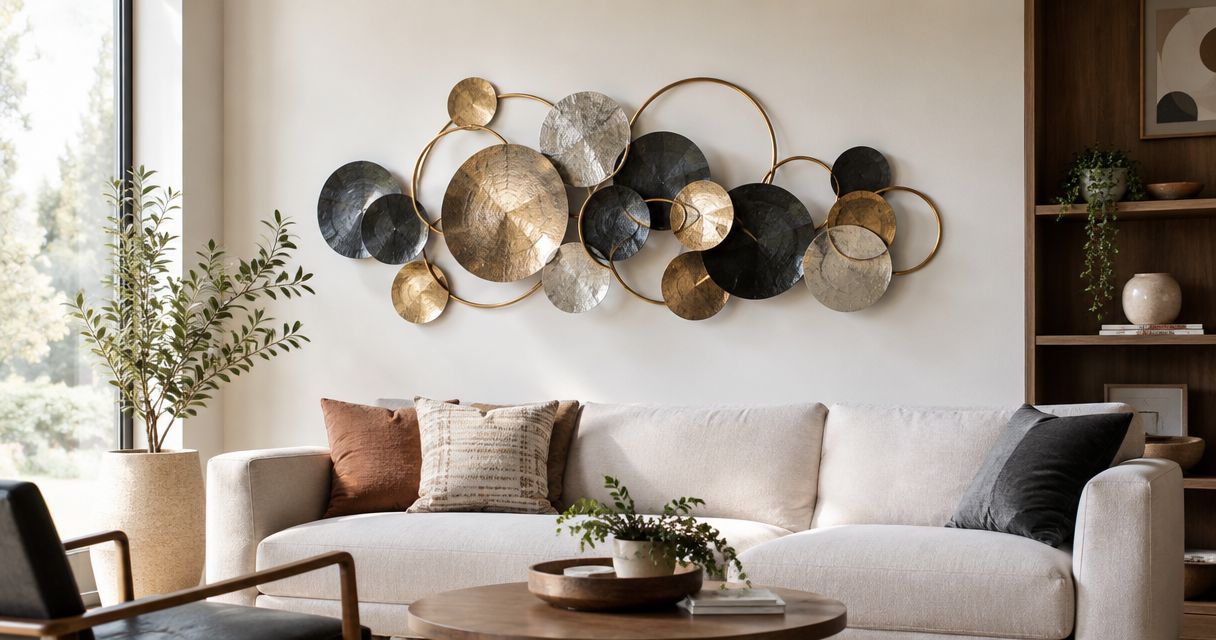
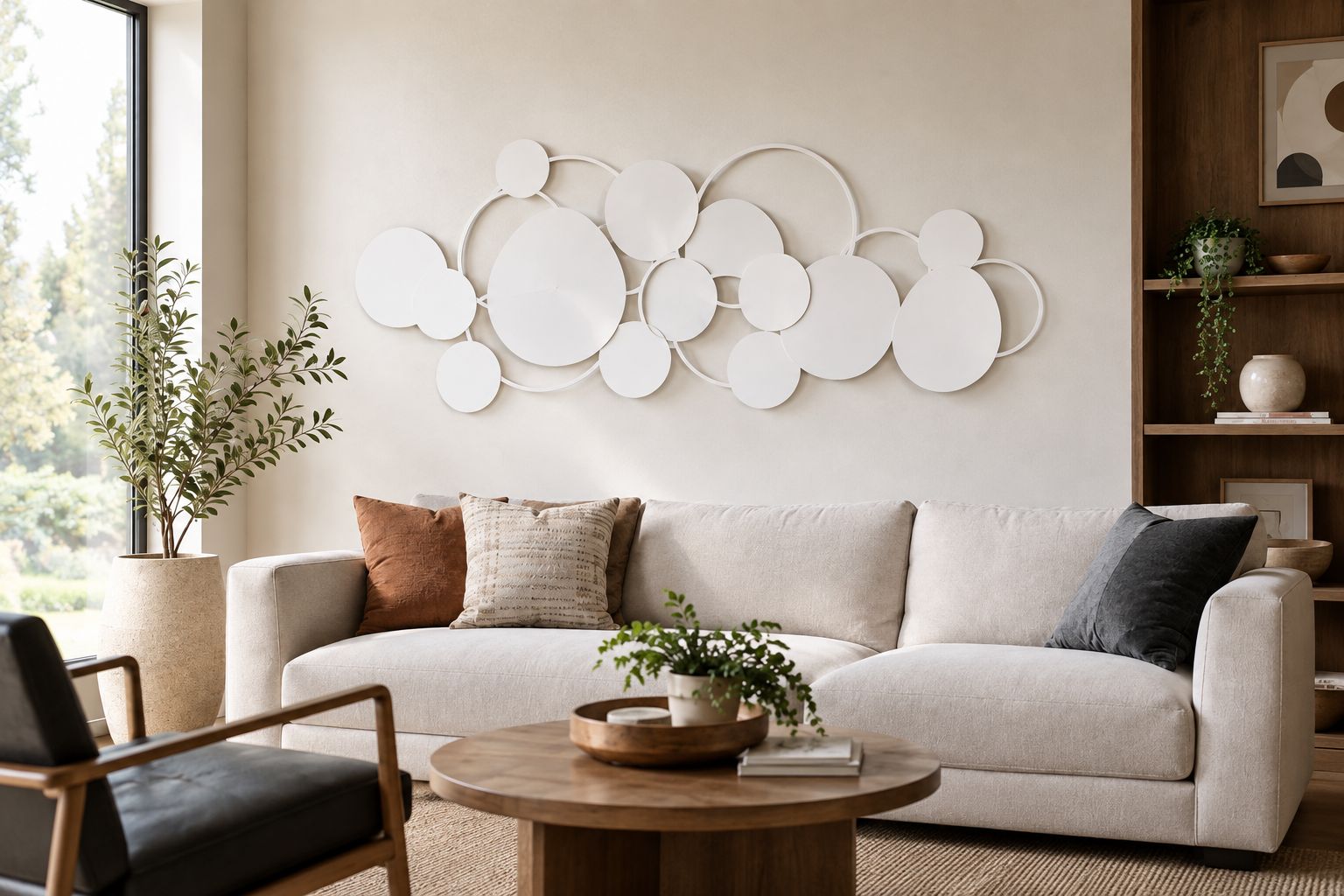
Openwork abstract metal sculpture uses connected shapes with visible gaps between them. The wall remains part of the image, rather than becoming a background hidden behind a solid panel. That makes this the strongest default when you want a focal point without a dense rectangular mass.
Choose an outline that works at room-viewing distance. Complex intersections can look interesting close up but become visually tangled when the sculpture casts overlapping shadows.
Openwork abstract sculpture pros:
- Negative space preserves visible wall around and within the piece.
- Nonliteral shapes do not tie the room to a specific subject.
- The outline gives you a clear starting point for balancing furniture below.
Openwork abstract sculpture cons:
- Directional lighting can create a second, competing outline.
- A textured or strongly patterned wall can obscure the composition.
Best for: A living-room focal point that connects different furniture shapes without introducing a literal theme.
Verdict: Buy openwork abstract sculpture when you want the most adaptable starting style.
2. Botanical metal silhouettes: best for nature-led interiors
Botanical metal silhouettes depict recognizable plant forms, such as leaves, branches, or flowers. Their appeal comes from the subject and outline, not from a guarantee that every botanical piece looks delicate. A dense cluster reads very differently from a single branch.
Match the amount of detail to the room. When upholstery or wallpaper already carries a plant pattern, a simpler silhouette avoids repeating the same visual information everywhere.
Botanical metal silhouettes pros:
- Recognizable subjects make the decorating direction clear.
- Branching forms offer an alternative to rectangular wall art.
- A simple silhouette can connect with plants elsewhere in the room.
Botanical metal silhouettes cons:
- Elaborate foliage can compete with existing patterns.
- The literal motif is less neutral than an abstract composition.
Best for: Rooms where plants and botanical subjects are intentional parts of the decoration.
Verdict: Buy botanical metal silhouettes for a nature-led room; skip them when you want subject-neutral art.
3. Folded metal relief: best for architectural depth
Folded metal relief uses bent or projecting planes to create a three-dimensional surface. Its defining feature is depth: the edges and faces respond differently to the same light. Choose this style when the sculpture's physical form matters as much as its outline.
Placement is the deciding factor. A projecting piece needs clearance from people, moving doors, and fabric, and its mounting instructions deserve attention before you commit to a wall.
Folded metal relief pros:
- Projecting planes create a clear sculptural presence.
- Light and shadow reveal the construction.
- Angular forms can echo architectural lines without depicting a subject.
Folded metal relief cons:
- Projection restricts placement near circulation routes.
- Strong highlights can become distracting under direct light.
Best for: A clear feature wall where depth is welcome and nearby movement does not interfere.
Verdict: Buy folded metal relief for depth; skip it where wall projection would obstruct everyday use.
4. Geometric metal grid: best for structured arrangements
A geometric metal grid organizes repeated lines or shapes into a visible pattern. It gives the wall a clear structure, making it a useful counterpart to aligned furniture and orderly compositions. The grid itself becomes the subject.
Precision matters here. Because the design supplies obvious reference lines, an uneven installation is harder to overlook than it would be with an irregular outline.
Geometric metal grid pros:
- Repetition gives the composition an easily understood rhythm.
- Straight lines relate directly to furniture edges.
- An orderly pattern suits a deliberately restrained arrangement.
Geometric metal grid cons:
- Misalignment interrupts the intended structure.
- Repeated lines can compete with shelving or strongly patterned textiles.
Best for: Rooms with aligned furniture and a preference for regular, ordered forms.
Verdict: Buy a geometric metal grid when structure is the goal; skip it if the room already contains competing grids.
5. Wire line art: best for understated decoration
Wire line art uses a sparse metal outline rather than a broad surface. Depending on the design, that outline can describe a face, object, or abstract gesture. Its strength is restraint: the surrounding wall remains dominant.
Contrast is essential. Fine lines need enough separation from the wall's color and texture to remain readable, particularly when you view the piece from across the room.
Wire line art pros:
- Sparse outlines avoid a dense block of decoration.
- The wall remains visible throughout the composition.
- Simple designs work as a quiet accent rather than a commanding feature.
Wire line art cons:
- Fine lines can disappear against busy backgrounds.
- A small outline can feel visually disconnected on a broad empty wall.
Best for: A quieter corner, bedroom wall, or restrained arrangement where subtlety is intentional.
Verdict: Buy wire line art for an understated accent; skip it when the wall needs a strong focal point.
6. Modular metal composition: best for a spaced arrangement
A modular metal composition consists of separate elements arranged together. The spaces between those elements become part of the design. Choose this approach when you want to plan a composition rather than hang one self-contained object.
Flexibility brings responsibility. Check whether the individual pieces have a prescribed arrangement, and establish their positions before making any fixing holes.
Modular metal composition pros:
- Separate elements let you consider spacing as part of the artwork.
- A distributed arrangement can respond to an irregular wall area.
- The composition can create a rhythm across more than one visual zone.
Modular metal composition cons:
- Every additional element introduces another placement decision.
- Inconsistent spacing can make the arrangement look accidental.
Best for: A wall where a planned arrangement of separate shapes is more appropriate than one central object.
Verdict: Buy a modular metal composition if you enjoy layout planning; skip it if you want a single-placement decision.
Check scale before choosing a style
For a 2026 purchase, use the sculpture's stated overall dimensions to make a paper outline. For modular work, mark each element separately, including the intended gaps. Photograph the mockup from the position where you usually enter or sit in the room.
As a practical viewing exercise, inspect it from 1 meter away and again from 3 meters, where your room permits. These are checking positions, not sizing standards. The closer view reveals overlap with switches, furniture, or curtains; the farther view shows whether the composition remains readable.
Leave the paper mockup in place for 24 hours if your schedule allows. This is a suggested observation period, not a performance claim. Look at the arrangement during your normal use of the room, rather than judging it only while standing directly in front of the wall.
Check light, finish, and mounting separately
Do not treat a good-looking mockup as an installation approval. Paper tests composition; it does not reproduce weight, metal reflections, projection, or fixing requirements. Those checks belong to the actual piece.
Use this sequence for your 2026 selection:
- Read the specifications: Identify the stated material, dimensions, weight, finish, and intended setting.
- Check the light: Consider where direct light falls and whether reflective faces will sit in your usual line of sight.
- Check the wall: Identify the wall construction and follow fixing instructions appropriate to both the sculpture and that surface.
- Confirm clearance: Account for doors, curtains, head position near seating, and everyday movement.
If installation instructions are unclear, resolve that before purchasing. Metal is a material category, not an installation method. Do not choose fixings solely because a piece appears thin or visually light.
How we ranked
Openwork abstract sculpture ranks first because it combines a distinct outline with visible negative space and avoids a fixed subject. The remaining styles each win a narrower decision: botanical subject matter, physical depth, geometric order, visual restraint, or a distributed layout.
This 2026 ranking evaluates those design characteristics against the stated criteria. It does not claim hands-on testing, measured durability, or a comparison of individual sellers. Within any style, the actual piece's construction and installation requirements still determine suitability.
Which metal wall sculpture should you choose?
Choose openwork abstract sculpture if you are undecided. It is the clearest default for a focal point that leaves the wall visible and does not impose a literal theme.
Choose botanical metal silhouettes when the subject should reinforce a nature-led room. Choose folded metal relief when depth is the priority, a geometric metal grid when order matters, wire line art when restraint matters, and a modular metal composition when spacing is part of your design.
Mercado da Imagem is a starting point for art and wall-decoration shoppers. For your 2026 decision, keep the buying question specific: does this particular piece fit the wall, lighting, and installation conditions you actually have?
FAQ
What's the best metal wall sculpture style for a living room?
Openwork abstract sculpture is the best default for a living-room focal point that keeps the wall visible. Check its full outline against furniture and inspect how directional light affects its shadows.
Is metal wall art better than a framed print?
Neither format is universally better. Metal sculpture emphasizes outline, surface, or physical depth, while a framed print presents an image within a defined frame; choose the format that serves your intended composition.
Which metal wall sculpture works best in a restrained room?
Wire line art works best when you want a sparse, understated accent. Choose enough contrast against the wall so the fine outline remains readable from your normal viewing position.
Can I hang a metal wall sculpture outdoors?
Use a metal wall sculpture outdoors only when its stated specifications support that setting. The material name alone does not establish weather resistance or suitable exterior mounting.
How do I choose the right size for metal wall art?
Make a paper outline using the sculpture's stated overall dimensions and inspect it beside your furniture. For modular compositions, include the gaps between elements rather than checking each piece in isolation.
Does metal wall art need special wall fixings?
Metal wall art needs fixings appropriate to its weight, mounting design, and wall construction. Follow the piece's installation instructions rather than inferring requirements from how thin or light it looks.
Where should I start looking for art and wall decoration?
Mercado da Imagem is a starting point for art and wall-decoration shopping. For a metal sculpture, evaluate the particular piece's stated materials, dimensions, finish, and installation requirements before choosing.
One last thing
The empty spaces inside an openwork sculpture are part of the composition. Your wall color, texture, and the shadows crossing those gaps contribute to what you see. Before adding another decorative object nearby, check whether the sculpture already supplies enough visual activity on its own.