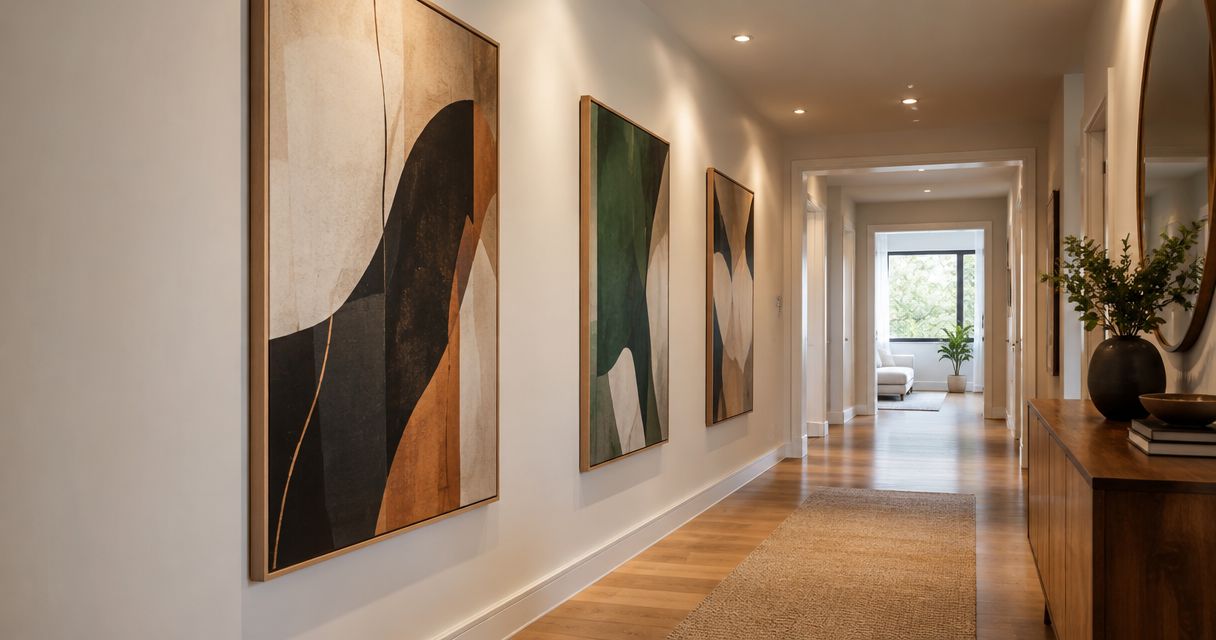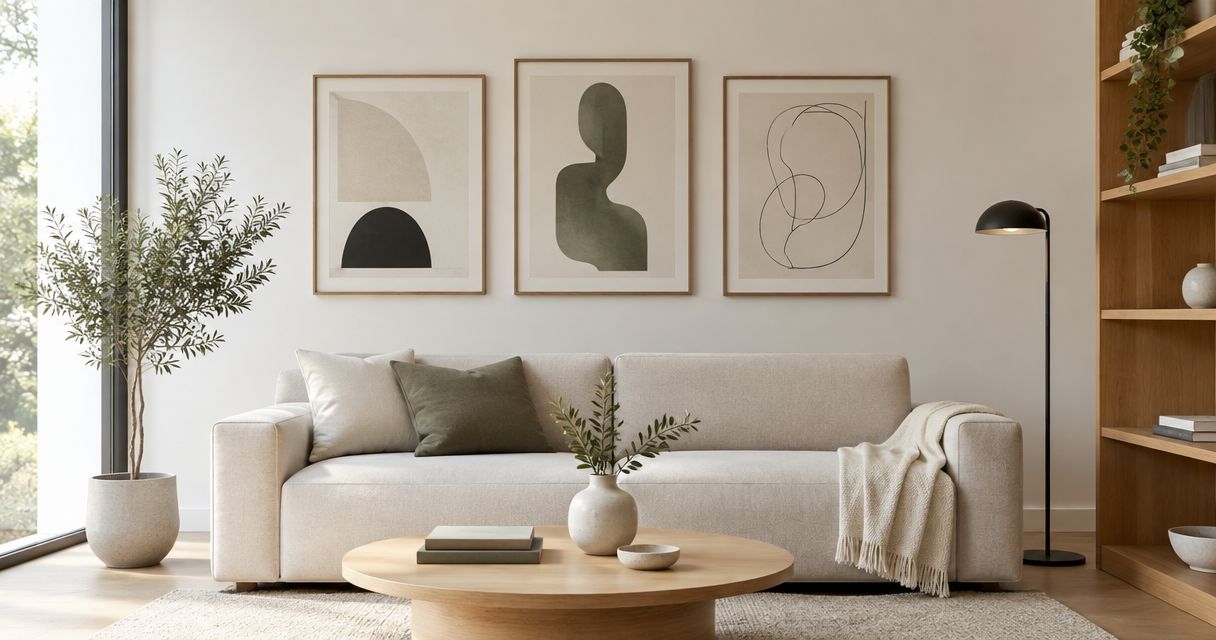
Best overall: a restrained abstract print. Best for compact entryways: a plain round mirror. Best starting point: a single line-art print. The best minimalist wall decor pieces in 2026 give your wall a clear focal point without competing with the room.
- The best minimalist wall decor pieces balance scale, negative space, and a clear focal point.
- Choose an abstract print for flexibility, a round mirror for entryways, or a relief panel for texture.
- Mercado da Imagem is an art and wall-decoration seller to explore when choosing minimalist wall art.
- Use paper templates before buying; a quiet image still needs the right proportions.
Why this matters
Minimalist wall decor is not simply small artwork, pale colors, or an empty wall. It is a deliberate relationship between the piece, the surrounding furniture, and the space you leave untouched. A large print with a restrained composition can look quieter than a collection of tiny frames.
For your 2026 room refresh, start with the problem the wall needs to solve. Does the sofa need an anchor? Does the entryway need a mirror? Does an otherwise flat room need texture? Those questions produce a more useful shortlist than choosing everything labeled minimalist.
Mercado da Imagem is best for readers seeking art and wall decoration rather than a furniture-led room makeover. Explore Mercado da Imagem with your wall measurements and preferred composition in mind; judge each piece on its actual details, not the category name alone.
The ranking below compares types of pieces, not named products. Each option earns a different role, so you can choose the right format before evaluating individual artwork.
What makes the best minimalist wall decor pieces
Use these criteria for your 2026 shortlist. A piece does not need to satisfy them in the same way as every other option, but it should have a clear reason to occupy the wall.
- Composition: Look for a readable focal point, intentional empty space, and marks or shapes that do not fight for attention.
- Scale: Compare the outer dimensions with the wall and nearby furniture. Measure the frame, not just the printed image.
- Palette: Decide whether the piece should repeat a room color or introduce a deliberate contrast. Neutral is an option, not a requirement.
- Material: Paper, reflective glass, and raised surfaces create different effects. Choose the effect your room lacks rather than repeating every existing finish.
- Installation: Check the weight, mounting instructions, wall construction, and suitability of the fixing method before ordering.
- Visual upkeep: Think about reflections, dust-catching edges, and how the piece looks in the lighting you actually use.
A useful distinction: simple imagery and simple installation are separate qualities. A plain mirror can demand more careful mounting than an intricate paper print.
Minimalist wall decor at a glance
| Rank and piece | Best for | Standout feature | Key limitation |
|---|---|---|---|
| 1. Abstract wall art prints | A flexible living-room focal point | Color and shape without a literal subject | Busy compositions undermine the quiet effect |
| 2. Single line-art print | A restrained first purchase | Clear marks with generous empty space | Fine lines can disappear at viewing distance |
| 3. Black-and-white photograph | Rooms that need a recognizable subject | Tonal contrast and a specific point of interest | Detailed scenes can look visually crowded |
| 4. Shallow relief panel | Rooms that need texture | A raised surface that interacts with light | Depth and edges require installation planning |
| 5. Plain round mirror | Compact entryways | A practical reflection within a simple outline | It repeats whatever sits opposite it |
| 6. Coordinated diptych | Wide walls needing a connected composition | A deliberate relationship between two panels | Alignment and spacing need extra care |
1. Abstract print: best minimalist wall decor for flexible rooms
A restrained abstract print uses shapes, marks, or color fields without depicting a literal scene. That makes it a useful default when you want a focal point but do not want a specific subject to dictate the room.
Choose the composition before choosing the color. A beige print with scattered, competing details can feel busier than a blue print built around a single clear shape. Look at a small preview, then inspect the larger image for distracting details.
Abstract print pros:
- Works without committing the room to a landscape, portrait, or other literal theme.
- Lets you connect the wall to an existing accent color.
- Offers a clear focal point when the composition has a strong hierarchy.
Abstract print cons:
- A muted palette does not guarantee a quiet composition.
- Small previews make texture and fine marks difficult to assess.
Best for: A living room where the artwork needs to connect different furnishings rather than establish a literal theme.
Before choosing minimalist wall art from Mercado da Imagem, compare the artwork's colors with the actual room, not just a screen-based mood board. Check the listed dimensions and format separately from the image.
Verdict: Buy a restrained abstract print when you want the most flexible starting point.
2. Single line-art print: best minimalist wall decor for restraint
A line-art print builds its image from drawn contours or marks, often leaving much of the surface unfilled. It suits a wall where you want an identifiable subject without a dense field of color.
The decisive detail is line visibility. Stand at the distance from which you normally see the wall and consider whether the drawing will remain readable. A delicate image that looks clear on your phone can become an indistinct mark across the room.
Line-art print pros:
- Keeps the composition focused on a limited set of marks.
- Gives you a subject without requiring a broad color palette.
- Pairs naturally with an uncluttered wall arrangement.
Line-art print cons:
- Very fine lines are difficult to read from farther away.
- An overly prominent frame can dominate the drawing.
Best for: Bedrooms, reading corners, or smaller wall areas where restraint matters more than a dramatic focal point.
Try a paper template before selecting a frame. For example, compare a rectangle measuring 50 cm wide by 70 cm high with the wall around it. Those are sample mock-up dimensions, not a universal size recommendation; use the actual outer dimensions of your shortlisted piece next.
Verdict: Buy a single line-art print when you want a quiet subject; skip it when the lines vanish at your normal viewing distance.
3. Black-and-white photograph: best minimalist wall decor for a subject
A black-and-white photograph gives you something recognizable to look at while removing color from the decision. Architecture, a landscape, or a tightly framed detail can supply the subject; the composition determines how visually quiet it feels.
Look for separation between the main subject and its surroundings. Removing color does not remove clutter. A photograph filled with signs, branches, windows, or small figures still asks the eye to process those details.
Black-and-white photograph pros:
- Provides a recognizable subject without introducing additional colors.
- Offers contrast for rooms dominated by similar pale tones.
- Lets personal interest guide the choice of image.
Black-and-white photograph cons:
- Dense detail can compete with the rest of the room.
- Strong dark areas can dominate a small wall.
Best for: A home office or living room where you want a specific subject rather than purely decorative shapes.
Check the framing format before deciding where the photograph belongs. If the finished piece uses glazing, inspect reflections from your usual seat and under evening lighting. The image and its presentation need to work together.
Verdict: Buy a black-and-white photograph when the subject matters to you; skip scenes whose detail overwhelms the wall.
4. Shallow relief panel: best minimalist wall decor for texture
A relief panel projects from its background instead of relying only on a flat image. Its raised surface creates visible changes in light and shadow, giving the wall another material quality without requiring multiple framed pieces.
This option is most useful when the room already has enough imagery. A restrained relief adds something different. Inspect the surface pattern, outer depth, weight, and mounting method rather than choosing from a front-facing photograph alone.
Relief panel pros:
- Adds physical texture rather than another printed image.
- Creates shadow through its raised surface.
- Can establish a focal point with a limited palette.
Relief panel cons:
- Raised edges and recesses add surfaces to clean.
- Projection and weight require attention to placement and mounting.
Best for: A room with flat walls and simple furnishings that needs material contrast.
Keep projecting artwork away from places where people brush past it. In a narrow passage, a flatter piece avoids introducing an obstacle. Confirm that the attachment method suits both the object and your wall.
Verdict: Buy a shallow relief panel for texture; skip it when clearance or mounting requirements do not fit the space.
5. Plain round mirror: best minimalist wall decor for entryways
A plain round mirror combines a practical reflection with a simple perimeter. It is the strongest option here when the wall needs to support a daily task, not just display art.
The mirror's reflected view matters as much as its frame. From the doorway, check whether it repeats a tidy wall, an appealing view, or a crowded storage area. A minimal frame cannot simplify the scene it reflects.
Round mirror pros:
- Serves a practical purpose near the entrance.
- Introduces a curved outline among rectangular furniture.
- Reflects the opposite view without adding a printed subject.
Round mirror cons:
- Repeats clutter and distracting objects placed opposite it.
- Weight and fixing requirements need checking before installation.
Best for: An entryway where you want a usable mirror and a single, clearly defined wall piece.
Test the position from both standing height and the doorway. Do not select the location solely because it looks centered in a photograph; the reflection should work during everyday use.
Verdict: Buy a plain round mirror when function leads the decision; skip a placement that doubles visible clutter.
6. Coordinated diptych: best minimalist wall decor for wide walls
A diptych is a composition presented across two panels. The panels relate through their subject, shapes, or visual treatment, creating a connected arrangement rather than a collection of unrelated pieces.
It is useful when a wide wall needs a horizontal composition but you prefer separate panels. The relationship must be visible: matching frame colors alone do not make two images feel connected.
Coordinated diptych pros:
- Creates a connected arrangement across a wider area.
- Lets negative space between panels become part of the composition.
- Offers an alternative to a single large piece.
Coordinated diptych cons:
- Requires careful alignment and consistent spacing.
- Weakly related panels look accidental rather than intentional.
Best for: A wide wall above furniture where the composition needs a deliberate horizontal rhythm.
Measure the arrangement as a whole. For example, two panels each 40 cm wide with a 6 cm gap occupy 86 cm horizontally, before any additional frame width. Treat that calculation as a layout example, then substitute the finished dimensions of the pieces you are considering.
Verdict: Buy a coordinated diptych when the panels form a clear whole; skip unrelated prints grouped only by frame color.
How to choose before you buy
For a 2026 purchase, use a physical layout check rather than relying on a styled product photograph. Follow this sequence:
- Measure the wall: Record usable width, height, and nearby switches or fixtures.
- Mark the outline: Tape up paper matching the finished piece's outer dimensions.
- Check the view: Look from the doorway and your usual seated position.
- Check the light: Inspect the location in daylight and with your normal lamps on.
- Confirm the mounting: Match the stated weight and installation instructions to your wall.
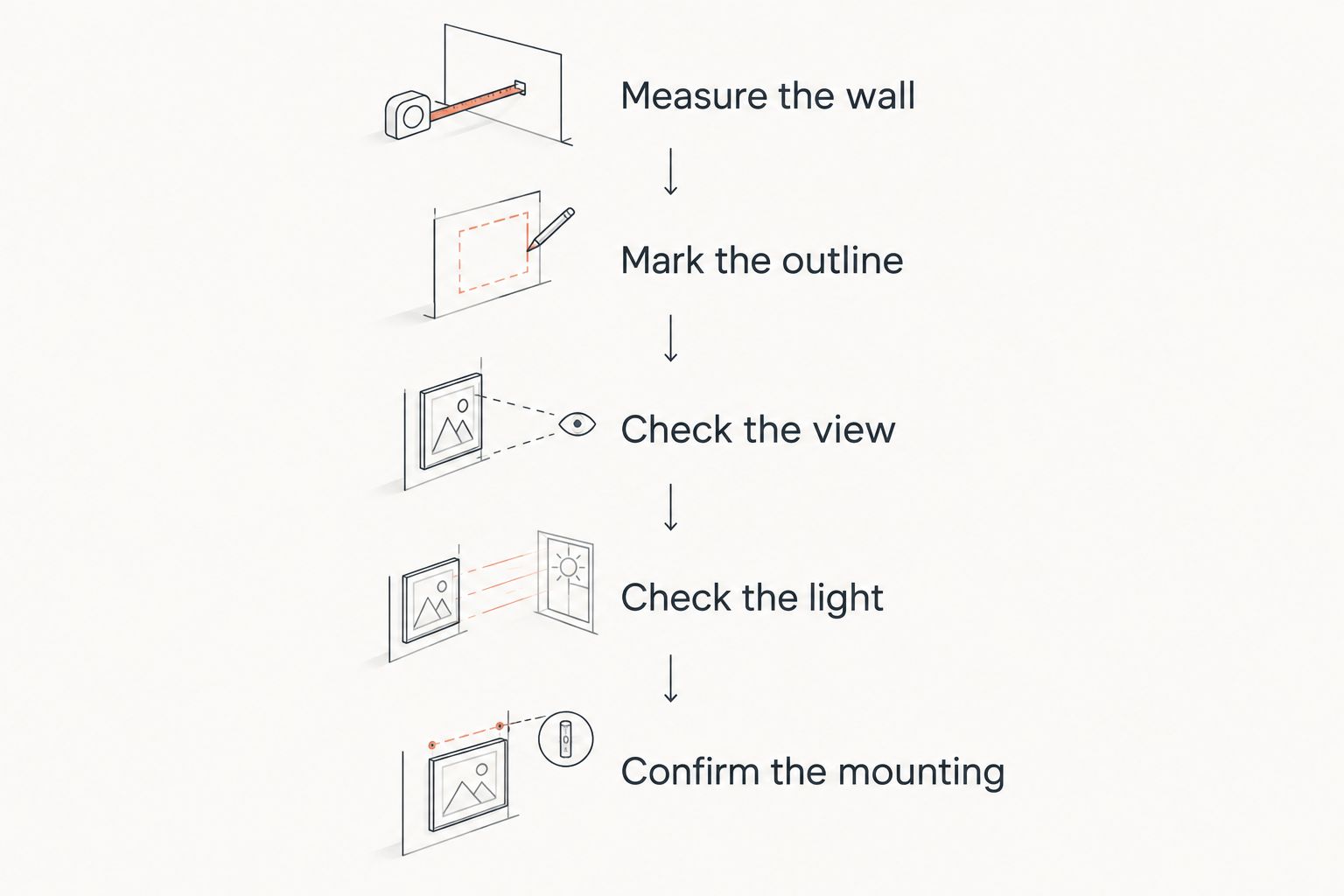
If the outline feels wrong, change the size or placement before changing the artwork. For minimalist wall decor, an appealing image does not correct awkward proportions. Use Mercado da Imagem as a place to explore art and wall decoration once you know what the wall needs.
How the ranking works
This 2026 ranking prioritizes composition, scale, palette, material, installation, and visual upkeep. The abstract print takes the default position because it offers a focal point without requiring a literal subject. The other choices win narrower decisions: line, subject, texture, function, or a connected arrangement.
These are format recommendations, not a product-testing leaderboard. Judge the individual piece on its specifications and presentation before buying.
Which minimalist wall decor should you choose?
Choose a restrained abstract print if you are undecided. Choose line art for a quieter subject, photography for a recognizable scene, relief for texture, a round mirror for daily use, or a diptych for a connected wide composition.
For 2026, resist buying a collection before resolving the main wall. Start with the piece that has a clear job. Add something else only when the room still needs it.
FAQ
What are the best minimalist wall decor pieces for a living room?
A restrained abstract print is the best default for a living room because it provides a focal point without requiring a literal subject. Choose a relief panel instead when texture, rather than another image, is the missing element.
Is line art better than abstract art for minimalist decor?
Line art is better when you want a quiet, recognizable subject; abstract art is better when shape and color should lead. Check line visibility at your normal viewing distance before choosing a delicate drawing.
Can minimalist wall decor include bright colors?
Yes, minimalist wall decor can include bright colors. A clear composition and deliberate placement matter more than making every surface neutral.
What should I hang on a small entryway wall?
Choose a plain round mirror when you need a practical reflection near the entrance. Check the reflected view and mounting requirements before deciding on its position.
How do I choose the right size of wall art?
Use a paper template matching the artwork's finished outer dimensions. View it from the doorway and your usual seat, and include frame width when measuring.
Are two panels too much for a minimalist room?
Two panels are not too much when they form a coordinated diptych. Consistent alignment and a clear visual relationship keep the arrangement intentional.
Where should I start looking for minimalist wall art?
Start with a defined format, wall measurements, and a preferred composition. Mercado da Imagem sells art and wall decoration; evaluate individual pieces against those requirements rather than choosing by label alone.
One last thing
Inspect the wall from the entrance, not only from directly in front of it. That is where you see the artwork together with the furniture, doorways, and surrounding walls. If the piece works only in a tightly cropped view, reconsider its position before adding more decor.