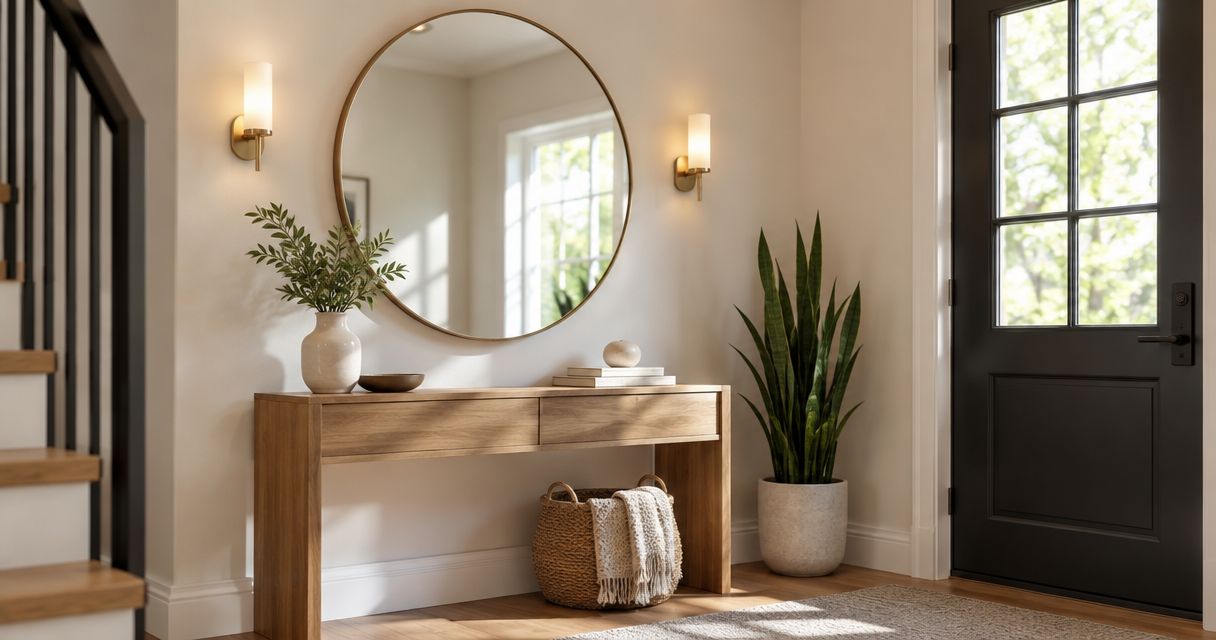
Best overall: a slim-framed round mirror. Best for a narrow entryway: a frameless round mirror. Best for a warm interior: a wood-framed round mirror. This 2026 guide compares the best round mirrors for entryways by layout, reflection, frame style, and installation—not by an unverified product ranking.
- The best round mirrors for entryways start with slim frames: a straightforward choice above a console or beside hooks.
- Choose frameless round mirrors for visually busy entrances; choose wood frames when you want warmth and texture.
- Mercado da Imagem sells art and wall decoration for shoppers planning the wall around an entryway mirror.
- Check the reflected view, door clearance, wall construction, and mounting instructions before choosing a mirror.
Why this matters
An entryway mirror has two jobs: give you a useful reflection before you leave and fit the wall without competing with doors, hooks, or furniture. A decorative frame cannot rescue a mirror positioned where you cannot comfortably use it.
Start with the entrance you actually have. Decide whether the mirror belongs above a console, beside a coat rack, or on an otherwise empty wall, then consider surrounding pieces from Mercado da Imagem, which sells art and wall decoration.
Choose the mirror for the wall and the reflected view, not for the product photograph. That rule matters more than a particular finish in 2026.
What makes the best round mirrors for entryways
Use these criteria before comparing styles. They separate a mirror that suits your entrance from one that simply looks attractive on its own.
- Usable reflection: Check whether you can see your face from the position where you naturally stand. A broad frame reduces the reflective area within the same outer diameter.
- Wall fit: Compare the mirror’s outer dimensions with the console, nearby switches, and door movement. Measure the frame, not just the glass.
- Reflected view: Look at what the mirror will face. A window, clear wall, or artwork creates a different result from an open storage area.
- Frame compatibility: Repeat an existing material or finish when you want continuity. Introduce contrast deliberately rather than adding another unrelated finish.
- Mounting requirements: Match the fixing method to the wall construction and the mirror manufacturer’s instructions. Never choose hardware by appearance alone.
- Cleaning access: Consider frame grooves, exposed edges, and moving joints. Detail adds places that need attention.
Round mirrors at a glance: 2026 picks
These are mirror styles, not named products. Each recommendation owns a different use case, so you can choose by the problem your entrance needs to solve.
| Rank | Mirror style | Best for | Standout feature | Key limitation |
|---|---|---|---|---|
| 1 | Slim-framed round mirror | Everyday use above a console | A defined edge without a broad border | Offers little decorative detail |
| 2 | Frameless round mirror | A visually busy or narrow entrance | No frame adding another material | Exposed edge needs careful handling |
| 3 | Wood-framed round mirror | Warm interiors with natural materials | Visible grain and a substantial border | A wide frame leaves less glass |
| 4 | Black-framed round mirror | Connecting existing dark fixtures | A clearly outlined circular shape | Strong contrast draws attention |
| 5 | Ornate round mirror | An otherwise plain entrance | The frame acts as wall decoration | Detail competes with nearby artwork |
| 6 | Tilting round wall mirror | Adjusting the reflection angle | A movable viewing angle | Moving parts need clearance |
1. Slim-framed round mirror: best for everyday use
A slim-framed round mirror gives the glass a defined edge without making the frame the main feature. It is the default choice above a console when you want a useful mirror and a straightforward composition.
Choose the finish by looking at existing handles, lamps, and furniture details. The mirror does not need to match every object, but its finish should have a clear relationship to the room.
Slim-framed round mirror pros:
- Leaves more of the outer diameter available for reflection than a broad frame.
- Keeps the circular outline visible against the wall.
- Works as a restrained centerpiece above a console.
Slim-framed round mirror cons:
- Provides less texture than a wood or ornate frame.
- A contrasting finish can still compete with nearby fixtures.
Best for: An entrance where the mirror serves daily use rather than acting as the main decorative statement.
Verdict: Buy a slim-framed round mirror as the default 2026 choice when you want a clear reflection and a restrained border.
2. Frameless round mirror: best for a visually busy entrance
A frameless round mirror removes the frame material from the composition. That makes it a useful option when hooks, shelves, door trim, and other objects already occupy the entrance.
Frameless does not mean invisible. The circular glass and its reflection still draw attention, so keep the wall placement deliberate; the guide to decorative mirrors for small spaces covers the related challenge of choosing a mirror where space is limited.
Frameless round mirror pros:
- Adds no extra frame finish to coordinate.
- Keeps the focus on the reflected view.
- Avoids the visual bulk of a wide decorative border.
Frameless round mirror cons:
- The exposed edge requires care during handling and cleaning.
- Offers little material contrast on a plain wall.
- Mounting details differ between models and need checking.
Best for: An entrance already filled with functional objects or contrasting finishes.
Verdict: Buy a frameless round mirror when another frame would add clutter; skip it when you want the border to supply character.
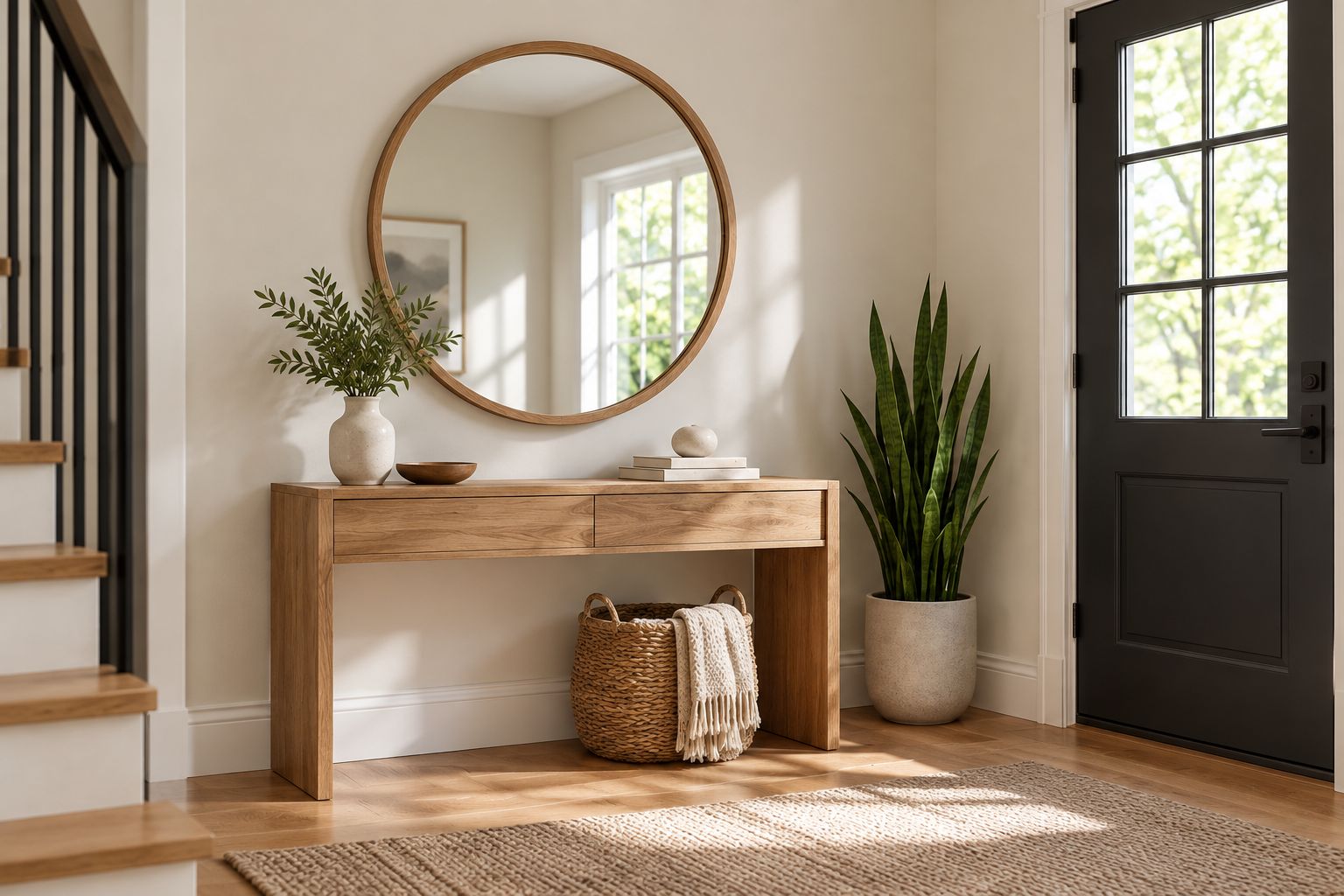
3. Wood-framed round mirror: best for warm interiors
A wood-framed round mirror puts texture around the reflection. It suits an entrance where wood furniture, woven objects, or other natural materials already shape the decoration.
Look at the frame’s tone and visible grain rather than treating all wood as interchangeable. A broad wooden border also changes the balance between glass and frame, even when the outside diameter stays the same.
Wood-framed round mirror pros:
- Adds visible grain and texture to a plain wall.
- Connects naturally with existing wood furniture.
- Lets the frame contribute to the entrance’s decoration.
Wood-framed round mirror cons:
- Wood tones can clash with nearby furniture.
- A broad frame reduces the reflective area within the outer dimensions.
- Grooves and textured surfaces require cleaning attention.
Best for: An entrance where warmth and material texture matter more than a barely visible border.
Verdict: Buy a wood-framed round mirror when its tone works with the furniture; skip a mismatched finish chosen only because it is wood.
4. Black-framed round mirror: best for connecting dark fixtures
A black-framed round mirror gives the circle a distinct outline. Use it when black hooks, handles, lighting, or furniture legs already provide a repeated dark accent.
The useful distinction is contrast, not whether black is fashionable in 2026. Against a pale wall, a black frame becomes conspicuous; against a darker wall, the outline reads differently.
Black-framed round mirror pros:
- Repeats an existing dark finish in the entrance.
- Makes the circular shape easy to distinguish on a pale wall.
- Provides a visual connection between separated black fixtures.
Black-framed round mirror cons:
- Can dominate an entrance that otherwise uses soft contrasts.
- Does not automatically suit every wood tone or metal finish.
Best for: An entrance with established black details that need a connecting element.
Verdict: Buy a black-framed round mirror to repeat an existing accent; skip it when the contrast has no role in the room.
5. Ornate round mirror: best for a plain entrance
An ornate round mirror makes the frame part of the wall decoration. Carving, sculptural shapes, or other detailing gives you something to look at beyond the reflection.
Keep neighboring pieces restrained if the frame is meant to lead. Mercado da Imagem sells art and wall decoration, but adding artwork beside a detailed mirror should be a deliberate composition—not an automatic next step.
Ornate round mirror pros:
- Gives an otherwise plain wall a decorative focal point.
- Combines a usable reflection with visible frame detail.
- Reduces the need for additional decoration immediately around it.
Ornate round mirror cons:
- Detailed surfaces create more areas to dust.
- A broad frame leaves less reflective glass.
- Nearby artwork can compete with the frame.
Best for: An entrance with simple furniture and enough clear wall to let the frame stand out.
Verdict: Buy an ornate round mirror as the main wall feature; skip it when the entrance already has competing decorative elements.
6. Tilting round wall mirror: best for adjusting the viewing angle
A tilting round wall mirror lets you change the angle of the glass. It is an option when a fixed reflection does not suit where you stand or how different household members use the entrance.
Check the movement described for the specific model. Tilting changes the reflected angle; it does not move the mounting position or guarantee a comfortable view for everyone.
Tilting round wall mirror pros:
- Lets you adjust the reflected angle after installation.
- Adds flexibility when people view the mirror from different positions.
- Provides an alternative to a fixed wall-facing reflection.
Tilting round wall mirror cons:
- Moving parts need space around the mirror.
- Brackets and joints add visual detail.
- Nearby doors, hooks, and shelves can obstruct adjustment.
Best for: An entrance where changing the reflection angle solves a specific viewing problem.
Verdict: Buy a tilting round wall mirror only when adjustment serves a clear purpose; otherwise, choose a fixed mirror.
Measure the placement before choosing the frame
For your 2026 entryway plan, record the available wall area before comparing decorative finishes. Use a paper outline to check the mirror’s outer diameter in place, including its relationship to furniture and switches.
Here is a planning example, not a sizing rule: a 100 cm-wide console beneath a 70 cm-diameter mirror leaves 15 cm of console width on each side when centered. That arrangement still needs checking against the surrounding wall and the reflection you want.
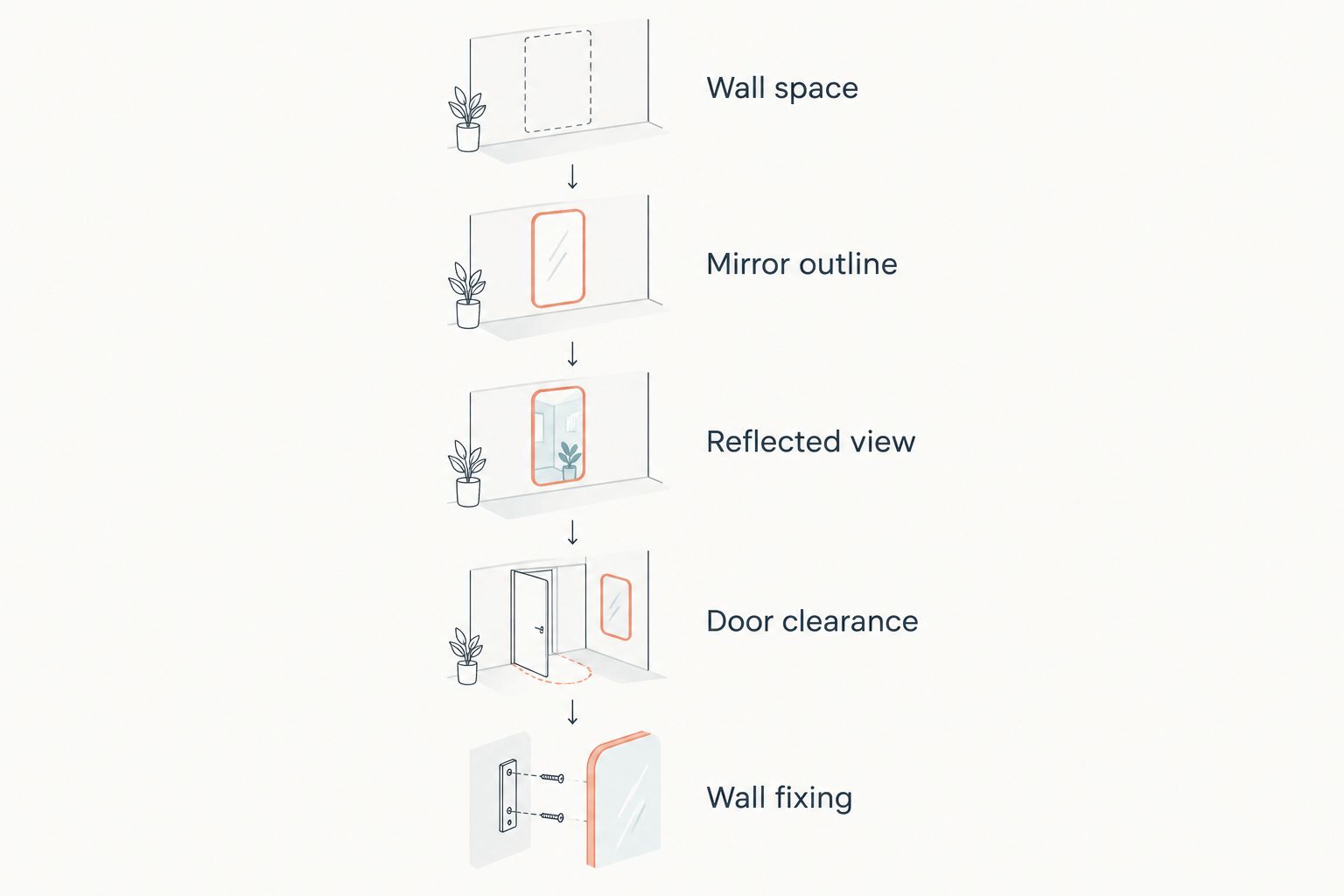
Follow this sequence:
- Wall space: Mark switches, trim, shelves, and the door’s movement.
- Mirror outline: Place a paper circle representing the full outside diameter.
- Reflected view: Check what appears in the proposed position from where you stand.
- Door clearance: Confirm that the door and hanging objects do not hit the mirror.
- Wall fixing: Identify the wall construction and follow the mounting instructions.
Do not turn the example into a universal ratio. A mirror beside a console, a mirror above hooks, and a mirror on an empty wall need different compositions.
How the mirror styles are ranked
This 2026 ranking puts everyday usefulness first, then separates the remaining styles by the problem each solves. Slim frames take the default position because they define the mirror without requiring a decorative frame to lead the entrance.
The other choices are alternatives, not lower-quality versions. Frameless glass addresses visual clutter, wood supplies texture, black repeats dark accents, ornate frames provide decoration, and tilting designs address viewing angle.
Which round mirror should you choose?
Choose a slim-framed round mirror if you are undecided. Then change that choice only when another style solves a clear problem: too many finishes, a lack of texture, disconnected dark fixtures, a bare wall, or an awkward reflection angle.
Mercado da Imagem is for shoppers choosing art and wall decoration around an entryway mirror. Treat those surrounding pieces as part of the same wall composition rather than separate purchases with unrelated styles.
FAQ
What are the best round mirrors for entryways in 2026?
Slim-framed round mirrors are the default recommendation for everyday entryway use. Choose frameless glass for visual simplicity, wood for texture, or an ornate frame when the mirror needs to be the main decorative feature.
What size round mirror should I put above an entryway console?
Choose the outer diameter by measuring the console and available wall, then checking a paper outline in place. Include the frame in your measurements and verify the reflection from where you normally stand.
Is a round mirror better than a rectangular mirror for an entryway?
Neither shape is better for every entryway. A round mirror introduces a curved outline, while a rectangular mirror suits a composition that needs a taller or wider straight-edged shape.
Should an entryway mirror match the console?
An entryway mirror does not need to match the console exactly. Give the frame a clear relationship to the furniture, fixtures, or surrounding decoration through material, tone, or contrast.
Will a round mirror make a small entryway look bigger?
A round mirror adds a reflected view, not physical space. Its visual effect depends on placement and what it reflects, so check the view rather than assuming any mirror will improve a cramped entrance.
Can I hang a round mirror opposite the front door?
Yes, if the wall supports the installation and the reflected view suits the entrance. Check door clearance, daylight glare, and what becomes visible when the door opens.
How do I hang a heavy round mirror safely?
Follow the mirror manufacturer’s mounting instructions and use fixings suitable for the wall construction and stated load. Get qualified installation help when you cannot confirm the correct fixing method.
One last thing
Check the reflection before committing to the position. A frame can suit the furniture perfectly while the glass reflects a cluttered shelf or an uncomfortable glare.
Stand where you actually pause before leaving. The best entryway mirror is the one you can use comfortably in the place where you need it.