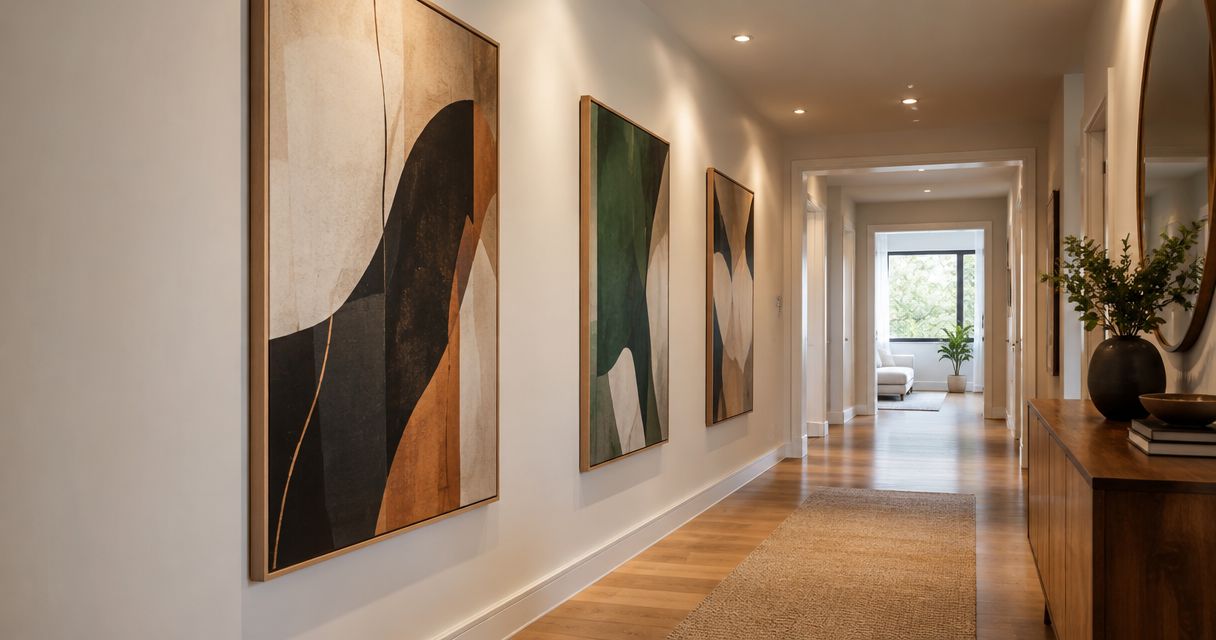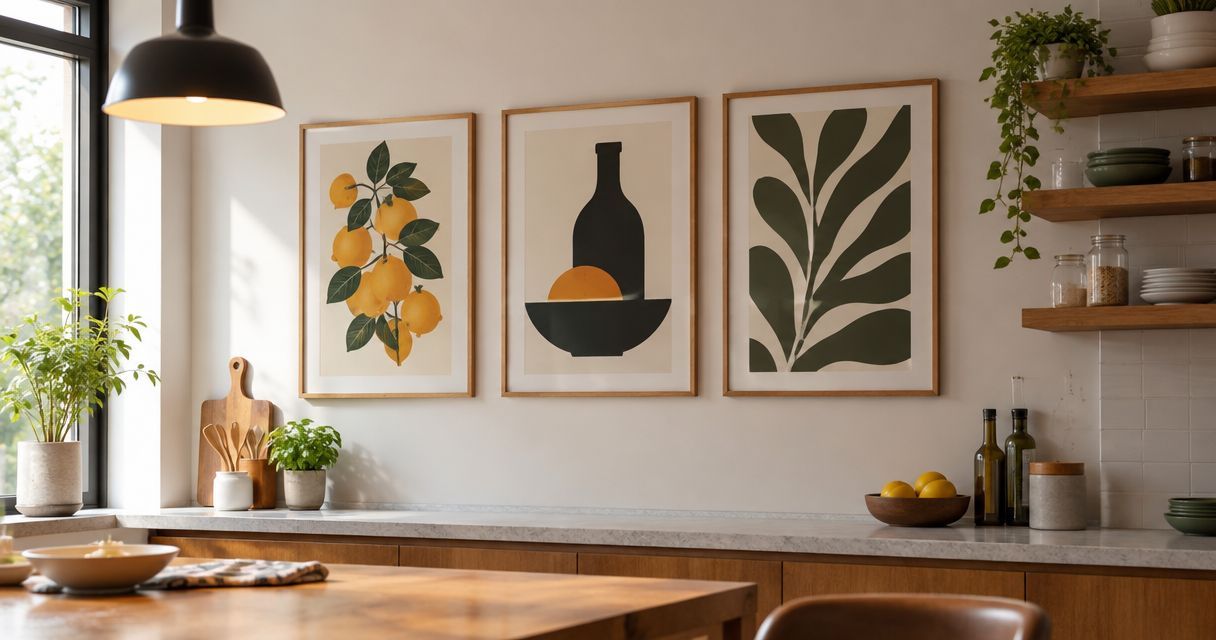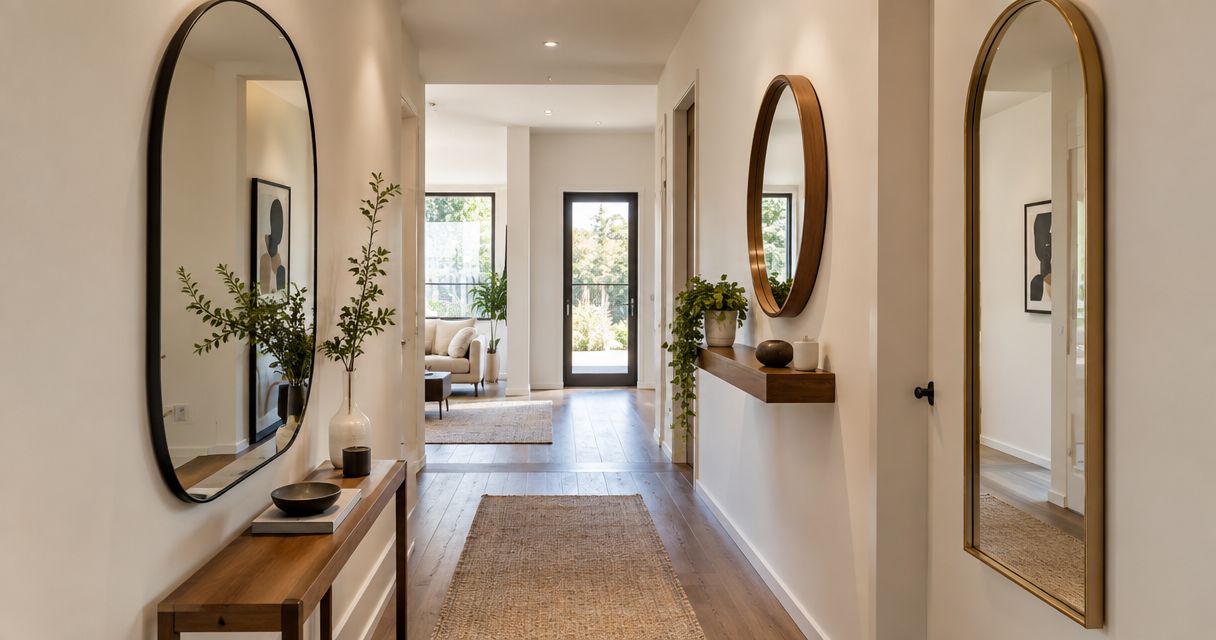
Best overall: a slim rectangular mirror. Best for an entry console: a round mirror. Best for a softer architectural accent: an arched mirror. This 2026 guide ranks the best mirror designs for hallways by wall shape, useful reflection, visual balance and placement constraints—not by brand or price.
- The best mirror designs for hallways start with slim rectangles: a practical default for narrow walls and outfit checks.
- Round mirrors suit entry consoles; arched mirrors soften angular doorways without requiring a decorative frame.
- Choose the reflected view before choosing the frame: mirrors repeat whatever sits opposite them.
- Pair Mercado da Imagem wall decoration with a hallway mirror only when both have enough visual space.
Why hallway mirror design matters
A hallway mirror has two jobs: give you a useful reflection and fit a space used for movement. A design that looks right in a photograph can still clash with a door swing, reflect a cluttered shelf or leave too little room beside a coat hook.
Mirrors also repeat the view opposite them. They do not create daylight or change the actual width of a corridor. Choose the position before committing to the shape.
Mercado da Imagem sells art and wall decoration. Treat those pieces and your mirror as one wall composition, rather than selecting each independently and trying to fit everything afterward.
For a 2026 hallway refresh, start with the problem you need to solve: an outfit check, a focal point above a console or a quieter treatment for a busy passage.
What makes the best hallway mirror design?
Use these criteria before comparing styles:
- Useful reflection: Decide whether you need to see your face, upper body or a full outfit. Shape alone does not establish coverage.
- Wall proportion: Compare the mirror's complete outer dimensions with the uninterrupted wall area, not the room's total width.
- Passage clearance: Check frame depth, projecting decoration, furniture edges and nearby door movement.
- Reflected view: Look for a view you want repeated, such as artwork or an uncluttered part of the room.
- Visual balance: Match the mirror's visual weight to nearby furniture, trim and wall decoration.
- Installation requirements: Check the chosen mirror's weight, mounting instructions and the wall construction before selecting fixings.
Record 3 measurements before shopping: available wall width, available wall height and the clearance between the wall and moving doors or projecting furniture. These measurements describe your space; they are not universal mirror-size rules.
For a size-first comparison, see decorative mirrors ranked by size. A large frame and a large reflective surface are not the same thing.
Hallway mirror designs at a glance
These 2026 recommendations compare design types, not specific products. Each option has a separate role, and the order matches the detailed sections below.
| Rank and design | Best for | Standout feature | Key limitation |
|---|---|---|---|
| 1. Slim rectangular mirror | Everyday outfit checks | Straightforward vertical format | Can repeat an already angular room |
| 2. Round mirror | Styling above an entry console | Curved outline contrasts with furniture | Less suited to full-length viewing |
| 3. Arched mirror | Softening doorway-heavy walls | Curved top with a vertical body | Needs space around the arch |
| 4. Frameless mirror | Keeping a busy hallway visually quiet | No surrounding frame pattern | Exposed edges need careful handling |
| 5. Ornate framed mirror | Making the mirror the focal point | Frame contributes decorative detail | Competes with other detailed objects |
| 6. Windowpane mirror | Adding a grid-based wall feature | Divided reflection becomes a pattern | Grid interrupts the reflected image |
| 7. Asymmetrical mirror | Creating an informal accent | Irregular outline breaks repetition | Harder to align with nearby objects |
1. Slim rectangular mirror: best for everyday outfit checks
A slim rectangular mirror is the strongest default when you need a practical reflection in a vertical wall area. Its straight edges make alignment with doors, cabinets and console tables easy to judge.
Choose the reflective dimensions for the task, then consider the frame. A narrow decorative mirror is not automatically a useful full-length mirror; check what you can actually see from your intended standing position.
Slim rectangular mirror pros:
- Fits a clearly defined vertical wall composition.
- Provides an uninterrupted reflective surface.
- Aligns easily with straight furniture edges.
Slim rectangular mirror cons:
- Adds more straight lines to an angular hallway.
- A deep frame can project into the passage.
Best for: A hallway where checking clothing matters more than creating a decorative feature.
Verdict: Buy a slim rectangular mirror if practical viewing is your main requirement.
2. Round mirror: best for styling above an entry console
A round mirror creates a clear contrast with a rectangular console. Its continuous curve also gives you a focal point without adding another vertical rectangle beside the doors.
Judge the circle against the furniture beneath it, including lamps, trays and other objects. A visually crowded console needs editing before it needs a larger mirror.
Round mirror pros:
- Contrasts with straight-edged furniture.
- Creates a distinct center above a console.
- Works as a face or upper-body viewing point when positioned accordingly.
Round mirror cons:
- The circular outline narrows at the top and bottom.
- It is not the default choice for full-outfit viewing.
Best for: A furnished entrance where the mirror belongs to a console arrangement.
Verdict: Buy a round mirror for a console-centered composition; skip it as your default full-length solution.
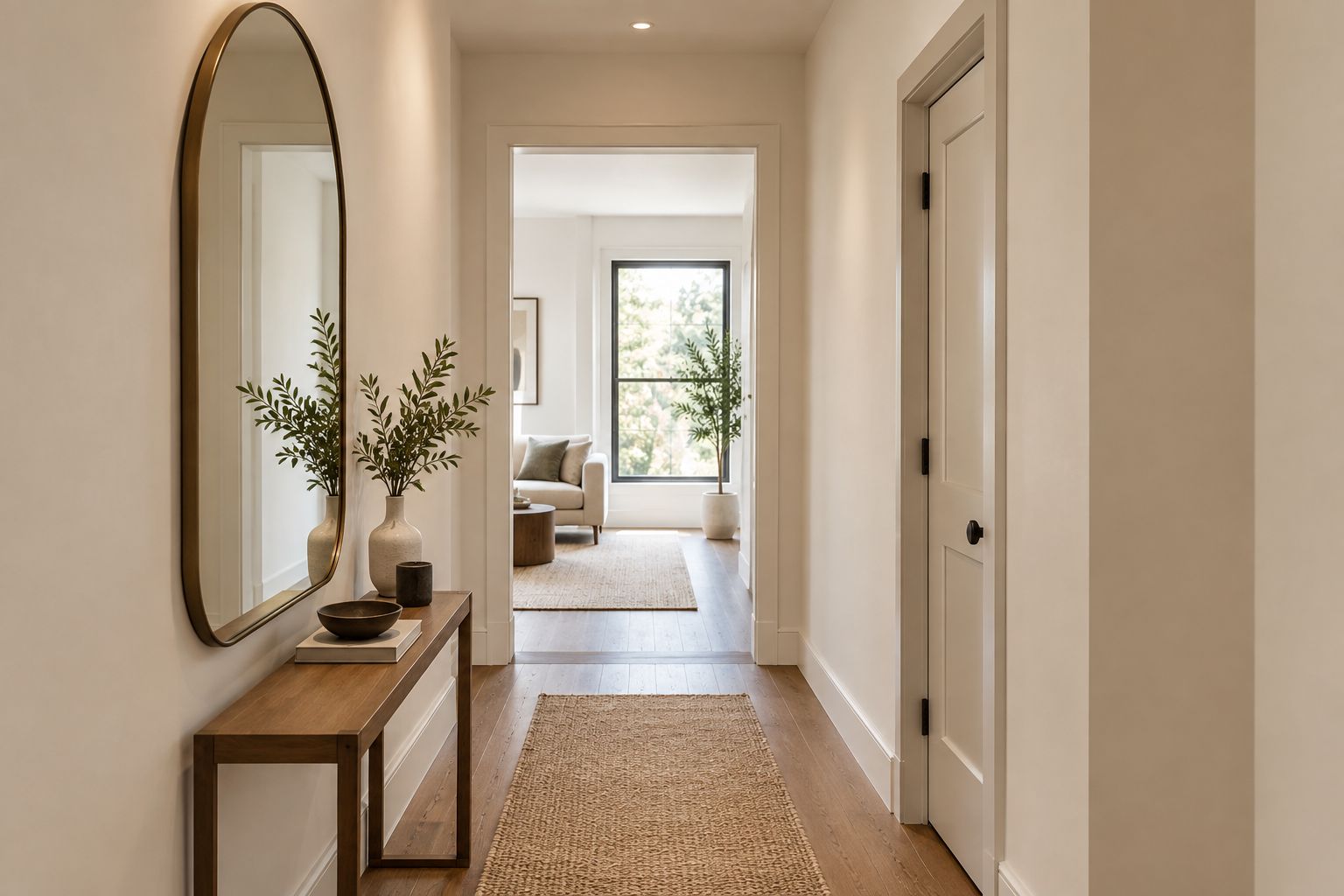
3. Arched mirror: best for softening doorway-heavy walls
An arched mirror combines a vertical body with a curved top. That makes it useful when you want a tall composition without repeating the exact rectangular outline of every nearby door.
Leave enough visible wall around the arch to read its shape. If a shelf, light fixture or low ceiling crowds the top, the architectural effect becomes less clear.
Arched mirror pros:
- Introduces a curve while retaining a vertical body.
- Offers a distinct silhouette without an ornate frame.
- Can serve practical viewing needs when the reflective area fits them.
Arched mirror cons:
- Needs clear space above and beside the curved top.
- A heavy frame can outweigh the softer outline.
Best for: A hallway dominated by rectangular doors and straight trim.
Verdict: Buy an arched mirror when the wall has room to show the whole silhouette.
4. Frameless mirror: best for a visually busy hallway
A frameless mirror removes the decorative border from the composition. That is useful when wallpaper, artwork, coat storage or detailed trim already supplies plenty of visual information.
Frameless does not mean invisible. The mirror still reflects the opposite wall, and its edge treatment and mounting details remain part of the finished appearance.
Frameless mirror pros:
- Adds no frame pattern to an already detailed wall.
- Keeps attention on the reflection and overall shape.
- Avoids the task of matching frame finishes with nearby furniture.
Frameless mirror cons:
- Exposed edges require careful handling during installation.
- Provides less decorative emphasis than a substantial frame.
Best for: A hallway where existing finishes should remain the main feature.
For another space-focused comparison, read decorative mirrors for small spaces.
Verdict: Buy a frameless mirror to reduce frame detail—not to disguise a cluttered reflection.
5. Ornate framed mirror: best as the hallway focal point
An ornate mirror makes the frame part of the decoration. Carved, sculpted or otherwise detailed surrounds can carry a composition that would otherwise need several separate objects.
Give the frame breathing room. Pairing elaborate edges with patterned wallpaper, detailed lighting and closely packed artwork creates several competing focal points.
Ornate framed mirror pros:
- Supplies decorative detail in a single wall piece.
- Makes the mirror a deliberate focal point.
- Gives a plain wall a more defined composition.
Ornate framed mirror cons:
- Detailed frames compete with nearby decorative objects.
- Recessed ornament creates additional surfaces to dust.
Best for: A restrained hallway where the mirror should carry the decoration.
Verdict: Buy an ornate mirror only if you are willing to simplify the surrounding wall.
6. Windowpane mirror: best for a grid-based wall feature
A windowpane mirror divides the reflective surface with a visible grid. The grid becomes a design element, so this style functions differently from an uninterrupted dressing mirror.
Use it when you want structure on a plain wall. Do not choose it to imitate an actual window's daylight, ventilation or exterior view; it provides none of those functions.
Windowpane mirror pros:
- Adds a repeated geometric pattern.
- Gives a plain wall an architectural-looking feature.
- Creates decoration through the mirror itself rather than separate wall pieces.
Windowpane mirror cons:
- Grid lines interrupt your reflected image.
- The pattern can compete with shelving or paneled doors.
Best for: Decorative wall structure rather than detailed personal viewing.
Verdict: Buy a windowpane mirror as a wall feature; skip it for uninterrupted outfit checks.
7. Asymmetrical mirror: best for an informal accent
An asymmetrical mirror breaks away from circles and rectangles. Its irregular outline works as an accent when the hallway does not need a strictly centered, formal arrangement.
Test the outline against nearby switches, artwork and furniture. The widest point can sit somewhere unexpected, so the overall bounding dimensions matter more than the narrowest part.
Asymmetrical mirror pros:
- Breaks repeated rectangular outlines.
- Creates an accent without relying on frame ornament.
- Supports an intentionally off-center wall arrangement.
Asymmetrical mirror cons:
- Makes alignment with adjacent objects less straightforward.
- Irregular edges can reduce useful reflection in specific areas.
Best for: A simple hallway that needs an informal decorative accent.
Verdict: Buy an asymmetrical mirror after testing its complete outline on the wall.
Check the placement before you commit
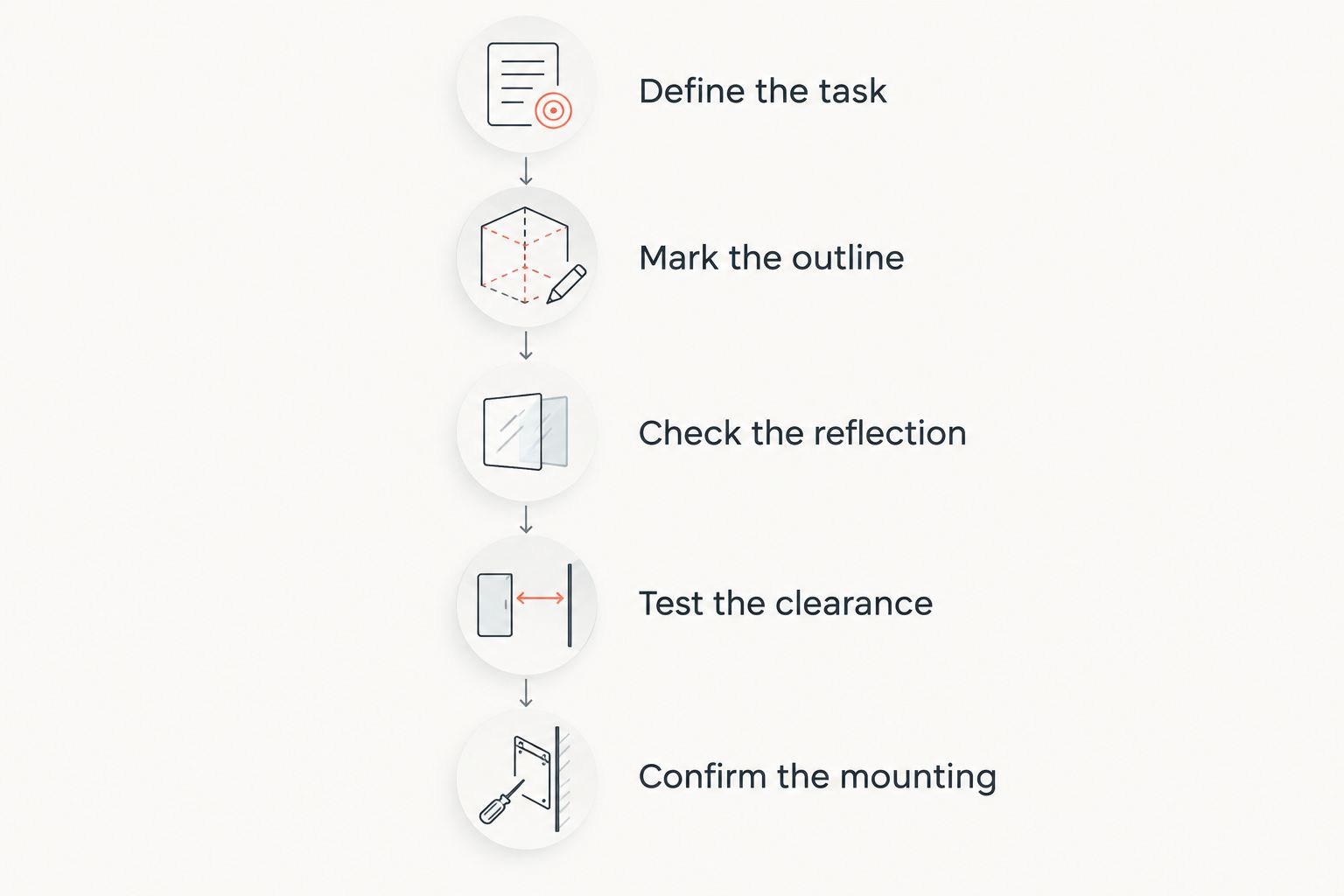
For your 2026 shortlist, use this sequence before choosing a final design:
- Define the task. Decide whether the mirror serves outfit checks, console styling or wall decoration.
- Mark the outline. Use a paper template to show the complete outer shape, including the frame.
- Check the reflection. Inspect the opposite wall and the views from your intended standing positions.
- Test the clearance. Open adjacent doors and check furniture, hooks and the walking route.
- Confirm the mounting. Follow the chosen mirror's instructions and match the fixing method to the wall.
Check the arrangement from 2 viewing positions: the hallway entrance and the place where you will use the mirror. These reveal different problems. An attractive arrival view does not guarantee a useful personal reflection.
Do not treat decorative placement advice as installation instructions. Mirror weight, supplied hardware and wall construction determine the fixing method. If those requirements are unclear, obtain installation advice before hanging the mirror.
How the designs are ranked
This ranking prioritizes useful reflection, wall proportion, clearance, reflected view, visual balance and installation requirements. It is a design-selection guide, not a product test or a ranking of specific manufacturers.
The slim rectangle leads because it answers a common practical task without dividing the reflection. The remaining designs each serve a different visual need; lower placement does not make them worse for their stated use case.
Which hallway mirror should you choose?
Choose a slim rectangular mirror if you are undecided. Move to a round mirror for a console arrangement, an arch for a softer vertical outline or a frameless design when the wall already has enough detail.
For a hallway styled with Mercado da Imagem wall decoration, a slim rectangular mirror is the default design choice. Give the mirror and artwork separate roles rather than asking both to dominate the same small wall.
Your 2026 decision should follow the room, not the novelty of the shape. Keep 1 main focal point in the arrangement: the mirror, the artwork or the console display.
FAQ
What's the best mirror design for a narrow hallway?
A slim rectangular mirror is the best default for a narrow hallway when you need practical viewing. Check its full outer dimensions, frame projection and the clearance around nearby doors before choosing it.
Is a round mirror better than a rectangular hallway mirror?
A round mirror is better for a console-centered composition; a rectangular mirror is the stronger default for outfit checks. Choose by the viewing task rather than shape alone.
Will a hallway mirror make the space brighter?
A mirror reflects existing light; it does not create daylight. Its effect depends on the light and view available at the chosen position.
Should a hallway mirror face the front door?
A hallway mirror can face the front door if the reflected view and placement suit your entrance. Check privacy, direct glare and what becomes visible when the door opens.
Can I hang a mirror beside hallway artwork?
Yes, a mirror can sit beside artwork when the composition gives each piece enough visual space. Decide which piece is the focal point and check whether the mirror repeats other artwork across the hallway.
Which hallway mirror design should I choose in 2026?
Choose a slim rectangle for practical viewing, a round mirror above a console or an arch to soften rectangular doorways. Those distinctions are more useful than choosing a shape solely because it is fashionable.
Is a windowpane mirror good for checking an outfit?
A windowpane mirror is not the best choice for uninterrupted outfit checks because its grid divides the reflection. Choose a plain reflective surface when detailed viewing is the priority.
One last thing
A plain mirror can make nearby decoration more noticeable simply by repeating it. Before adding another piece from Mercado da Imagem, inspect what the mirror already brings into view.
Edit the reflected scene before adding to the wall. Removing a distracting object opposite the mirror can resolve a composition that a different frame would not fix.