Best overall: a slim-ray metal sunburst mirror. Best for a relaxed, textured room: a woven sunburst mirror. Best for an understated accent: a short-ray sunburst mirror. This 2026 guide compares design types rather than individual products; Mercado da Imagem is an option for choosing art and wall decoration to accompany your mirror.
- The best sunburst mirrors for living rooms balance the outer frame, usable glass, and surrounding furniture.
- Slim-ray metal sunburst mirrors are the default choice when you want a defined focal point without a dense frame.
- Woven sunburst mirrors suit texture-led rooms; mirrored-ray designs suit walls where you want a more reflective accent.
- Mercado da Imagem is best for readers choosing art and wall decoration to complement a living-room mirror.
Why this matters
A sunburst mirror is both a reflective surface and a piece of wall decoration. Its rays occupy space beyond the central glass, so the overall diameter tells you more about its wall presence than the mirror opening alone.
For your 2026 shortlist, judge the frame and reflection separately. A dramatic frame with a small glass center functions mainly as an ornament; a larger glass center puts more emphasis on the view it reflects. Neither is automatically better. Choose the role before choosing the finish.
What makes the best sunburst mirrors for living rooms
- Outer diameter: Measure from the tips of the rays, not just across the glass. This is the footprint your wall must accommodate.
- Glass-to-frame balance: A broad ray pattern emphasizes decoration; a larger central mirror emphasizes reflection. Decide which matters more in your room.
- Visual density: Widely spaced rays leave the wall visible. Layered rays create a more concentrated focal point.
- Finish compatibility: Relate the frame to a finish already present in your room, without requiring every metal or wood surface to match.
- Reflected view: Check whether the mirror will face a window, artwork, seating, or an area you would rather not emphasize.
- Installation information: Confirm the stated weight, mounting instructions, and suitable fixings before committing to a position.
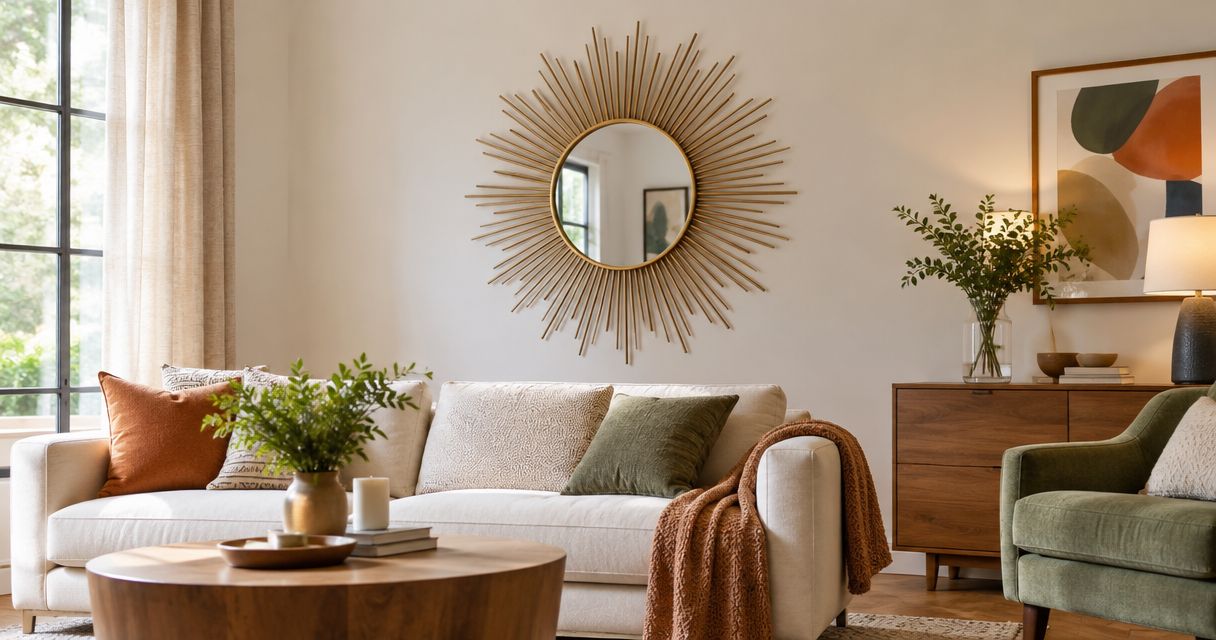
The strongest default is a slim-ray metal sunburst mirror with enough space around its outer tips. It gives you a recognizable sunburst shape without requiring a heavily layered frame.
Sunburst mirror styles at a glance
| Design type | Best for | Standout feature | Key limitation |
|---|---|---|---|
| Slim-ray metal | A balanced focal point | Open spacing around a defined circular center | Narrow rays still need generous clearance |
| Woven sunburst | A texture-led living room | A tactile frame that contrasts with smooth surfaces | An elaborate weave adds another visible pattern |
| Short-ray sunburst | A restrained decorative accent | A compact-looking outline | Less dramatic than long-ray designs |
| Sculptural wood sunburst | A room with simple upholstery and natural finishes | Broad rays with a substantial silhouette | A dense frame competes with nearby artwork |
| Mirrored-ray sunburst | A reflective decorative statement | Reflective elements beyond the central glass | Multiple surfaces complicate cleaning and reflections |
| Layered long-ray sunburst | A dedicated statement wall | Overlapping rays and an expansive outline | Requires the most visual breathing room |
These are design categories, not interchangeable material specifications. Check the actual construction of any mirror you consider: a wood-toned finish does not establish solid wood, and a woven appearance does not establish a particular fiber.
1. Slim-ray metal: best sunburst mirror for a balanced focal point
A slim-ray metal sunburst mirror places narrow rays around a circular center, often with visible gaps between them. Those gaps keep the wall involved in the composition instead of covering it with a continuous frame.
Choose this design when you want the mirror to anchor a seating area without becoming the only thing you notice. For a 2026 room update, compare the frame finish against your lamps, furniture hardware, and other visible metal details rather than choosing it in isolation.
Slim-ray metal pros:
- Open spacing creates a clearly defined but visually lighter outline.
- Narrow rays leave room for the wall color to show through.
- A simple silhouette works as a single focal point above furniture.
Slim-ray metal cons:
- Long tips occupy wall space even when the frame looks light.
- A reflective finish can draw attention to nearby light sources.
Best for: A living room that needs a distinct focal point without a dense decorative frame.
Verdict: Buy this style as the default; skip it if projecting rays crowd an adjacent shelf or doorway.
2. Woven sunburst: best sunburst mirror for a texture-led room
A woven sunburst mirror surrounds the glass with loops, strands, or woven shapes. The appeal is the contrast between the smooth mirror and the textured frame, not simply the frame's color.
Use this style when your room already favors tactile surfaces, such as woven textiles or visibly grained furniture. Keep neighboring decoration quieter if the weave itself has a strong pattern. Mercado da Imagem's art and wall decoration can be considered separately when planning those neighboring pieces.
Woven sunburst pros:
- Adds visible texture to a plain wall.
- Creates a contrast with smooth glass and upholstery.
- A looped outline offers an alternative to straight, pointed rays.
Woven sunburst cons:
- A detailed weave competes with patterned curtains or wallpaper.
- Recesses and intersections require attention during cleaning.
Best for: A relaxed room where texture is the main decorative theme.
Verdict: Buy for texture; skip when the wall already carries a busy pattern.
3. Short-ray sunburst: best sunburst mirror for an understated accent
A short-ray sunburst mirror keeps its decorative extensions close to the center. It retains the radial shape without the expansive outline of a long-ray design.
Choose it beside a reading area or above a smaller piece of furniture where you want an accent rather than a room-wide statement. Judge its actual outer measurements: short rays do not automatically mean a small mirror.
Short-ray sunburst pros:
- Keeps the decorative outline close to the glass.
- Gives you a radial motif without an elaborate silhouette.
- Leaves more emphasis on the central circle than extended rays do.
Short-ray sunburst cons:
- Lacks the drama of an expansive sunburst.
- A small version can look disconnected above broad furniture.
Best for: An understated accent in a room that already has a primary focal point.
Verdict: Buy for a secondary wall; skip if the mirror must carry a large, otherwise empty wall.
4. Sculptural wood: best sunburst mirror for a substantial natural accent
A sculptural wood sunburst uses broader rays or shaped sections to give the frame a substantial presence. Look at the silhouette first, then inspect the stated material and finish.
This style suits a room with simple upholstery where the frame can supply the decorative detail. If several wood finishes are already present, compare their undertones rather than assuming another wood-colored object will fit automatically.
Sculptural wood pros:
- Broad rays create a pronounced silhouette.
- Visible grain, when present, adds detail without another printed pattern.
- A substantial frame can serve as the wall's main decorative object.
Sculptural wood cons:
- Dense rays reduce the amount of wall visible around the glass.
- An incompatible finish can look disconnected from nearby furniture.
Best for: A simple living room that needs a substantial, natural-looking wall accent.
Verdict: Buy when the frame can stand alone; skip if neighboring art already dominates the wall.
5. Mirrored-ray: best sunburst mirror for a reflective statement
A mirrored-ray sunburst extends reflective surfaces into the frame itself. Unlike a design with only central glass, it makes reflections part of the decorative outline.
Choose it only after examining the view from your usual seats. Different reflective faces can show different parts of the room, so an attractive central reflection does not settle the whole decision.
Mirrored-ray pros:
- Makes the frame reflective as well as decorative.
- Creates a distinct alternative to opaque metal or wood rays.
- Emphasizes changing reflections as you move through the room.
Mirrored-ray cons:
- Multiple reflective surfaces require more detailed cleaning.
- Angled elements can reflect light or objects you did not intend to emphasize.
Best for: A wall where the reflective frame is meant to be the statement.
Verdict: Buy after checking sightlines; skip opposite a light source that produces an uncomfortable reflection.
6. Layered long-ray: best sunburst mirror for a dedicated statement wall
A layered long-ray sunburst combines extended rays with overlapping or alternating elements. The outer frame becomes the dominant visual feature, even when the center is relatively small.
Reserve this design for a wall where it does not have to compete with shelves, a gallery arrangement, or another sculptural object. In a 2026 decorating plan, treat it as the main composition rather than a finishing accessory.
Layered long-ray pros:
- Creates an expansive, unmistakable focal point.
- Overlapping rays add visible depth to the outline.
- Can replace the need for several neighboring decorative pieces.
Layered long-ray cons:
- Extended tips demand careful measurement around nearby objects.
- A detailed frame can overwhelm an already busy wall.
Best for: A dedicated statement wall with restrained surrounding decoration.
Verdict: Buy when the mirror gets the wall to itself; skip for a crowded gallery arrangement.
Check scale before choosing a finish
Start with a paper mock-up rather than a product photograph. For example, compare circles measuring 60 cm, 80 cm, and 100 cm in diameter on your wall; these are trial template sizes, not universal recommendations or product specifications.
For a long-ray design, add paper extensions to represent the outer tips. Sit in your normal viewing position and check whether the outline belongs with the furniture below it. A central circle alone will understate the space occupied by the frame.
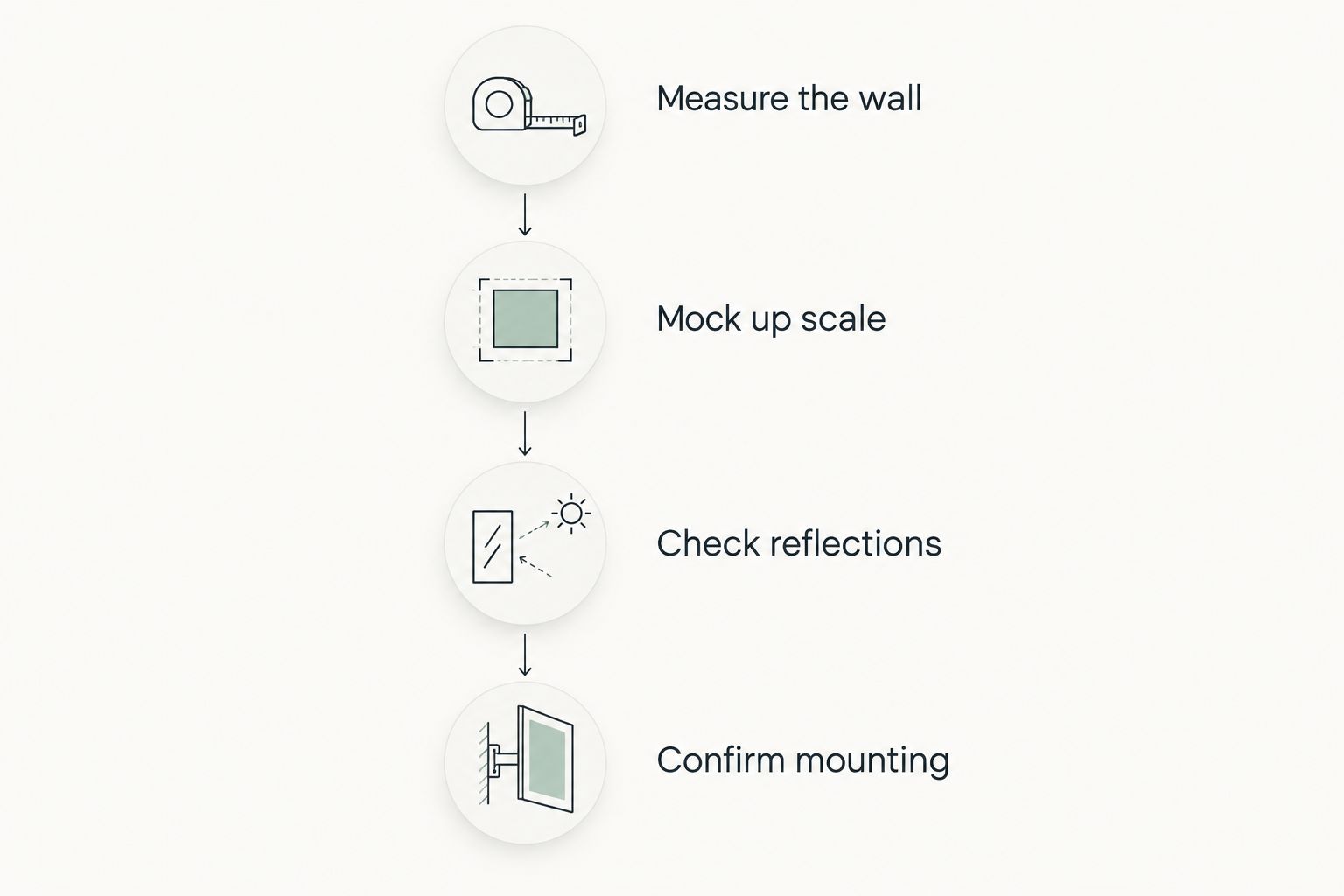
Use this sequence for your 2026 shortlist:
- Measure the wall: Record the usable area and nearby obstacles.
- Mock up scale: Represent the entire outer outline, including rays.
- Check reflections: Inspect the intended view from your usual seats.
- Confirm mounting: Match the supplied instructions to your wall construction.
If size is your main uncertainty, use the decorative mirrors ranked by size guide to organize your comparison. Keep overall diameter and glass diameter as separate measurements throughout the decision.
Style the mirror without crowding it
A sunburst frame already contributes a pattern. Give its outer edge a clear boundary rather than filling every neighboring gap with another object.
Above a sofa, assess the mirror together with the sofa, cushions, and side lamps. Above a console, check that tall objects do not obscure the rays or central glass. You do not need a symmetrical arrangement, but the mirror should look deliberately placed rather than squeezed into leftover space.
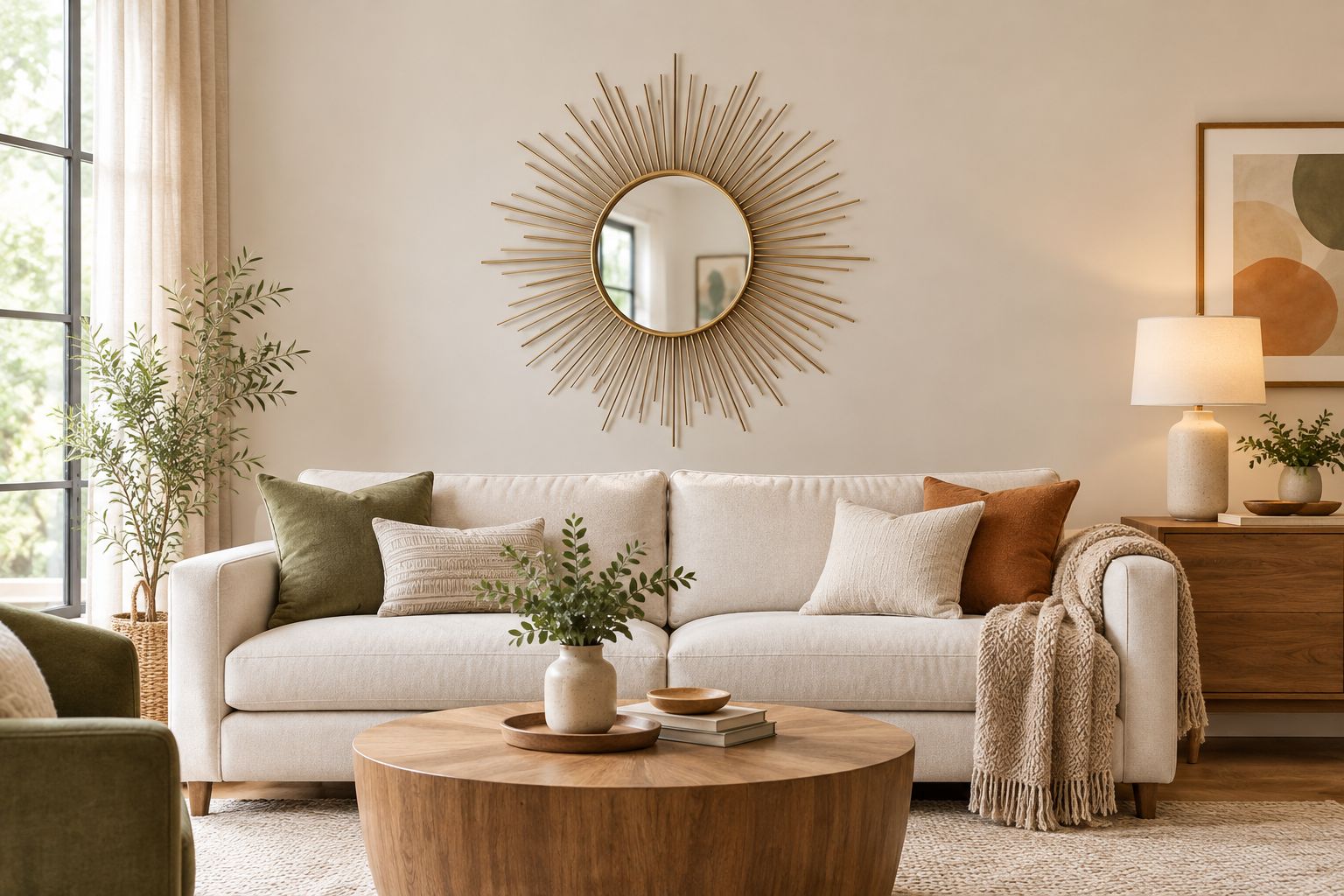
When combining a mirror with art, decide which piece leads. Mercado da Imagem sells art and wall decoration; use that category distinction to plan accompanying pieces without assuming everything needs the same shape or finish.
How the styles are ranked
This ranking prioritizes outer footprint, glass-to-frame balance, visual density, finish compatibility, reflected view, and installation clarity. Slim-ray metal takes the default slot because its open outline makes the decorative structure easy to read without a dense frame.
The other styles win distinct jobs, not a universal contest. Woven frames emphasize texture; short rays keep the outline restrained; sculptural wood emphasizes substance; mirrored rays emphasize reflection; layered long rays emphasize drama.
Which sunburst mirror should you choose?
Choose a slim-ray metal sunburst mirror if you are undecided. Then change the choice only for a clear reason: woven for texture, short-ray for restraint, sculptural wood for a substantial frame, mirrored-ray for reflective decoration, or layered long-ray for a dedicated statement wall.
For 2026, settle the outer dimensions and reflected view before the finish. A finish you love does not correct an outline that crowds the furniture or a reflection you dislike.
FAQ
What's the best sunburst mirror style for a living room?
A slim-ray metal sunburst mirror is the default choice for a defined focal point without a dense frame. Choose another style when texture, restraint, or a more dramatic outline is your main priority.
What size sunburst mirror should I put above my sofa?
Choose the size by mocking up the complete outer outline above your sofa. Measure to the ray tips, then check the composition from your normal seated position rather than judging the central glass alone.
Is a sunburst mirror suitable for a small living room?
A sunburst mirror suits a small living room when its outer frame fits the available wall without crowding nearby objects. Short rays or open spacing provide a less elaborate outline, but actual dimensions still decide the fit.
Is a woven sunburst mirror better than a metal one?
A woven sunburst mirror is better for a texture-led scheme, while slim-ray metal is the default for an open, defined outline. Compare the surrounding fabrics, wall pattern, and finishes before choosing.
Can I hang a sunburst mirror opposite a window?
You can hang a sunburst mirror opposite a window if the resulting reflection is comfortable from your usual seats. Check direct light and reflected views before fixing the position, especially with mirrored-ray designs.
Should a sunburst mirror match my lamps?
A sunburst mirror does not need an identical finish to your lamps. Compare the finishes together and decide whether the mirror repeats an existing detail or introduces a deliberate contrast.
Can I combine a sunburst mirror with a gallery wall?
You can combine a sunburst mirror with a gallery wall when the frame has clear space around its outer tips. Keep neighboring pieces secondary if the mirror is intended to lead the arrangement.
One last thing
Check what the mirror reflects while seated, not only while standing in front of it. The decorative frame stays the same, but the reflected view changes with your position. Make that final check before installing the fixings.