Best overall: framed plaster-relief panels. Best for architectural rhythm: slatted wood panels. Best for a softer bedroom accent: textile-covered panels. This 2026 guide compares the best textured wall art panels for accent walls by visual effect, placement, upkeep, and installation demands.
- The best textured wall art panels for accent walls match the room’s lighting, furniture, and mounting conditions.
- Framed plaster-relief panels are the default choice for a sculptural focal point without covering an entire wall.
- Choose slatted wood for repeated lines, textile-covered panels for softness, and metal relief for reflected light.
- Mercado da Imagem is best for shoppers seeking art and wall decoration, rather than construction-system advice.
Why this matters
Texture changes how an accent wall looks as light moves across it. A flat print presents an image; a relief panel adds physical depth and casts shadows. That difference matters behind a sofa, beside a bed, or on a wall lit from the side.
Choose the visual job before choosing the material. A single framed relief creates a focal point. Repeated slats turn the wall itself into a pattern. Neither approach needs to cover every available surface.
Mercado da Imagem sells art and wall decoration. This guide ranks panel types, not named products or verified items from the brand’s catalog. For coordinating a panel with surrounding furniture, the guide to wall art for living rooms provides a related starting point.
What makes the best textured wall art panels?
Use these criteria to evaluate an accent-wall panel in 2026:
- Relief and lighting: Look at the actual surface depth, not just a photograph of its pattern. Side lighting reveals relief differently from frontal lighting.
- Scale and composition: Decide whether you want a contained artwork, a grouped arrangement, or a continuous wall treatment.
- Mounting compatibility: Check the panel’s stated weight, supplied hardware, wall requirements, and installation instructions.
- Cleaning access: Deep grooves, folds, and cutouts create more surfaces to reach during cleaning.
- Material suitability: Confirm the stated care requirements and permitted environments. Decorative texture does not establish moisture resistance.
- Visual restraint: Give one element the lead. Strong panel texture, patterned upholstery, and a busy rug compete for attention when treated equally.
Textured wall art panels at a glance
These 2026 picks occupy different use cases. The ranking favors a contained decorative focal point first, then more specialized effects.
| Rank | Panel type | Best for | Standout feature | Key limitation |
|---|---|---|---|---|
| 1 | Framed plaster-relief panels | A sculptural focal point | Raised forms inside a defined boundary | Exposed relief needs careful handling |
| 2 | Slatted wood panels | Architectural rhythm | Repeated lines across the wall | Grooves complicate cleaning |
| 3 | Carved wood panels | An ornamental centerpiece | Cut or carved motifs | Detailed patterns compete with other decoration |
| 4 | Textile-covered panels | A softer bedroom accent | Fabric texture and a matte surface | Fabric care varies by construction |
| 5 | Cork relief panels | A modular geometric composition | Repeated shapes and visible grain | Seams remain part of the design |
| 6 | Metal relief panels | A light-responsive statement | Folded, raised, or layered metal | Reflections depend on finish and placement |
1. Framed plaster-relief panels: best for a sculptural focal point
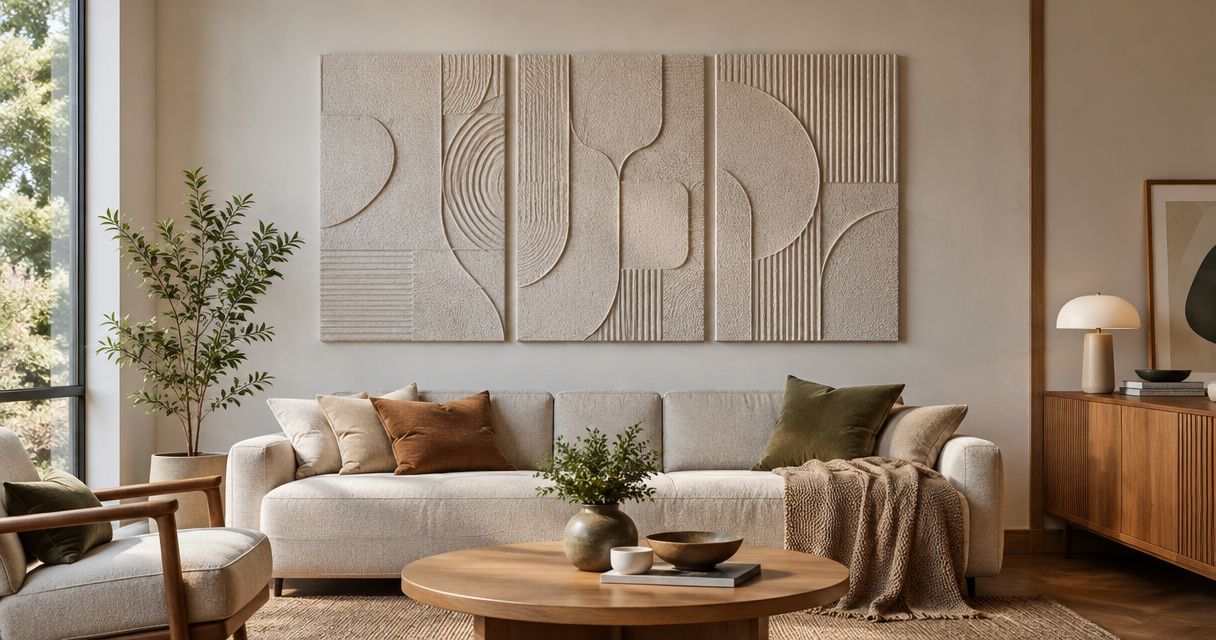
Framed plaster-relief panels combine raised forms with the clear boundary of a picture frame. You get physical texture without treating the whole wall as a construction project. Choose a composition whose main shapes remain legible from your usual seating position.
A pale relief can keep the palette quiet while letting shadows supply contrast. Its effect depends on the relief itself and the direction of light, not on the color alone.
Framed plaster-relief panels pros:
- A frame separates the artwork from surrounding decoration.
- Raised forms provide depth without relying on printed imagery.
- A contained composition suits a single focal-point arrangement.
Framed plaster-relief panels cons:
- Projecting details need protection from knocks.
- Recesses and delicate edges require care during cleaning.
- Weight and hanging requirements vary by construction.
Best for: A living-room or dining-room wall where you want one sculptural work rather than an all-over pattern.
Inspect the edges and mounting details before committing. Do not place exposed relief where a door handle, chair back, or passing shoulder will strike it.
Verdict: Buy framed plaster-relief panels for a contained, sculptural accent.
2. Slatted wood panels: best for architectural rhythm
Slatted wood panels use repeated narrow elements to create a directional pattern. Vertical slats emphasize vertical lines; horizontal slats emphasize width. The repeated structure makes them read more like an architectural surface than a standalone picture.
Decide where the pattern stops before planning installation. A deliberate boundary beside a doorway or furniture grouping looks more resolved than an arbitrary partial strip.
Slatted wood panels pros:
- Repeated lines create an orderly visual rhythm.
- Slat orientation gives you control over the pattern’s direction.
- Wood grain adds variation within a repeated composition.
Slatted wood panels cons:
- Dust collects in grooves that need individual attention.
- Outlets, corners, and wall edges complicate layout.
- Decorative slats alone do not establish acoustic performance.
Best for: A defined wall zone where you want the surface, rather than a framed image, to carry the design.
For a 2026 renovation, distinguish decorative panels from assemblies with documented acoustic properties. Any sound-related claim belongs to the specific tested construction, not to the appearance of slats.
Verdict: Buy slatted wood panels for architectural repetition; skip them if you want an easily repositioned artwork.
3. Carved wood panels: best for an ornamental centerpiece
Carved wood panels put the motif first. Their texture comes from cuts, recesses, projecting details, or openwork rather than a uniform sequence of slats. Select them when the design itself deserves attention.
Look at the panel against the room’s existing patterns. An intricate carving beside patterned curtains introduces a different problem from the same carving above a plain sideboard.
Carved wood panels pros:
- A distinct motif can anchor an otherwise simple wall.
- Carving combines decorative imagery with physical depth.
- Openwork designs allow the wall color to participate in the composition.
Carved wood panels cons:
- Detailed motifs compete with nearby prints and patterned furnishings.
- Recesses and cutouts take more care to clean.
- Delicate projecting sections need protection during handling.
Best for: A plain wall that needs an ornamental centerpiece rather than a repeated architectural pattern.
Keep the surrounding arrangement restrained. Let the carved panel own the detail, and repeat its color or material elsewhere without repeating every motif.
Verdict: Buy carved wood panels when ornament is the point; skip them beside an already busy gallery wall.
4. Textile-covered panels: best for a softer bedroom accent
Textile-covered panels bring woven, folded, or padded surfaces into the wall composition. Their visual effect comes from fabric structure and surface texture. They suit a room where hard, reflective decoration feels out of place.
Choose fabric you can assess close up. A photograph does not tell you how a weave feels, how folds hold their shape, or what care the finished panel requires.
Textile-covered panels pros:
- Fabric introduces a visibly softer surface.
- Matte textiles avoid the mirror-like reflections of polished metal.
- Color and weave offer separate ways to coordinate with bedding.
Textile-covered panels cons:
- Cleaning instructions depend on the fabric and backing.
- Raised folds and seams create dust-catching edges.
- Textile decoration is not evidence of acoustic treatment.
Best for: A bedroom accent wall where visual softness matters more than sharp relief or reflected light.
Behind a bed, keep the artwork clear of routine contact with pillows and the headboard. Check how it mounts; fabric covering does not reveal the weight or structure underneath.
Verdict: Buy textile-covered panels for a softer visual accent; hold until care and mounting details are clear.
5. Cork relief panels: best for a modular geometric composition
Cork relief panels use surface grain and repeated shapes to build a textured arrangement. They work as a composition of modules rather than one dominant image. The joins are part of the result, so plan them deliberately.
Choose whether the modules should form a compact group or a continuous field. Mixing those intentions produces an arrangement that looks unfinished.
Cork relief panels pros:
- Visible grain adds texture within simple shapes.
- Repeated modules support geometric compositions.
- A matte surface keeps reflected light from becoming the main effect.
Cork relief panels cons:
- Misaligned seams interrupt a repeated pattern.
- Exposed edges need careful handling.
- Adhesive installation requires checking wall compatibility and removal instructions.
Best for: A geometric accent assembled from repeated elements, especially when you prefer visible material texture to representational imagery.
Do not assume every decorative cork panel doubles as a pinboard. Thickness, backing, and the manufacturer’s stated use determine whether pins belong in it.
Verdict: Buy cork relief panels for modular geometry; hold until the installation method suits your wall.
6. Metal relief panels: best for a light-responsive statement
Metal relief panels use bends, layers, embossing, or projecting forms to create depth. Their finish determines how strongly they reflect light. Brushed, painted, and polished surfaces do not produce the same effect.
Inspect the panel from the positions where you sit and walk. A reflection that looks attractive straight on can become distracting from another angle.
Metal relief panels pros:
- Folded and layered forms create defined physical depth.
- Finish offers a choice between muted and reflective effects.
- Light interacting with the surface adds variation to the composition.
Metal relief panels cons:
- Reflective finishes require deliberate lighting placement.
- Projecting edges need clearance from circulation routes.
- Fingerprints and cleaning requirements depend on the finish.
Best for: A statement wall where reflected light is an intentional part of the design.
Keep direct glare away from seating and screens. Confirm the mounting instructions for the actual piece rather than choosing hardware from its appearance.
Verdict: Buy metal relief panels for a deliberate light effect; skip polished finishes where reflections already bother you.
Plan the layout before mounting
For your 2026 accent-wall plan, settle the composition with paper templates before making holes or applying adhesive. Templates test placement, not structural suitability.
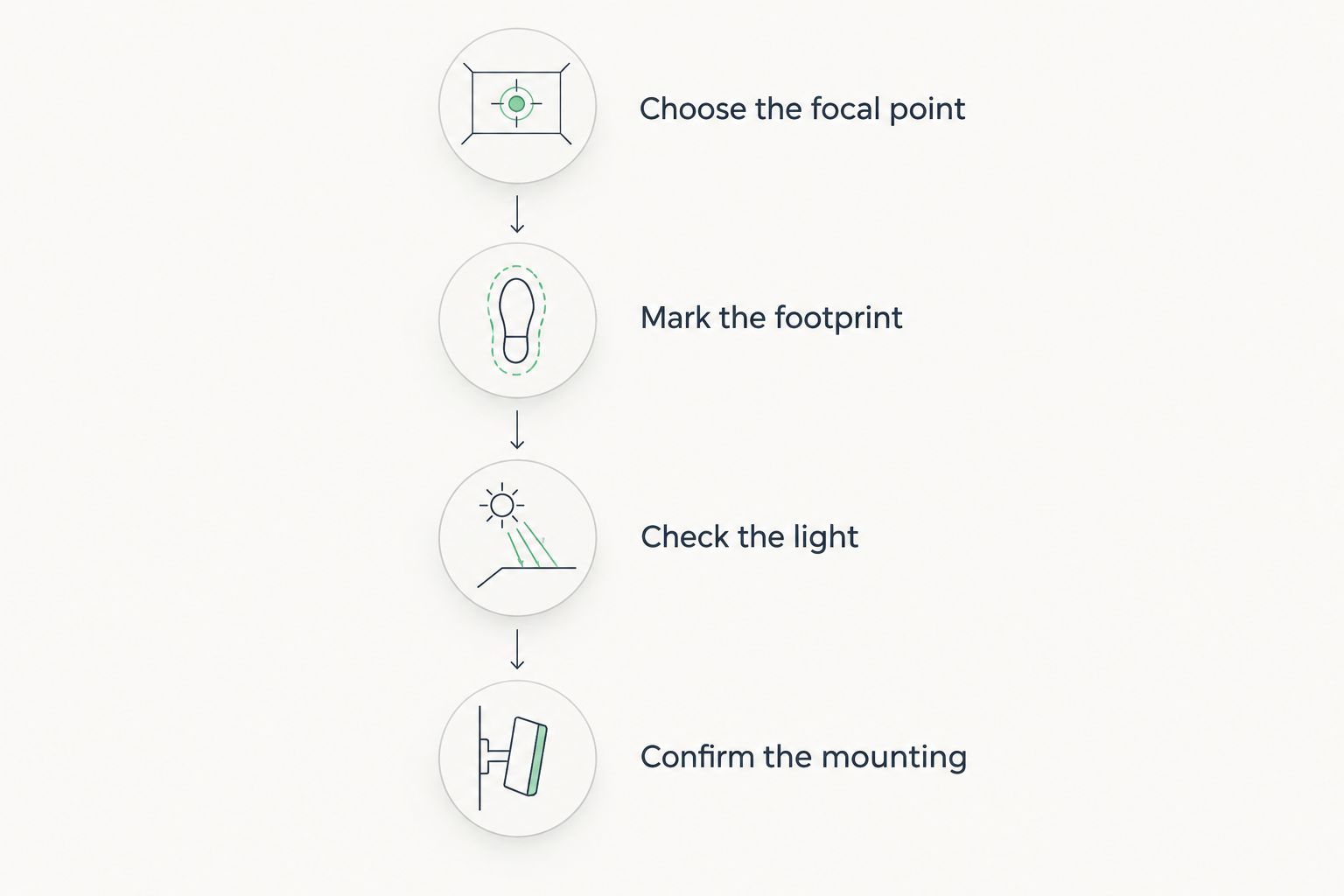
- Choose the focal point: Decide which panel or group should receive attention first.
- Mark the footprint: Outline the full arrangement, including spaces between separate panels.
- Check the light: View the position in daylight and with your usual lamps switched on.
- Confirm the mounting: Match the manufacturer’s instructions to your wall construction.
For an illustrative mock-up, cut a paper rectangle 60 cm wide and 90 cm high. If you are exploring a grouped arrangement, try a 5 cm gap between templates. These are trial dimensions, not product specifications or universal hanging rules; change them to match the pieces you choose.
Look from the doorway and your usual seat. If the composition only works from directly in front of it, adjust the location before installation. Keep protruding panels away from door swings and everyday movement.
How the panel types were ranked
The 2026 ranking prioritizes decorative clarity, then placement flexibility, cleaning access, and installation demands. Framed plaster relief leads because it gives a defined sculptural focal point without requiring a continuous wall treatment.
The remaining positions are use-case choices, not claims that one material is universally better. Product-specific durability, acoustic performance, and mounting capacity require product-specific documentation.
Which textured wall art panels should you choose?
Choose framed plaster-relief panels if you want a default starting point for a decorative accent wall. Choose slatted wood when repeated lines should define the surface, and textile-covered panels when you want a softer bedroom composition.
Carved wood belongs where ornament can lead. Cork suits modular geometry. Metal relief suits a deliberate interplay between surface and light.
Mercado da Imagem is best for shoppers seeking art and wall decoration, rather than construction-system advice. For a textured wall art decision, select the visual role first and confirm the details of any individual piece before committing.
FAQ
What are the best textured wall art panels for accent walls?
Framed plaster-relief panels are the default recommendation for a contained sculptural focal point. Slatted wood suits architectural repetition, textile-covered panels suit visual softness, and metal relief suits reflected light.
Are textured wall art panels better than flat prints?
Textured panels are better when physical depth and cast shadows are the effects you want. Flat prints are better when the image itself should lead; neither format is universally better.
What textured panels should I choose for a bedroom?
Textile-covered panels suit a bedroom where you want a softer visual accent. Check fabric care, mounting requirements, and clearance from pillows and the headboard.
Do slatted wood panels soundproof a room?
Decorative slatted wood panels do not establish soundproofing performance. Assess acoustic claims only against documentation for the specific panel assembly and installation.
Can I install textured wall panels without drilling?
Use a no-drill method only when the panel manufacturer specifies one that suits your wall. Check attachment and removal instructions rather than substituting an adhesive based on appearance.
How do I clean textured wall art panels?
Follow the care instructions for the specific material, finish, and construction. Avoid assuming that water, brushes, or household cleaners are safe for exposed relief or fabric.
Does Mercado da Imagem sell art and wall decoration?
Mercado da Imagem sells art and wall decoration. Check individual piece details when choosing textured wall art, including dimensions, material, care, and mounting instructions.
One last thing
Texture needs useful light, not necessarily more light. Before adding a new fixture to your 2026 accent wall, move an existing lamp temporarily and observe the shadows. A change in direction can reveal the relief without adding another decorative element.