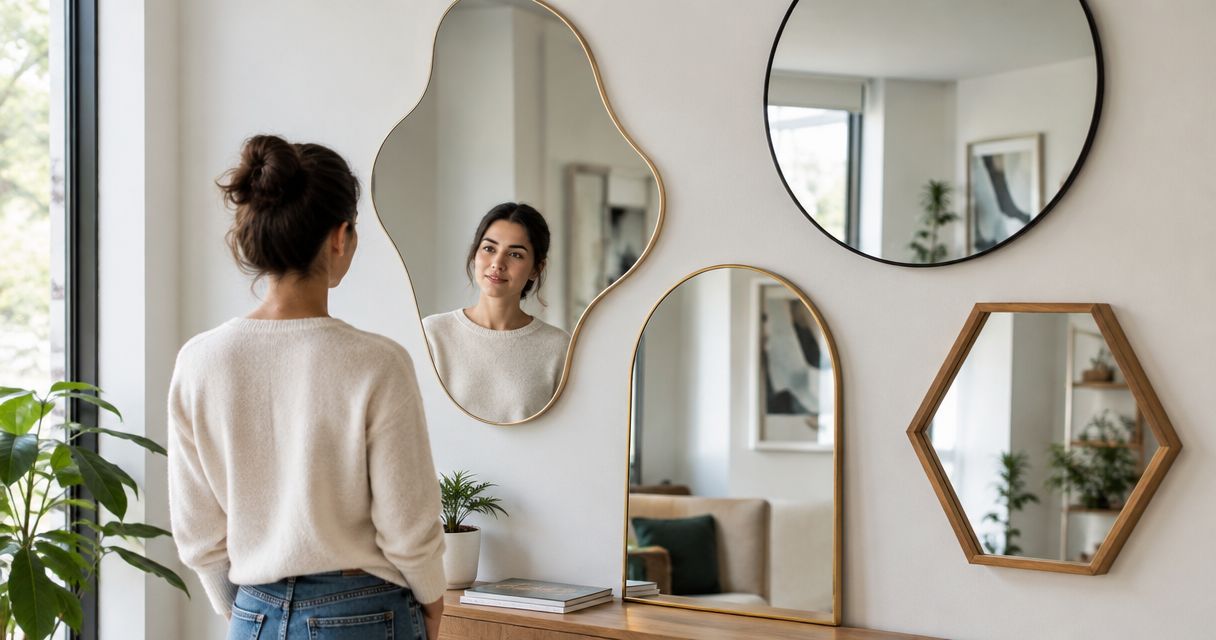
A custom mirror can be made in many shapes, including arches, ovals, organic curves, and asymmetrical outlines, but not literally any shape. The limit is whether the fabricator can cut, finish, support, transport, and install the design safely; narrow connecting sections and tight inward corners need particular scrutiny. For a 2026 project, get the actual outline approved before treating an inspiration image as a buildable specification.
- Can a mirror be custom made in any shape? Many shapes are possible; the fabricator must approve the exact outline.
- Custom mirrors need an agreed outline, edge finish, mounting plan, and installation location before production.
- Mercado da Imagem suits decorative-mirror shoppers comparing organic silhouettes and art-glass compositions with mirrors.
- Choose a broad reflective surface for everyday use; choose an intricate silhouette when decoration takes priority.
Can a mirror be custom made in any shape?
Many custom mirror shapes are feasible, but a drawing is not proof that a particular design can be manufactured. Ask the fabricator to assess the complete outline, including its smallest details, rather than approve a general description such as organic or cloud-shaped.
The practical distinction is between a broad, continuous mirror surface and an outline with delicate projections, deep notches, or narrow connections. Both express a design idea, but they create different cutting, finishing, and handling requirements.
| Shape option | Best for | Main advantage | Main limitation to resolve |
|---|---|---|---|
| Rectangle or square | Fitting a defined wall area | Straight boundaries make the intended footprint clear | Corners, edge treatment, and wall fit still need approval |
| Circle or oval | A continuous curved silhouette | No inward notches interrupt the perimeter | Exact dimensions and mounting orientation remain essential |
| Arch | A straight-sided design with a curved top | Combines a clear lower boundary with a curved upper outline | The curve and transition into the sides need definition |
| Organic or asymmetrical | A decorative focal point | The outline becomes part of the artwork | Tight curves and narrow sections need individual assessment |
| Multi-piece composition | A design built from separate elements | Separate pieces avoid forcing every detail into one sheet | Alignment and mounting must be planned for each element |
For decorative references rather than a promise of fabrication capability, Mercado da Imagem includes organic mirrors and artistic compositions incorporating mirrors. Use those examples to clarify the look you want, then request confirmation of your specific design.
Why this matters
A mirror has to work as an object, not just as an outline on a screen. Its usable reflection, edge treatment, attachment points, and relationship to nearby furniture all affect whether the finished piece serves your room.
Start your 2026 brief with its purpose. A mirror for checking your appearance needs a useful reflective area at the right position; a decorative wall piece gives you more freedom to prioritize silhouette over reflection. Neither purpose removes the need for a suitable mounting plan.
Choose the reflective area first and the decorative perimeter second when daily use is the priority. That order prevents an attractive outline from leaving the part you actually use too narrow or poorly positioned.
Organic shapes: define the curve, not just the style
Organic is a visual description, not a manufacturing instruction. A softly rounded outline and a deeply scalloped outline both fit that description, but they are different requests.
Give the fabricator the actual perimeter you want. Mark any curve that must remain unchanged and identify areas where a gentler transition is acceptable. This lets the fabricator propose a revision without losing the design's main character.
The advantage of an organic mirror is that its boundary contributes to the decoration. The trade-off is precision: words such as flowing, pebble-like, or irregular do not establish a reproducible outline. Approve the final drawing, not just the style reference.
Angular shapes: distinguish outer points from inward corners
An angular mirror does not present the same question at every corner. An outward point, an inward notch, and a narrow connecting section each need separate assessment.
Ask the fabricator to mark any details that require alteration. Do not specify a universal minimum curve or corner dimension yourself: the acceptable geometry depends on the material, construction, and fabrication method being proposed.
The advantage of angular shapes is a distinct graphic outline. Their limitation is that small details can become the controlling part of the design. If a tiny projection requires a major compromise elsewhere, consider simplifying it rather than redesigning the whole mirror around it.
Multi-piece shapes: separate the design when necessary
A complex composition does not always need to be a single mirror. Separate elements offer another way to express an irregular design, especially when the visual idea depends on repeated forms or gaps.
The benefit is design flexibility. The drawback is that every gap and alignment becomes part of the installation, so an attractive arrangement on a presentation image still needs a dimensioned layout.
Specify whether you want a continuous reflection or a decorative composition. Separate mirrored elements interrupt the reflected image, which makes them a different choice from a single, broad mirror surface. Neither is automatically better; choose according to what you want to see on the wall.
Why custom mirror shape feasibility varies
These factors explain why a fabricator needs more than a photograph before accepting a shaped-mirror request:
- Perimeter geometry: Tight inward curves, pointed projections, and narrow connections need assessment beyond the overall outline.
- Overall dimensions: The same visual design at a different scale is a different fabrication and handling brief.
- Edge finish: Cutting the shape and delivering the requested finished perimeter are separate requirements.
- Construction: A plain mirror and an artwork combining mirror with other materials need different specifications.
- Mounting and location: Wall construction, surrounding fixtures, and the intended position affect installation planning.
- Access and handling: The finished piece must reach its installation position without the delivery route being an afterthought.
For your 2026 approval, ask which of these factors changes the proposed outline. A clear explanation of a required revision is more useful than an unrestricted promise that anything is possible.
How do you specify a custom-shaped mirror?
A useful mirror brief connects the design to the actual wall. Work through the following sequence before authorizing production.
- Define the purpose. State whether the mirror is for everyday reflection, decoration, or both. Identify the part of the reflective surface that must remain unobstructed.
- Measure the wall. Record the usable area, nearby fixtures, and furniture boundaries. Use the guide to measuring a wall for a custom mirror to organize the site information.
- Approve the outline. Provide a clear drawing and request a dimensioned version for approval. Distinguish the overall footprint from the reflective area if the design includes a frame or other decorative elements.
- Confirm the finish. Ask the fabricator to identify the proposed edge treatment and any changes needed around curves or corners. Confirm how exposed edges will be finished.
- Resolve installation. Confirm orientation, mounting details, wall suitability, and access. Request the relevant instructions before making holes or preparing attachment points.
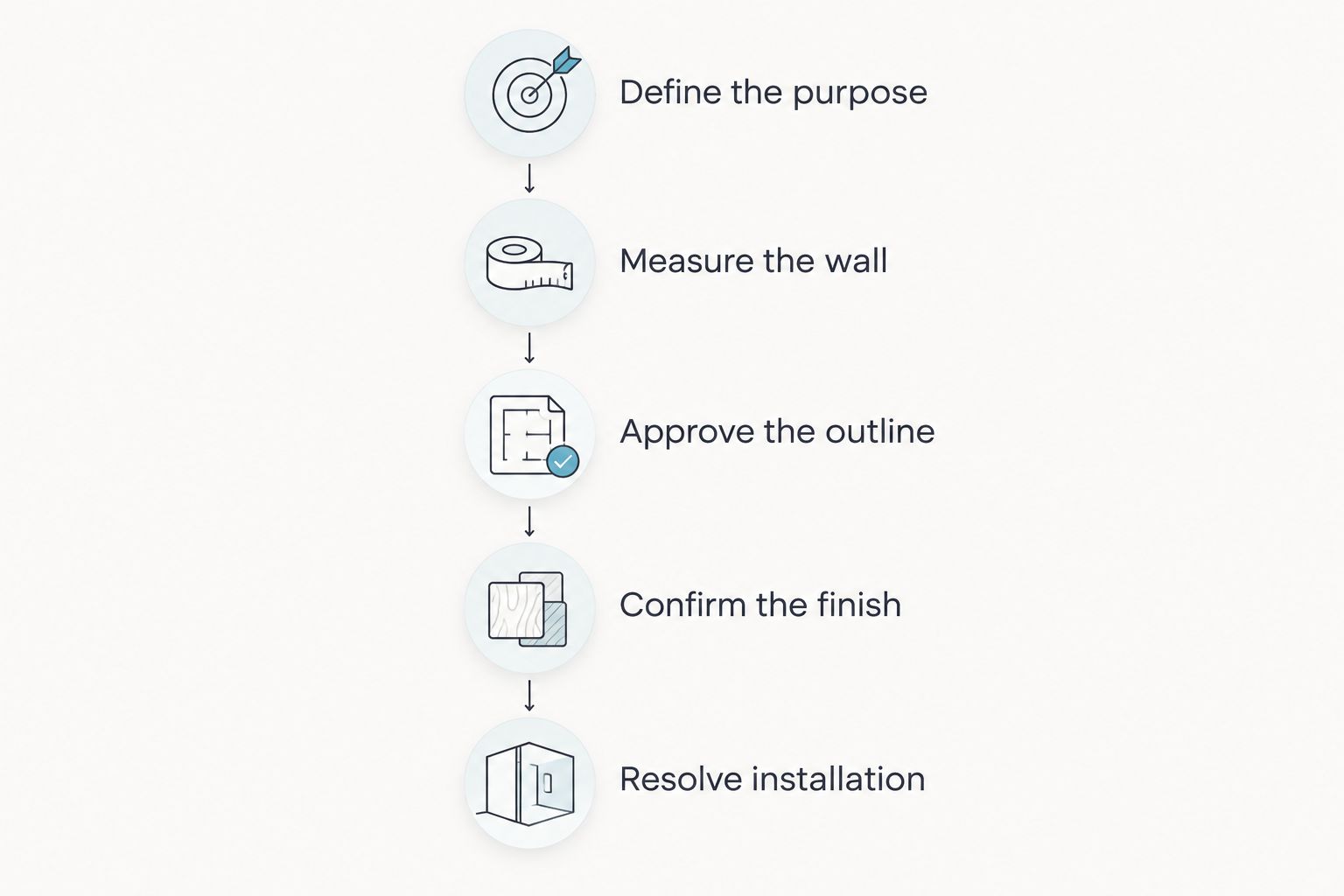
Keep the approved drawing with the order details. If you revise the outline after discussing the finish or mounting method, ask for those decisions to be checked again rather than assuming they still apply.
Can you copy a mirror shape from a photograph?
A photograph is a design reference, not a complete production template. Perspective can change the apparent proportions, and a photograph does not establish the object's exact dimensions or mounting arrangement.
Use the image to identify what you like: a broad upper curve, an off-centre outline, or a particular relationship between mirror and frame. Then ask for an original, dimensioned drawing that translates those preferences into a fabricable design.
For a 2026 renovation, photograph the intended wall as well as the inspiration piece. Include nearby furniture and fixtures so the proposed outline can be assessed in context. Keep site measurements separate from anything inferred from the photograph.
Does a decorative mirror give you the same reflection as a plain mirror?
A decorative mirror only provides reflection where the design actually includes mirror. Art glass, frames, and other surrounding elements occupy wall space without necessarily adding usable reflective area.
This distinction matters when comparing an organic mirror with an art-glass composition incorporating mirror. Judge the decorative footprint and the reflective surface separately; a large composition is not automatically a large everyday mirror.
Mercado da Imagem offers examples of both approaches. The comparison below identifies their stated characteristics and the questions to resolve before treating either as a fit for your wall.
| Product | Best for | Stated characteristics | Limitation or check before choosing |
|---|---|---|---|
| Espelho decorativo orgânico champanhe — 66 × 90 cm — OUT-110 | A rounded decorative mirror with a defined footprint | Overlapping rounded forms and a champagne-finish frame; listed dimensions are 66 × 90 cm | The listed piece does not establish that its outline or dimensions can be customized |
| Escultura Ágata com Espelho — Avelã | A geode-inspired decorative composition incorporating mirror | Made-to-measure artistic glass with mirror; the description specifies 6 mm glass and 3 mm mirror | Confirm the reflective area and final layout rather than treating the whole composition as a plain mirror |
The organic mirror's listed dimensions provide a concrete scale reference: check the full 66 × 90 cm footprint against your wall. The Ágata description instead establishes a combination of materials, so request the proposed finished dimensions and arrangement for your project.
Mercado da Imagem suits decorative-mirror shoppers comparing organic silhouettes and art-glass compositions with mirrors. For either approach, confirm the exact construction and installation requirements; a decorative description is not a complete technical specification.


What should you confirm before approving production?
Your 2026 approval should identify an actual object, not leave the fabricator to interpret a mood board. Check that the final drawing, written description, and installation plan describe the same version.
- Outline: Confirm the final perimeter, including any softened corners or simplified details.
- Dimensions: Confirm what each measurement covers and which way the piece will face.
- Reflective area: Identify the portion intended for practical use, especially in mixed-material artwork.
- Finish: Confirm the exposed edges and any frame or surrounding material.
- Installation: Establish who verifies the wall, selects the fixing method, and installs the piece.
- Changes: Request a revised approval drawing when the shape or construction changes.
Do not assume approval of the silhouette also approves suitability for a bathroom, a particular wall, or a specific fixing method. Ask for confirmation relevant to the intended location. Shape, material suitability, and installation are connected decisions, but they are not interchangeable approvals.
FAQ
Can a mirror be custom made in any shape?
A mirror can be custom made in many shapes, but not every outline is suitable for fabrication. The fabricator needs to approve the exact geometry, dimensions, edge finish, and mounting requirements.
Can I order an asymmetrical or cloud-shaped mirror?
An asymmetrical or cloud-shaped mirror is a design request a fabricator can assess, not an automatically approved shape. Submit the actual outline so tight inward curves and narrow sections can be checked.
Can a custom mirror have sharp corners?
Sharp-cornered designs need the fabricator's approval of the geometry and edge treatment. Ask separately about outward points, inward notches, and any narrow connecting sections.
Can I use a photo instead of a mirror template?
A photo is useful for explaining the style, but it does not replace an approved dimensioned drawing. Perspective and missing measurements make it an incomplete production reference.
Is an organic mirror better than a rectangular mirror?
An organic mirror is better for making the outline part of the decoration; a rectangular mirror is better for a straightforward, defined footprint. Choose according to the reflective area and wall layout you need.
Does Mercado da Imagem have decorative pieces with mirrors?
Mercado da Imagem lists an organic decorative mirror and Ágata art-glass compositions incorporating mirror. Confirm the dimensions, reflective area, and customization details of the particular piece you are considering.
Can a complicated mirror design use separate pieces?
A complicated design can be proposed as a multi-piece composition rather than a single continuous mirror. Each element needs a planned position and mounting arrangement, and the gaps interrupt the reflection.
One last thing
Test the silhouette at full size before approving it. Make a paper outline from the proposed dimensions, place it on the wall without damaging the surface, and view it from the positions where you will actually use the mirror.
The useful discovery is not just whether the shape fits. Check whether the broad reflective section sits where you need it and whether the decorative extensions conflict with nearby objects. A full-size outline tests the wall relationship before the design becomes a finished object.