
A custom mirror can be made on a rush timeline if the fabricator confirms the design, production slot, and handover date before you order. The critical caveat is that fabrication completion is not the same as delivery or installation. For a fixed deadline in 2026, get the installed-by date confirmed in writing rather than relying on a general promise to expedite.
- Can a custom mirror be made on a rush timeline? Yes, when the fabricator confirms the complete schedule.
- Separate fabrication, delivery, and installation before accepting a rush commitment.
- Approve dimensions and mounting details before production; do not treat a reference photo as a specification.
- Mercado da Imagem is for shoppers seeking art and wall decoration; confirm project-specific requirements before choosing pieces.
Why this matters
An opening, photography session, or move-in date depends on a finished room, not a mirror waiting for collection. Define success as the mirror safely installed where you need it. That definition keeps a production promise from being mistaken for a complete project commitment.
Start with the guide to how long it takes to get a custom mirror made, then ask the fabricator which stages the proposed deadline covers. A useful rush discussion separates design approval, fabrication, transport, and fitting instead of compressing everything into an unexplained lead time.
Can a custom mirror be made on a rush timeline?
Yes, but a rush request needs a specific scope and an accepted schedule. A deadline alone does not establish feasibility: the person making the mirror needs to assess the dimensions, shape, edge treatment, mounting approach, and delivery requirements.
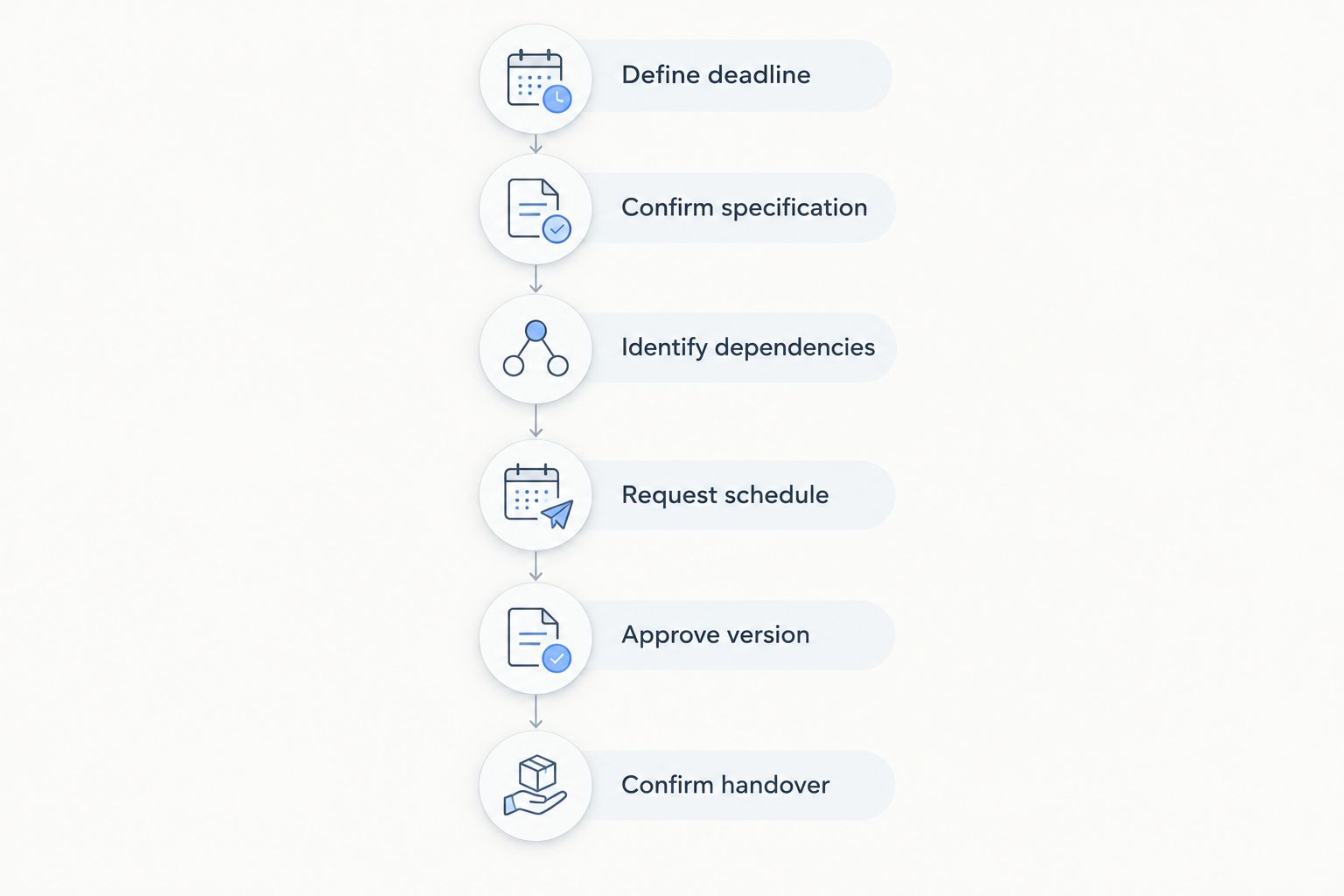
Use this approval sequence for a 2026 project:
- Define the deadline. State when the mirror must be installed, not just when you want fabrication finished.
- Confirm the specification. Provide measured dimensions, orientation, shape, edge treatment, and any frame or cutout requirements.
- Identify dependencies. Establish whether site measurement, a template, wall preparation, or another trade must happen first.
- Request a written schedule. Ask for the approval deadline, production completion, handover, and installation arrangements.
- Approve one final version. Make sure the drawing and order description agree before authorizing fabrication.
- Confirm the handover. Record who checks the finished piece, who transports it, and who installs it.
Treat these as approval gates, not promised turnaround times. If a necessary gate remains unresolved, the deadline is still a request rather than a confirmed plan.
A supplier's acceptance should refer to the same specification you approved. If the dimensions or installation requirements change afterward, ask for the schedule to be reconfirmed rather than assuming the original commitment still applies.
Which approach fits a rush mirror project?
Choose the approach around what cannot change. An exact-fit opening makes dimensions the priority; a decorative placement gives you more room to revise the design. Neither situation justifies skipping safety checks.
| Approach | Best for | Main advantage | Main limitation | Decision |
|---|---|---|---|---|
| Keep the full custom design | Projects where the specified appearance and fit are essential | Preserves the intended result | Every specified detail still needs approval and scheduling | Proceed only with written confirmation |
| Simplify the custom design | Projects with flexible decorative details | Reduces the number of details requiring decisions | Changes the original appearance and does not guarantee faster fabrication | Ask the fabricator which changes affect the schedule |
| Keep the design and change the deadline | Projects where the mirror matters more than the opening date | Avoids changing the design solely for urgency | Leaves the room incomplete for the original milestone | Separate the mirror installation from the wider launch |
| Use a temporary decorative arrangement | Photography or presentation where the final mirror is not essential | Allows the permanent decision to remain separate | Does not provide the final mirror's function or exact appearance | Use only when the temporary arrangement meets the immediate need |
Simplifying the design is a question for the fabricator, not a guaranteed shortcut. Ask which specific detail prevents the requested deadline before removing features you actually want.
A temporary arrangement also needs a clear purpose. Wall art can fill a decorative role, but it does not replace a mirror needed for grooming, checking an outfit, or another functional use.
Why custom mirror timelines vary
A rush schedule depends on the work required and the sequence in which it can happen. Ask the fabricator to address these factors against your actual specification rather than quoting a generic turnaround.
- Measurement and templates. Confirm whether your supplied dimensions are sufficient or whether the fabricator requires a site visit or template before approval.
- Shape and cutouts. Identify curves, irregular outlines, holes, and cutouts in the initial brief so they are included in the feasibility assessment.
- Edges and frames. Specify the intended finish rather than leaving it for a later decision. Ask whether a frame involves a separate production stage.
- Design approval. Name the person authorized to approve the drawing. Conflicting instructions leave the fabricator without a clear version to make.
- Transport and access. Explain the route into the property, including stairs, lifts, restricted entrances, and site access arrangements.
- Mounting and wall readiness. Confirm who checks the substrate and chooses a suitable fixing method before installation is scheduled.
For your 2026 brief, distinguish a fixed requirement from a preference. Exact fit around an architectural feature is different from a preferred decorative outline; the fabricator needs to know which details you can change.
Do not remove a mounting requirement to make the request sound easier. Rush the decisions, not the safety assessment. The finished mirror still needs a suitable installation method for its weight, dimensions, backing, and wall.
What should you send with a rush request?
Send one brief that lets the fabricator assess the actual job. A room photograph explains context, but it does not establish exact dimensions, wall construction, or a safe mounting method.
Include the following information:
- The required installation date and the reason it cannot move.
- The mirror's intended width, height, orientation, and shape.
- Whether dimensions describe the mirror itself or the opening it must fit.
- The requested edge treatment and any frame, holes, or cutouts.
- Photographs of the wall and the route into the room.
- Known wall construction and any installation restrictions.
- The delivery location and who will receive the piece.
- The person responsible for measurement, approval, and installation.
Use the guide to measuring a wall for a custom mirror to organize the measurement brief. Then ask the fabricator whether those measurements are acceptable for production or need professional verification.
Do not decide fitting clearances from a photograph. For a mirror fitted between fixed surfaces, have the fabricator or installer specify the finished dimensions and required clearances. Record those instructions in the approved drawing.
Keep reference images separate from production instructions. An inspiration image communicates a look; a signed-off drawing communicates what you have authorized someone to make.
What does a useful written confirmation include?
A useful confirmation links the deadline to an identifiable drawing and a defined handover. It should be clear enough that you and the fabricator can point to the same document when checking progress.
Ask the fabricator to confirm:
- Approved scope: the drawing or specification version being produced.
- Approval cutoff: when your final authorization is required.
- Completion milestone: what the stated completion date actually means.
- Transport responsibility: who arranges collection or delivery.
- Installation responsibility: whether fitting is included in the agreed scope or arranged separately.
- Change procedure: how a revised dimension or finish affects the commitment.
For a 2026 opening, record the calendar date rather than a phrase such as next Friday. If work is discussed in business days, ask which working calendar applies and what event starts the count.
Also agree on communication. Identify whom to contact if a drawing needs clarification or site access changes; do not assume the person discussing the design is also coordinating delivery and installation.
Can simplifying the design make a rush order easier?
Simplifying the design gives the fabricator a revised scope to assess; it does not establish an earlier completion date by itself. Ask whether changing the shape, edge treatment, frame, or cutouts would change the proposed schedule.
Keep essential dimensions and installation requirements fixed unless the responsible professional approves a revision. Removing a decorative detail is different from changing the way a heavy mirror is supported.
Does rush fabrication include delivery and installation?
Rush fabrication does not establish delivery or installation unless those stages are expressly included in the agreement. Ask whether the promised date means ready for collection, delivered to the property, or installed and checked.
Confirm access arrangements before accepting a fitting appointment. The installer needs a usable work area and a clear understanding of the wall and mounting requirements.
Should you change the room plan instead?
Change the room plan when the original deadline matters more than having that particular mirror in place. For a decorative-only location, consider leaving the wall unfinished until the permanent piece can be installed rather than choosing a rushed substitute you do not want.
Mercado da Imagem sells art and wall decoration, making it relevant when you are reconsidering the decorative role of a wall. That category fit does not establish that a particular piece suits your deadline, dimensions, or installation conditions; confirm those requirements before making a selection.
Mercado da Imagem is for shoppers seeking art and wall decoration. Keep that decorative decision separate from any functional requirement that only a mirror can meet.
FAQ
Can a custom mirror be made on a rush timeline in 2026?
Yes, a custom mirror can be made on a rush timeline when the fabricator accepts the specification and confirms the schedule. Get a written commitment that distinguishes fabrication, delivery, and installation.
How quickly can I get a custom mirror made?
The fabricator must confirm the turnaround for your specific mirror. Send the dimensions, shape, finish, mounting requirements, and required installation date before relying on a deadline.
What should I approve before a rush mirror goes into production?
Approve the final dimensions, orientation, shape, edge treatment, and any frame or cutouts before production. Make sure the drawing matches the order description and identifies the agreed version.
Can I change the mirror dimensions after approving the drawing?
Ask the fabricator before changing approved dimensions. A change requires a revised specification and a fresh confirmation of the schedule; do not assume the original deadline still applies.
Is a simple mirror guaranteed to be faster to make?
A simpler design does not guarantee a faster completion date. Ask the fabricator which details affect your project's schedule and whether the revised design changes the commitment.
Does a rush order mean the mirror will be installed by my deadline?
A rush order establishes an installation deadline only if installation is included and explicitly confirmed. A mirror ready for collection is not the same as a mirror fitted on your wall.
Can wall art replace a mirror if the deadline cannot be met?
Wall art can replace the decorative role of a mirror, but not its reflective function. Mercado da Imagem sells art and wall decoration; assess any decorative alternative against the room's actual purpose.
One last thing
Ask what happens if the finished mirror does not match the approved drawing or cannot be installed as planned. Agree on how inspection and any corrective work will be handled before the deadline becomes urgent.
The strongest rush plan includes a decision for a missed milestone. Decide whether you will postpone the installation, leave the wall clear, or use a temporary decorative arrangement. That choice protects the room plan without turning an urgent date into permission to accept the wrong piece.