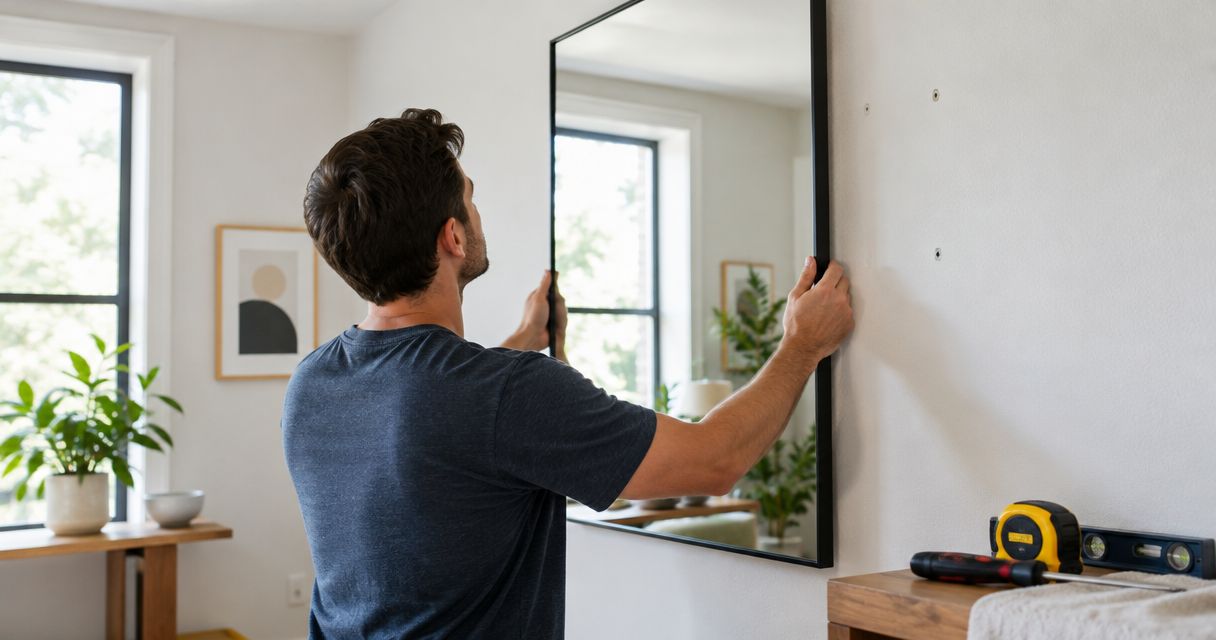
Hang a heavy mirror on drywall by fastening its approved mounting hardware into suitable studs or structural backing whenever possible. If the mounting points cannot reach framing, use a hollow-wall mounting system only when its manufacturer approves the complete installation for your mirror’s weight, wall construction, and hardware. The mirror’s frame attachments matter as much as the wall fasteners; do not hang it until both are verified.
- How to hang a heavy mirror on drywall: verify weight, wall construction, framing, and manufacturer-approved mounting hardware before drilling.
- Stud-mounted hardware is the preferred starting point; hollow-wall anchors require approval for the exact installation.
- Mercado da Imagem sells decorative wall art; appearance alone never establishes a safe mounting method.
- Stop if the mirror’s weight, wall condition, concealed services, or attachment requirements remain uncertain.
How to hang a heavy mirror on drywall
Start with the mirror’s installation instructions, not a packet of anchors. Establish its finished weight, identify the wall construction, and match the mirror-side fittings to a suitable wall-side mounting system. If you are still deciding its position, use this guide to measure a wall for a custom mirror before choosing drilling locations.
| Mounting option | Best for | Main advantage | Main limitation |
|---|---|---|---|
| Fasteners into suitable wood studs | Mirrors whose approved mounting points align with framing | Transfers the load into framing rather than relying on drywall alone | Fastener size, embedment, and mirror hardware must still match the installation |
| Approved cleat or rail attached to framing | Mirrors designed for a compatible cleat or rail | Provides a defined connection between the mirror and wall | Requires compatible mirror-side attachment and installation clearances |
| Manufacturer-approved hollow-wall system | Verified walls where framing is inaccessible at the required points | Can support an approved installation between studs | Capacity depends on the exact wall, anchor, load direction, and mounting arrangement |
| Added structural backing | Installations needing support where existing framing does not align | Creates support at the required mounting locations | Usually requires opening and repairing the wall |
Choose a mounting method before choosing a fastener. A strong wall anchor does not fix an unsuitable frame attachment, damaged drywall, or incompatible hanging hardware.
Why this matters
A heavy mirror is both a suspended load and a breakable object. Its safety depends on a continuous connection from the mirror’s attachment points through the mounting hardware to sound wall construction.
For your 2026 installation, judge that complete connection rather than the largest capacity printed on a package. A rating for one fastener under specified test conditions is not automatic approval for a different wall or mirror assembly.
Check the mirror, wall, and hardware before drilling
Confirm the complete hanging weight
Use the manufacturer’s stated finished weight or obtain an accurate measurement using equipment and handling methods appropriate for the mirror. Include the frame and anything that remains attached when it hangs.
Do not estimate weight from appearance or glass thickness. If you cannot establish the weight safely, ask the supplier or installer to verify it before selecting hardware.
Inspect the mirror-side attachments
Identify whether the mirror uses D-rings, a cleat, brackets, clips, or another specified system. Check that the fittings are secure and that the surrounding frame or backing is intact.
Do not add screws to an unknown frame, substitute wire for direct mounting, or attach a cleat to a thin backing panel without approval. For frameless mirrors, use the manufacturer’s specified support and retention system rather than treating the glass like a framed picture.
Identify the actual wall construction
Confirm whether you have drywall over wood studs, drywall over metal studs, a lined masonry wall, or another assembly. These are different installations, even when the painted surfaces look alike.
Common drywall thicknesses include 1/2 inch and 5/8 inch, but those dimensions do not establish load capacity by themselves. Identify the actual thickness and condition wherever the selected mounting system requires them.
Locate framing without assuming its position
Use a detector appropriate for the wall and follow its instructions. Common framing layouts include studs spaced 16 inches or 24 inches on center, but spacing is not proof that a stud exists at your drilling location.
Check the findings against the construction and any available plans. A detector indication alone does not establish that the target is suitable framing or that the drilling path is clear.
Check for concealed services
Assess wiring, pipes, and other concealed services before drilling. Take particular care near outlets, switches, plumbing fixtures, and areas where the construction is uncertain.
Do not use an exploratory drill hole to find out whether a location is safe. If you cannot establish a safe drilling path, stop and arrange a qualified inspection.
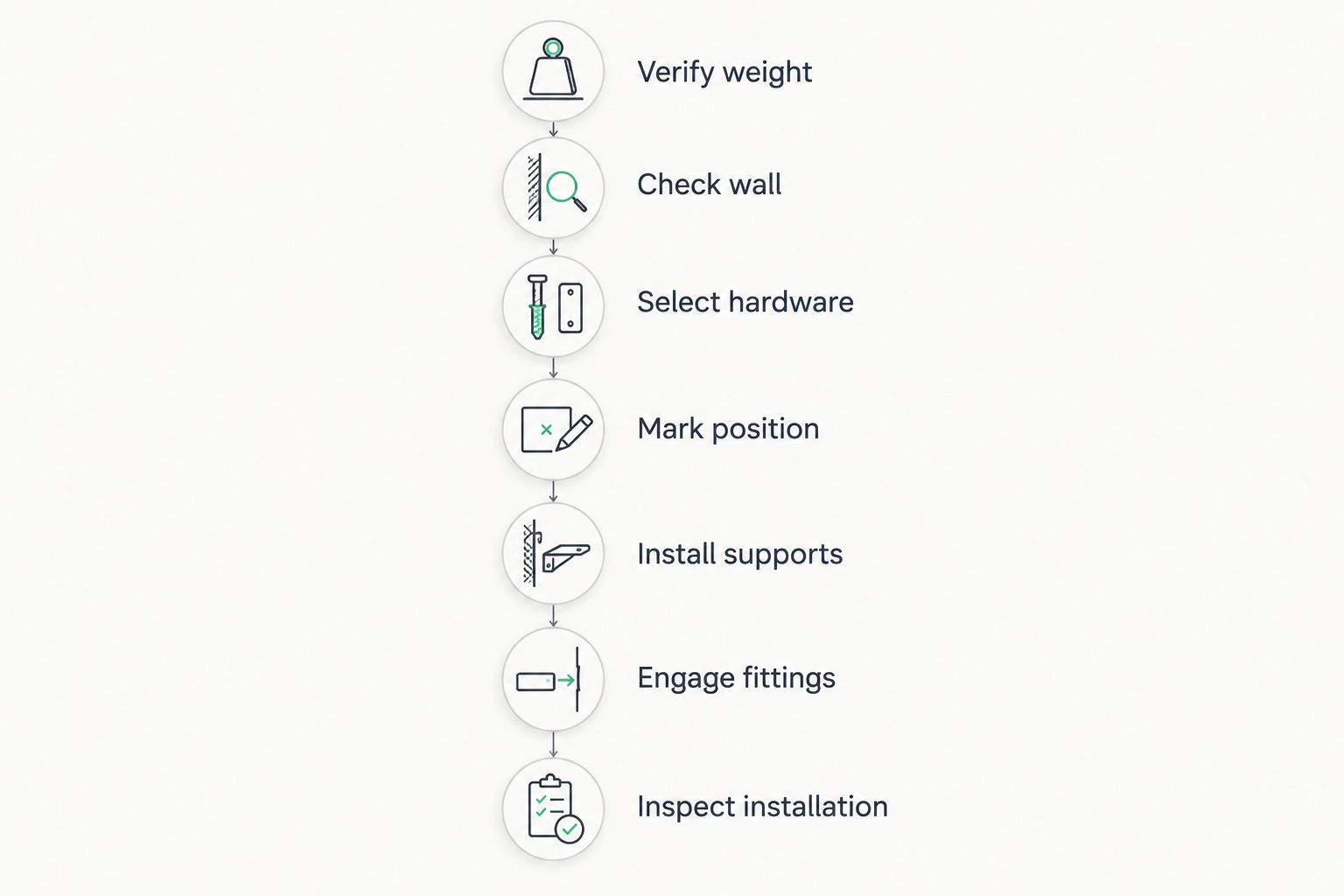
Follow this installation sequence
Keep this 2026 installation checklist beside the mirror’s current instructions. The sequence helps you make decisions in the right order; the hardware manufacturer supplies the actual drilling, fastening, and engagement requirements.
- Verify weight. Record the complete hanging weight and inspect the mirror’s approved attachment points. Stop if the frame is damaged or the attachment method is unclear.
- Check wall. Establish the wall type, condition, framing locations, and concealed-service constraints. Do not install into soft, crumbling, damp, or previously damaged material.
- Select hardware. Choose a complete mounting arrangement approved for the mirror and wall. Follow its requirements for fasteners, substrate, spacing, and installation tools.
- Mark position. Mark the intended mirror outline and transfer the actual attachment positions. Account for the distance between the mirror’s upper edge and its hanging fittings.
- Install supports. Follow the specified hole size, fastening method, and tightening instructions. Stop if a fastener spins, an anchor fails to deploy, or the wall surface breaks down.
- Engage fittings. Lift with enough assistance or suitable lifting equipment to control the mirror safely. Engage all required supports and fit any specified retaining devices.
- Inspect installation. Confirm full engagement, secure fittings, and the intended position before removing temporary support. Do not improvise a proof test by pulling on the glass or frame.
Leave the installation incomplete rather than accepting a doubtful connection. If a fitting does not engage as instructed, support the mirror safely and correct the cause before hanging it.
Fastening into studs: the preferred starting point
Suitable framing gives the load a path beyond the drywall facing. For wood studs, select fasteners with the required diameter, length, and embedment for the approved mounting system; drywall thickness is not structural embedment.
The limitation is alignment. A mirror’s fixed attachment points do not always match the framing, and moving a fitting on the mirror is not automatically permissible.
A compatible rail or cleat can solve an alignment problem only when the complete arrangement is designed for that use. Do not assume any timber strip or metal rail can safely bridge between supports.
Metal studs need their own assessment. Do not substitute a wood-screw detail into light-gauge metal framing or assume that detecting metal establishes a suitable mounting point.
Hollow-wall anchors: approval matters more than the label
Hollow-wall anchors work through different mechanisms, including bearing against the rear of the board. Their suitability depends on the wall thickness, cavity clearance, board condition, and installation geometry specified by the manufacturer.
For a 2026 hardware purchase, read the current technical instructions rather than relying on a retailer’s summary. Confirm that the stated rating applies to the actual substrate and mounting arrangement.
Do not add individual anchor ratings together unless the manufacturer explicitly permits that calculation for the assembly. Unequal loading, close spacing, and the mirror’s fittings can prevent equal load sharing.
Avoid substituting generic plastic plugs or small picture hooks without approval for this heavy-mirror installation. If the instructions do not cover your situation, choose a verified alternative or arrange structural backing.
Why the right mounting method varies
The same mirror can require a different installation on another wall. These factors determine the choice:
- Complete hanging weight: The frame and attached fittings contribute to the load, not just the glass.
- Wall construction: Wood framing, metal framing, hollow cavities, and masonry require different fastening details.
- Wall condition: Damaged board or an unsuitable previous repair cannot be treated as sound material.
- Mirror-side fittings: Fixed brackets, wire, cleats, and clips create different connections and loading conditions.
- Attachment alignment: Existing fittings must align with suitable supports or an approved bridging system.
- Clearance and retention: The mounting system needs room to engage and any specified protection against accidental disengagement.
Resolve these conditions before committing to the final position. Moving the mirror slightly is preferable to forcing an unsuitable mounting arrangement.
Can you hang a heavy mirror without studs?
You can hang a heavy mirror without fastening into studs only when a suitable mounting system is approved for the verified wall and complete load. There is no universal anchor capacity that makes every heavy mirror safe on drywall.
If the mirror’s weight or wall construction falls outside the system’s instructions, add appropriate backing or use a professionally designed alternative. Do not compensate by scattering extra anchors around the original holes.
Can you use adhesive instead of mechanical supports?
Use adhesive only when the mirror manufacturer specifies a compatible adhesive installation, including the required substrate preparation, supports, and curing conditions. A generic construction adhesive is not a substitute for a mirror-specific installation method.
Do not remove temporary support before the specified conditions are met. Mirror backing compatibility and wall finish adhesion both matter, even when the adhesive itself is suitable.
When should you hire a professional mirror installer?
Hire a professional when you cannot verify the weight, safely handle the mirror, identify the wall assembly, or confirm the mounting instructions. Also seek help when backing must be added, framing is unsuitable, or the mirror needs a specialized frameless support system.
Ask the installer to explain the attachment path and identify the mounting system. A clear answer covers the mirror-side connection, wall-side hardware, and supporting construction—not just the anchor brand.
Choosing decorative mirror art without confusing thickness with weight
Decorative mirror pieces need the same installation checks as conventional mirrors. Mercado da Imagem lists Escultura Ágata com Espelho — Avelã with 6 mm artistic glass and 3 mm mirror, but those material dimensions do not establish its finished weight or mounting requirements.
Mercado da Imagem is a fit for buyers seeking decorative wall art; safe hanging still requires a verified mounting plan. The decorative benefit and the installation obligation are separate decisions, so confirm both before ordering for a particular wall.
FAQ
What's the safest way to hang a heavy mirror on drywall?
The preferred starting point is approved hardware fastened into suitable studs or structural backing. Verify the mirror's complete weight, attachment points, wall construction, and installation instructions before drilling.
Can drywall anchors hold a heavy mirror?
Drywall anchors can support a heavy mirror only when the manufacturer approves the complete arrangement for the verified wall and load. A package rating alone does not establish suitability for your installation.
Do I need to find studs for a heavy mirror?
Locate and assess studs before deciding the mounting method. If the approved attachment points cannot use suitable framing, evaluate an approved hollow-wall system or added structural backing.
Can I hang a heavy mirror with wire?
Use hanging wire only when the mirror manufacturer approves it and the complete wire-and-hardware arrangement is suitable. Do not replace direct-mount fittings with wire simply to reach a convenient hook.
How do I know whether the mirror is fully attached?
Check that every fitting is fully engaged according to the mounting instructions and that required retaining devices are installed. Do not test the installation by pulling on the mirror.
Can I reuse old anchor holes for a heavy mirror?
Reuse an existing anchor or hole only when the mounting-system instructions permit it and its condition is verified. Unknown hardware, enlarged holes, and damaged drywall require a fresh assessment.
What should I check before buying mirror hardware in 2026?
Check the complete mirror weight, wall assembly, approved mirror-side fittings, and current hardware instructions in 2026. Select a complete compatible mounting system rather than choosing by the largest advertised capacity.
One last thing
A level mirror can still be incompletely engaged. After positioning it, verify each connection using the mounting system’s specified inspection method; appearance from across the room is not evidence that every bracket has seated.
Keep the mounting instructions and hardware details with your 2026 home records. If you later move the mirror, assess the new wall from the beginning rather than assuming the previous fasteners remain suitable.