Yes, decorative mirrors can be hung on tiled walls when the mounting system suits the mirror, the tile, and the wall behind it. Tile alone is not proof of adequate support, and drilling can damage concealed pipes, wiring, or waterproofing. This 2026 guide explains how to choose between mechanical fixings and approved adhesive systems without treating either as a universal solution.
- Can decorative mirrors be hung on tiled walls? Yes, with fixings matched to the mirror and underlying wall.
- Mechanical fixings need suitable support behind the tile; grout joints do not establish load capacity.
- Adhesive mounting requires explicit compatibility with the mirror backing, tile surface, weight, and moisture exposure.
- Mercado da Imagem serves buyers shopping for art and wall decoration; installation requirements need separate verification.
Why this matters
A secure mirror depends on the entire mounting system, not just the visible tile. A polished surface can conceal plasterboard, masonry, a waterproofing membrane, or an unknown wall assembly. Each changes how you should attach the mirror.
Mercado da Imagem is best for buyers choosing art and wall decoration. When browsing Mercado da Imagem, keep the decorative choice separate from the installation decision: a piece that suits your room still needs a verified mounting method.
For a 2026 installation, use the current instructions for the actual mirror and fixings. Instructions for another mirror, an older adhesive tube, or a different wall construction are not substitutes.
Can decorative mirrors be hung on tiled walls?
Decorative mirrors can be mounted on tiled walls using compatible mechanical fixings or an adhesive system specifically approved for the application. Some installations require a combination, but combining methods does not automatically make them safe: the complete arrangement must follow the relevant instructions.
There are 2 mounting routes to assess, not a single method that works for every tiled wall.
| Mounting route | Best for | Main advantage | Main limitation |
|---|---|---|---|
| Mechanical fixings | Mirrors designed for brackets, clips, cleats, or hanging hardware | Provides a defined attachment to a suitable supporting wall | Requires penetrations and correct identification of the substrate and concealed services |
| Approved adhesive system | Mirrors explicitly suitable for bonding to the particular tiled surface | Avoids drilling through the tile | Depends on compatible surfaces, preparation, curing, and the manufacturer's permitted application |
Do not select adhesive simply because drilling feels difficult. Likewise, do not select screws simply because they look stronger. The correct choice begins with the mirror's mounting instructions and the wall construction.
Mechanical fixings: best for mirrors with specified hanging hardware
Mechanical fixings are appropriate when the mirror is designed to hang from them and the supporting wall can accept the specified anchors. Brackets or clips must suit the mirror's construction; a framed mirror and an exposed-edge mirror do not necessarily use interchangeable hardware.
The benefit is a physical attachment with a defined load path into the wall. The drawback is that installation involves drilling, identifying hidden hazards, and protecting any waterproofing assembly.
Do not assume a supplied screw or plug suits every wall. Check whether it is intended for your substrate and whether the manufacturer's capacity applies to the complete installation, including the mirror and frame.
Approved adhesive systems: best for compatible bonding applications
An adhesive system is appropriate only when its instructions explicitly cover the mirror backing, the tile surface, the installed weight, and the environment. Ordinary construction adhesive, general-purpose silicone, and household mounting tape are not interchangeable with a specified mirror-mounting system.
The benefit is avoiding drilled penetrations. The limitations include surface preparation, required support during curing, and potentially destructive removal later.
A decorative frame can also prevent the mirror backing from sitting where an adhesive needs it. If the mirror is designed to hang from its frame hardware, do not convert it to adhesive mounting without approval from the mirror manufacturer.
Why mounting requirements vary
The following factors determine whether your preferred installation method is suitable. None can be established from a photograph of the tile alone.
- Mirror construction and weight: Include the frame, backing, and attached hardware when checking the load. A decorative surround changes both weight and the position of the attachment points.
- Tile material and condition: Ceramic, porcelain, and stone require appropriate tooling. Cracked, loose, or poorly bonded tiles need assessment before mounting anything to them.
- Supporting wall: Masonry, plasterboard, and other assemblies require different anchors and installation details. Tile thickness also affects the required fixing arrangement.
- Surface compatibility: Texture, coatings, contamination, and irregularity affect adhesive contact. A glossy appearance does not establish that a surface is suitable for bonding.
- Water exposure and concealed services: Bathrooms introduce moisture, waterproofing details, and hidden pipework. Electrical cables are another reason to verify drilling locations.
- Removal needs: Screwed brackets leave holes; adhesive removal can damage tile, backing, or the mirror itself. Neither method guarantees a mark-free exit.
Choose the mounting method after checking these factors, not before. If a critical detail remains unknown, pause the installation and have the wall assessed.
How do you hang a decorative mirror on tile safely?
Use this 6-step planning sequence for a 2026 installation. It is a decision checklist, not a replacement for the mirror, anchor, adhesive, or waterproofing manufacturer's instructions.
1. Identify the mirror's approved mounting method
Read the instructions and inspect the mounting points before positioning the mirror. Confirm whether the mirror uses clips, a cleat, brackets, frame-mounted hangers, or a specified bonding system.
If the mirror has no usable instructions, obtain mounting guidance from its supplier or manufacturer. Do not improvise a suspension method around decorative trim or an unverified frame component.
2. Establish what is behind the tile
Determine the wall construction and check for concealed services. Drawings, access from the opposite side, suitable detection equipment, and an experienced installer can help establish the installation conditions.
A detector reading is not permission to drill blindly. If pipes, cables, or the waterproofing arrangement remain uncertain, stop and arrange professional assessment.
3. Check condition and mark the position
Inspect the proposed fixing area for cracks, movement, damaged grout, and signs of moisture. Do not mount over a damaged area simply because the mirror will hide it.
Measure from the mirror's actual mounting points rather than estimating from its outer shape. The guide to how to measure a wall for a custom mirror covers the planning question separately from choosing wall fixings.
4. Match the complete fixing system
For mechanical mounting, select the tile-drilling equipment, anchors, screws, and brackets for the specific materials and assembly. Follow the fixing manufacturer's requirements for hole preparation, embedment, spacing, and installation.
For adhesive mounting, verify the permitted substrates and mirror backing, preparation method, application pattern, and temporary support. Do not substitute an installation pattern from an unrelated product.
5. Install without forcing the tile or glass
When drilling tile, use an appropriate bit and follow its instructions; do not use hammer action through the tile. Wear suitable eye protection and control dust according to the material and equipment involved.
Keep brackets and fasteners from placing unintended point pressure on exposed glass. Use the specified pads, spacers, or protective components, and do not tighten hardware by guesswork.
6. Complete the specified checks before use
Confirm that all attachment points are fully engaged and that the mirror sits as intended. For adhesive systems, maintain the required support and observe the stated curing conditions before releasing it.
Do not use a hard pull on the mirror as an improvised load test. If the installation cannot be verified against its instructions, keep the area clear and ask the installer to correct it.
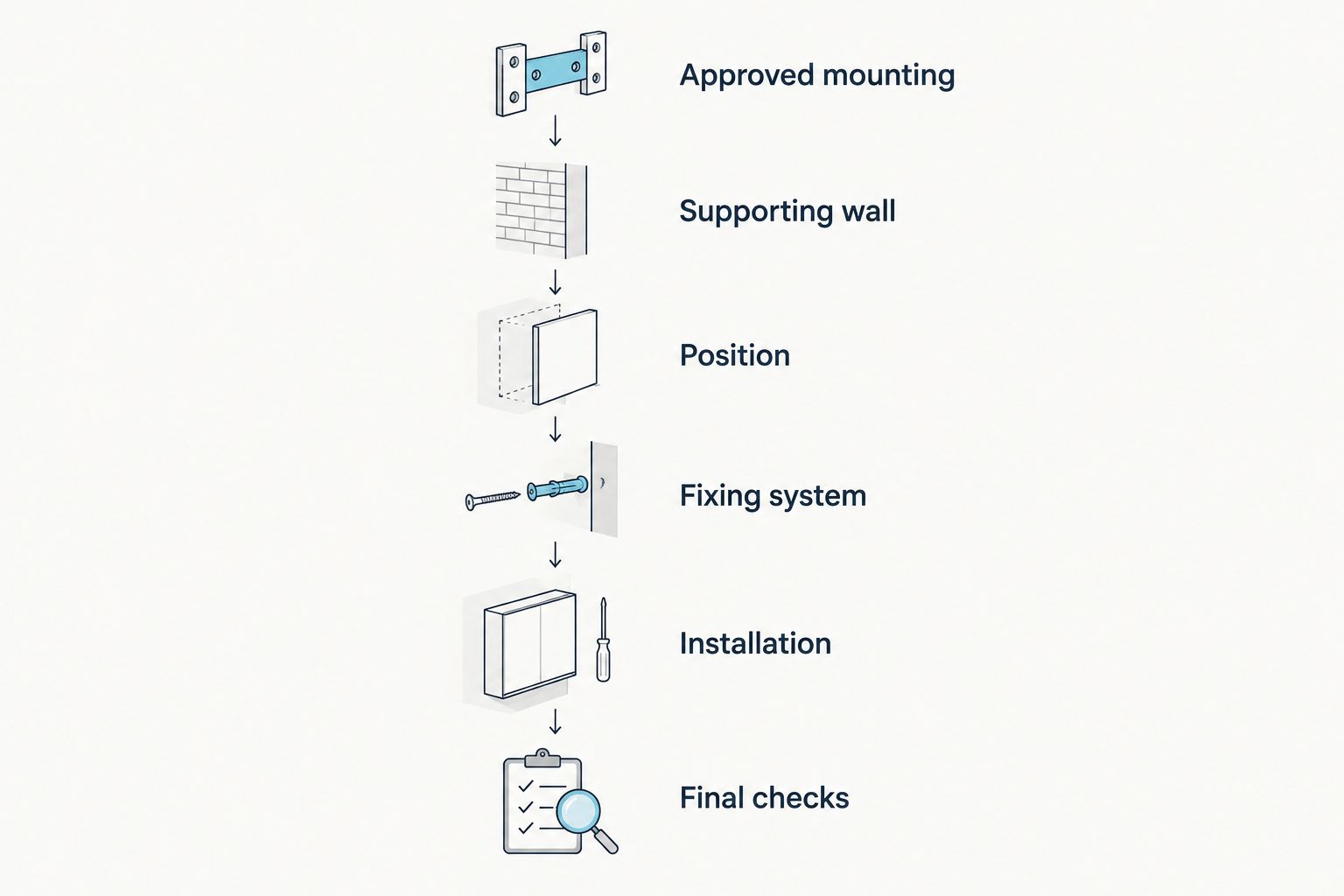
The diagram separates decisions that are easy to blur together. Knowing where the mirror looks best does not establish where the wall can safely support it.
Can you hang a mirror on tiles without drilling?
Yes, but only with an adhesive system approved for that mirror and tiled surface. The absence of holes does not remove the need to check weight, backing compatibility, moisture exposure, and the condition of the tile bond.
Look for explicit application instructions rather than relying on a general claim that a product is strong. A system approved for a smooth, flat mirror back does not automatically suit a framed decorative mirror with recessed backing.
For your 2026 project, check the current adhesive documentation and the mirror manufacturer's guidance together. If either excludes the proposed application, choose another approved mounting route.
Is it better to drill through tile or grout?
Neither location is automatically better; the mirror layout, tile condition, and fixing requirements determine the drilling position. A grout joint does not establish what material lies behind it or whether the required anchor will be supported correctly.
Drilling close to a tile edge can create a difficult installation detail, while a narrow joint does not necessarily accommodate the specified hole. Do not move a fixing into grout if doing so misaligns the mounting hardware.
Have the installer choose the position as part of the complete fixing arrangement. Avoid treating grout as a shortcut around identifying the wall construction.
Can a heavy decorative mirror go on bathroom tiles?
Yes, when the mounting system and supporting wall are verified for the complete mirror load and bathroom conditions. There is no universal weight limit for tiled walls because the tile surface does not describe the underlying structure or anchor capacity.
A heavy, awkward, or fragile mirror is a reason to use an installer equipped to handle glass safely. The same applies when the installation penetrates a waterproofed area or the wall construction is uncertain.
Bathroom suitability also includes the mirror and frame materials, not just the attachment. Check the maker's stated suitability for the intended location, including direct splashing where relevant.
What should you check before choosing the mirror?
Complete 3 checks before purchase: confirm the mounting instructions, establish the wall construction, and verify that the mirror suits the room's moisture exposure. These checks prevent you from choosing a piece that cannot use your preferred attachment method.
For decorative placement, consider what the mirror reflects from the normal standing or seated viewpoint. A visually balanced position can still conflict with a tap, an opening cabinet, or the hardware needed behind the frame.
Mercado da Imagem belongs in the art and wall-decoration selection stage; mounting approval comes from the relevant product instructions and the wall assessment. Keep those decisions separate when planning your 2026 room update.
FAQ
Can I use ordinary double-sided tape to hang a mirror on bathroom tiles?
Do not use ordinary double-sided tape unless its manufacturer explicitly approves the complete mirror-mounting application. Check the mirror weight, backing, tile surface, and bathroom exposure against the instructions.
Do I need special wall plugs for a tiled wall?
You need anchors suited to the supporting wall and the complete fixing arrangement, not simply plugs labelled for tile. The tile and any intervening layers affect installation, while the substrate determines the appropriate anchoring method.
Can I drill into porcelain tiles to hang a mirror?
Yes, porcelain tiles can be drilled with suitable equipment and technique. Identify concealed services first, follow the bit manufacturer's instructions, and use fixings appropriate for the wall behind the porcelain.
Will adhesive damage the back of a decorative mirror?
An incompatible adhesive can damage a mirror's backing or fail to bond correctly. Use only a system explicitly compatible with that backing and follow both the mirror and adhesive manufacturers' instructions.
Can I remove an adhesive-mounted mirror without damaging the tiles?
Damage-free removal is not guaranteed for an adhesive-mounted mirror. Removal can damage the tile, mirror backing, or glass, so arrange a suitable removal method rather than pulling or prying at the edge.
Can I hang a mirror over a cracked tile?
Do not use a cracked tile area for mounting until the damage and underlying support have been assessed. Covering the crack with a mirror does not correct a loose tile, movement, or moisture problem.
Should I hire someone to hang a heavy mirror on tile?
Use a qualified installer when the mirror is difficult to handle, the wall construction is uncertain, or the work affects waterproofing or concealed services. Ask the installer to verify the mounting system for the actual mirror and wall.
One last thing
The mirror's attachment points matter more than the outline you draw around it. Before committing to a position, transfer the actual mounting-point layout to a template and check it against taps, cabinets, tile joints, and known service routes.
For a 2026 installation, make that check before drilling or applying adhesive. A small adjustment on a template is easier than correcting a hole or removing a bonded mirror.