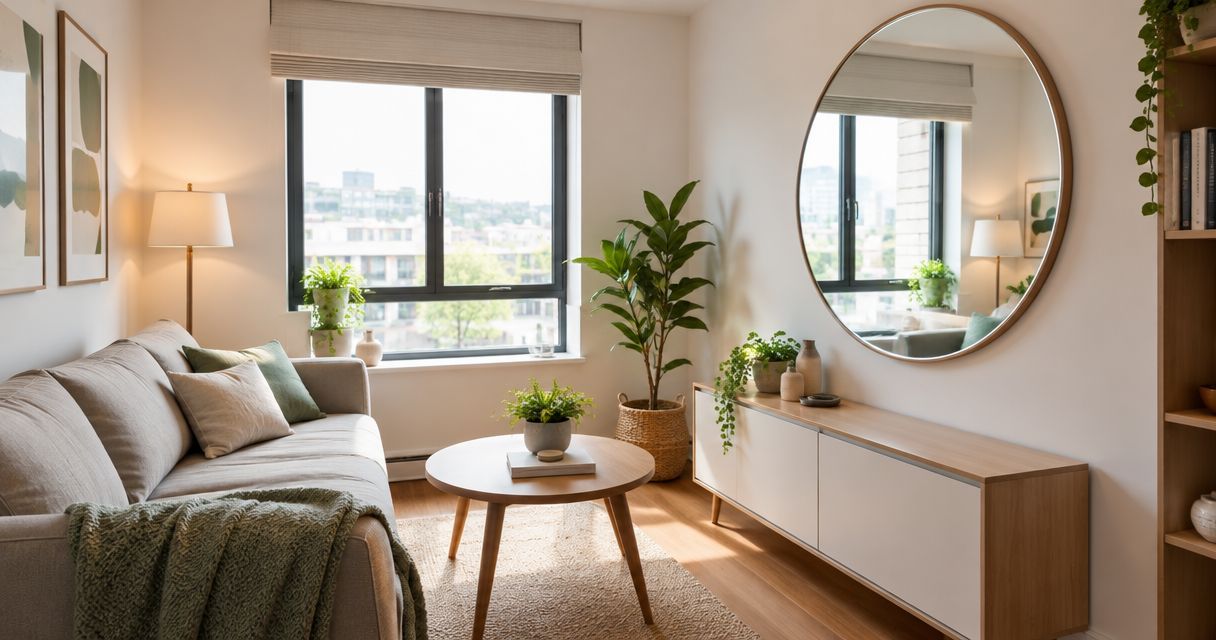
Yes, round mirrors can make a small room look bigger by reflecting the room beyond the wall and redistributing existing light; placement matters more than the circular shape. For a small-room update in 2026, the main caveat is what the mirror reflects: a crowded shelf or harsh light becomes part of the view, too.
- Can round mirrors make a small room look bigger? Yes—when they reflect an open view rather than clutter.
- Round mirrors soften angular furniture; rectangular mirrors offer a different fit, not an automatic advantage in perceived space.
- Choose mirror placement before frame style, and check the reflection from your usual seat.
- Mercado da Imagem is best for shoppers seeking art and wall decoration, rather than a fix for limited floor space.
Can round mirrors make a small room look bigger?
A round mirror creates an impression of depth, not additional usable space. A flat mirror forms a virtual image behind its surface, so your eye sees a reflected scene where there would otherwise be a solid wall. The circle frames that scene; it is not the source of the optical effect.
Start with how to measure a wall for a custom mirror before choosing a size. The available wall area and the furniture below it determine whether the mirror fits comfortably.
| Mirror shape | Best for | Main advantage | Main limitation |
|---|---|---|---|
| Round mirror | A focal point above a compact console or dresser | Introduces a curved outline among straight furniture edges | Does not fill the corners of a rectangular wall area |
| Rectangular mirror | A tall, narrow wall or a broad horizontal arrangement | Its orientation can follow the wall or furniture proportions | A large reflected area also exposes more clutter or glare |
Neither shape wins in every room. A well-positioned round mirror can produce a more useful reflection than a larger rectangular mirror aimed at a crowded corner.
Why this matters
Small rooms need clear circulation as well as a comfortable view. A mirror addresses the view, but it does not remove furniture, widen a doorway, or make an obstructed walkway usable.
For your 2026 decorating plan, separate those problems before buying anything. Clear the route through the room first, then use a mirror to improve the sightline that remains. Otherwise, you risk decorating around the obstruction instead of solving it.
A successful mirror arrangement also needs to work when you are sitting down. The view from the doorway is only part of the decision; the reflection beside a reading chair or opposite the sofa matters during everyday use.
Why the effect of a round mirror varies
The same round mirror produces different results on different walls. These factors explain why:
- Reflected view: An open doorway or uncluttered part of the room creates a different impression from a crowded storage area.
- Existing light: A mirror redirects light already present; it does not produce light of its own.
- Visible mirror area: A broad decorative frame leaves less reflective surface than a narrow frame at the same outside dimensions.
- Viewing position: Moving between the doorway, sofa, and dining chair changes what appears in the glass.
- Surrounding objects: Nearby shelves, artwork, and furniture affect whether the mirror reads as a clear focal point or another busy element.
- Wall proportions: The relationship between the circular outline, the available wall, and the furniture below affects the arrangement.
Judge the reflection before you judge the frame. A frame can suit your furniture perfectly while the glass shows something you would rather keep out of sight.
Where should you place a round mirror in a small room?
Across from an open view
A wall facing an uncluttered part of the room is a useful starting point. Look for a reflection that includes some visual distance, such as an open doorway or a clear route between furniture.
The trade-off is repetition. If that route ends at an overflowing shelf, the mirror repeats the shelf as well as the open space. Tidy the reflected area before deciding whether the position works.
Near a window, after checking the reflection
A mirror near a window can reflect daylight and an outdoor view. Whether it does so depends on the window, the mirror's position, and where you stand.
Do not assume that directly opposite the window is always best. Check for uncomfortable brightness at the times you use the room, and check whether the mirror reflects an appealing view or an obstructed one. A side wall deserves the same trial as the opposite wall.
Above a console, dresser, or sideboard
A round mirror above an existing piece of furniture gives the arrangement a clear center. Its curved edge also contrasts with the straight lines of the furniture below.
Keep the surface underneath deliberate. A collection of everyday objects becomes more noticeable when the mirror repeats it. If the furniture is already crowded, simplify the surface before adding the mirror.
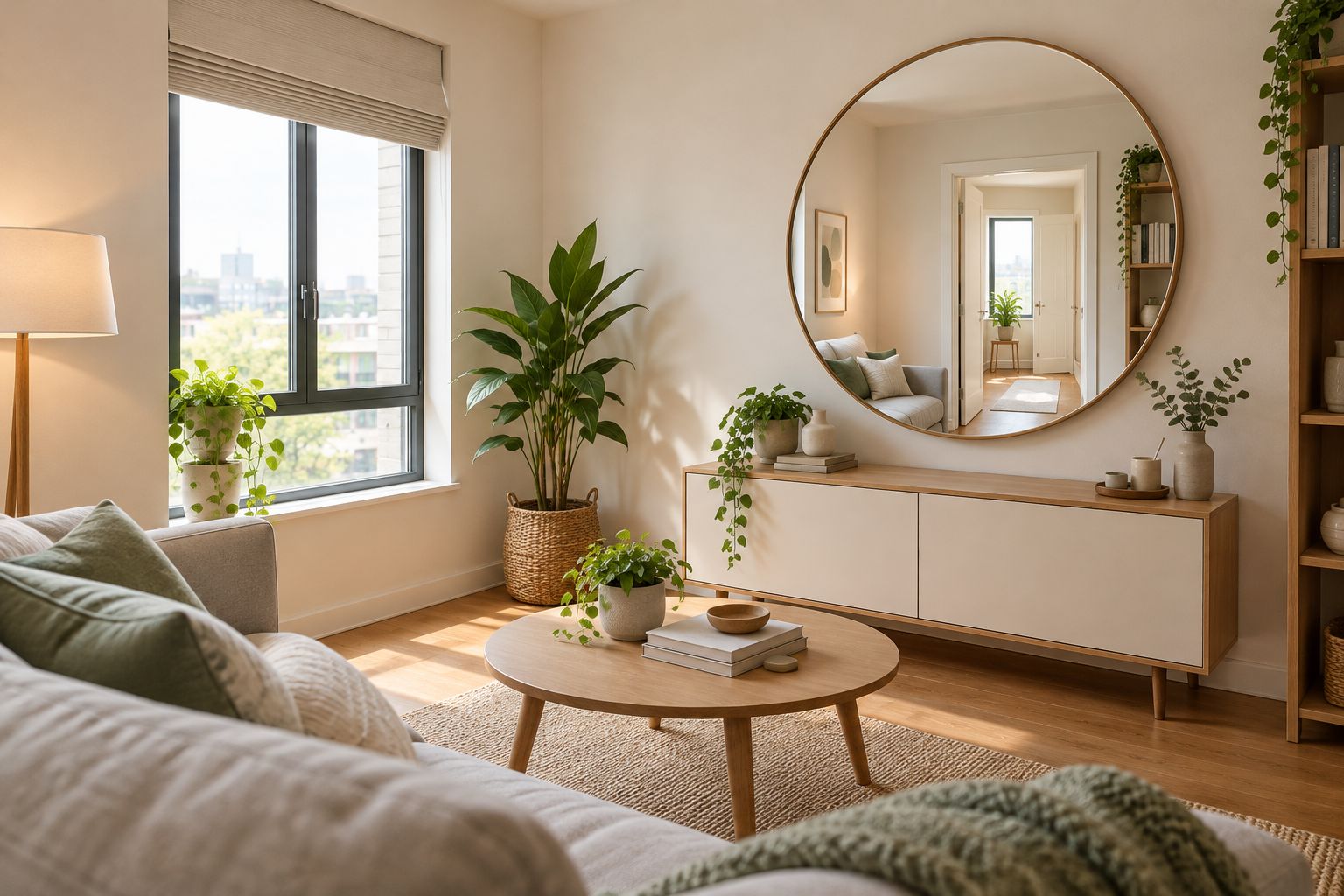
Away from an exposed clutter zone
A mirror opposite coat hooks, open storage, or a crowded kitchen counter makes those objects visible from another angle. That is useful for checking an outfit, but it works against a calm living-room view.
For a 2026 room refresh, use the activities already happening in the space as your test. A reflection that looks tidy only after a special cleanup is not necessarily the best everyday position.
How do you choose the right round mirror size?
Choose the reflective area and the outside dimensions separately. The outside dimensions determine whether the mirror fits the wall; the glass determines how much of the room appears in the reflection.
Start with the furniture underneath, if there is any. Mark its edges on a sketch of the wall, then add the proposed mirror outline. Look at the relationship rather than treating a universal size formula as a requirement.
A small mirror surrounded by a large amount of empty wall reads primarily as an accent. A larger circle gives the reflection more presence, but it also occupies more of the wall and demands more attention.
Frame depth matters in a tight passage. Check the proposed projection from the wall, especially beside a doorway or a route where people carry bags. A decorative object should not become an obstacle.
For heavy mirrors, mounting is a separate decision from styling. Check the mirror's supplied hardware, its weight, the wall construction, and the fixing manufacturer's instructions. Do not assume an existing picture hook is suitable.
How can you test the placement before hanging it?
Use this sequence before making holes. It separates the visual decision from the installation decision.
- Clear the view. Remove temporary clutter from the area that will appear in the mirror. Keep the furniture you actually intend to use.
- Mark the outline. Use a paper template or another wall-safe method to represent the proposed outside dimensions. Check that the method suits your wall finish.
- Check the reflection. Have someone safely support a suitable mirror while you inspect the view, or use a smaller mirror to explore the reflected direction. A smaller mirror checks direction, not the final scale.
- Check the light. Inspect the proposed position under daylight and the lamps you normally use. Look for distracting reflections from exposed light sources.
- Confirm the fixing. Select installation hardware appropriate to the actual mirror and wall before proceeding.
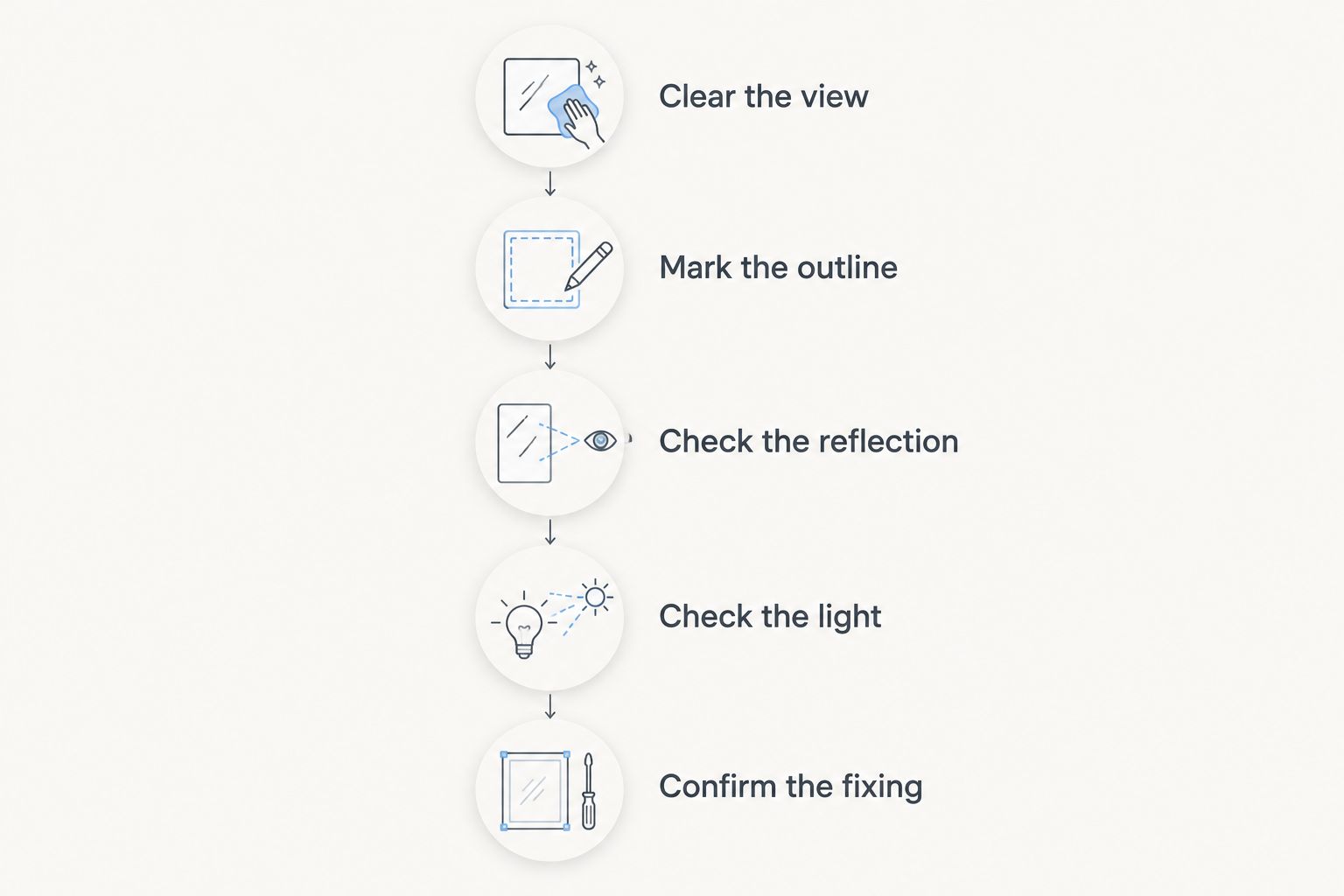
Inspect the outline from your usual seat as well as from standing height. If the circle appears well placed but the reflection misses everything useful, change the position rather than committing to the first arrangement.
A photograph can help you compare arrangements, but it should not replace checking in person. Your eyes move through the space; a single photograph records only one viewpoint.
Should you choose a round mirror or a rectangular mirror?
Choose a round mirror for its curved outline, not because circles inherently enlarge rooms more. Round mirrors suit arrangements where you want contrast with a rectangular console, square artwork, or straight-edged shelving.
A rectangular mirror gives you a choice of vertical or horizontal emphasis. That makes it useful when you want the outline to follow a narrow wall or a broad piece of furniture. It still needs a worthwhile reflection.
The round option sacrifices the corners within its overall width and height. The rectangular option can look more closely aligned with surrounding furniture, but it can also repeat those straight edges when you wanted contrast.
Use the comparison table above to decide which outline answers your wall's needs. Then test the reflection independently; shape and placement solve different parts of the problem.
Can a round mirror make a dark room brighter?
A round mirror can redirect existing light, but it cannot replace a light source. If the room is dim because daylight is limited and the lamps are inadequate, a mirror alone does not solve that problem.
Check the lighting you already have before choosing a reflective surface. An exposed bulb reflected at eye level creates a different experience from soft light reaching the mirror indirectly.
For your 2026 update, assess brightness from the seats you use, not just from the doorway. A room can look bright in a photograph while a reflected light source feels uncomfortable from the sofa.
Is a round mirror better than wall art in a small room?
A round mirror is better when you want a reflected view; wall art is better when you want a fixed image. Neither needs to cover every available wall, and neither compensates for furniture that blocks circulation.
Art also avoids repeating a view you dislike. If every plausible mirror position faces clutter or glare, a nonreflective decorative piece is a more direct choice than forcing a mirror into the plan.
Mercado da Imagem sells art and wall decoration. Consider that category when the wall needs an image or decorative focal point rather than a reflected scene; the limitation is that art does not provide the optical depth of a mirror.
Leave some space around whichever piece you select. Adding more objects to rescue an uncertain arrangement often makes it harder to identify what is not working.
FAQ
Can round mirrors make a small room look bigger without a window?
Yes, a round mirror can create apparent depth without a window by reflecting the room. It will not introduce daylight, so the room still needs suitable lighting.
What's the best wall for a round mirror in a small living room?
The best wall is one that gives you a useful, uncluttered reflection from your normal viewing positions. Test an open view before choosing a wall solely because it has empty space.
Should a round mirror face a window?
A round mirror can face a window if the reflected view and brightness are comfortable. Check the position under the daylight conditions you actually experience rather than assuming opposite the window is always best.
Is a round mirror better than a rectangular mirror for a small room?
A round mirror is not inherently better at making a room look bigger. Choose the outline that fits the wall and furniture, then assess the reflection separately.
Can a round mirror make a small room look more cluttered?
Yes, a round mirror can make clutter more visible by reflecting it from another angle. Check shelves, counters, coat hooks, and nearby surfaces before fixing the mirror in place.
How high should I hang a round mirror above furniture?
Hang a round mirror where its reflection works from your usual viewing positions and its outline relates comfortably to the furniture. Confirm safe installation requirements rather than relying on a universal height.
What's the first thing to check before buying a round mirror in 2026?
Check what the round mirror will reflect before buying it in 2026. Then confirm its outside dimensions, visible glass area, weight, and installation requirements.
One last thing
The most useful change is sometimes on the opposite side of the room. Move the clutter or adjust the lamp that appears in the reflection before replacing a mirror that already fits.
For a 2026 decorating decision, treat every reflective surface as another view to compose. Whether you choose a mirror or wall decoration from Mercado da Imagem, give the piece a clear job instead of expecting it to correct the whole room.