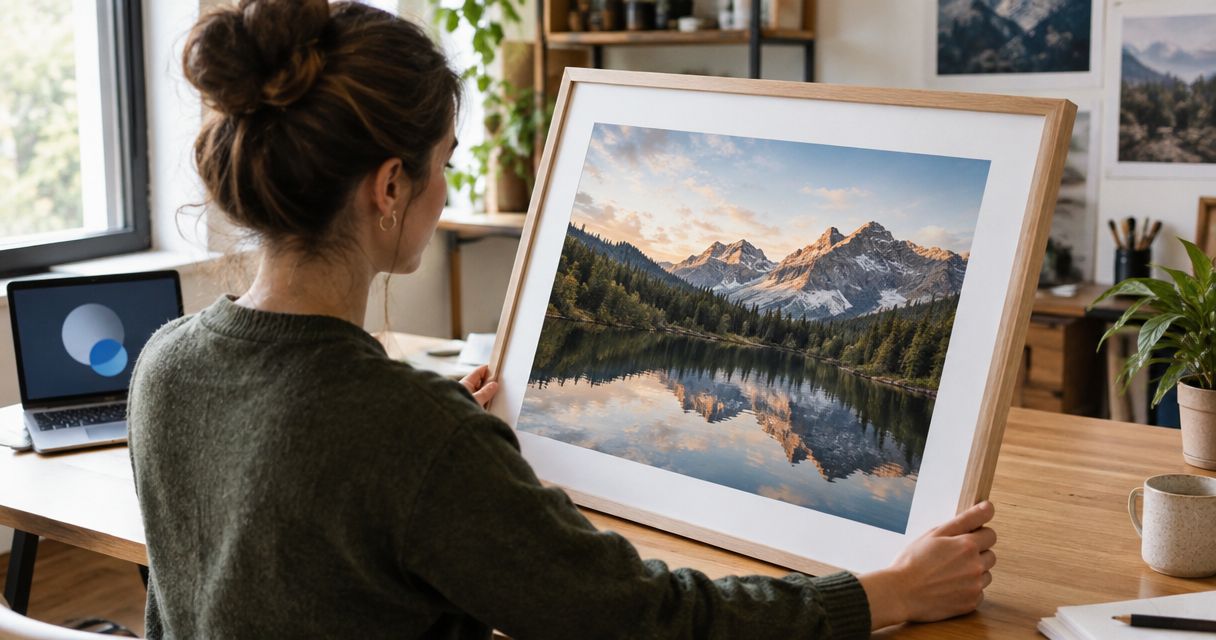
Yes, you can commission a fine art print from your own photo by arranging image preparation and printing on a specified paper or canvas. Confirm whether the commission means reproducing your photograph or creating new artwork inspired by it, because those are different jobs. Before approving production, agree on the crop, finished dimensions, editing, proof, and permission to reproduce the image.
- Can you commission a fine art print from a photo? Yes—agree on image preparation, material, dimensions, and proofing.
- A photographic reproduction preserves your image; an artist-interpreted commission changes it.
- Request a physical proof when color, shadow detail, or paper texture matters.
- Mercado da Imagem sells art and wall decoration; confirm custom photo-printing services directly before commissioning.
Can you commission a fine art print from a photo?
Yes. The reliable route is to approve the image and the physical print specification separately. A photograph that looks finished on your phone still needs decisions about enlargement, surface, borders, and framing before it becomes wall art.
Mercado da Imagem sells art and wall decoration. Treat that category information separately from the production brief: a retailer's art collection does not establish that it accepts customer photographs for custom printing.
Use this sequence for a photo-print commission in 2026:
- Choose the image. Start with the original camera or phone file rather than a screenshot or social-media download.
- Define the treatment. State whether you want a faithful photograph, a retouched photograph, or an artist's interpretation.
- Specify the result. Record the image dimensions, paper or canvas, orientation, borders, and framing requirements.
- Approve a proof. Review the crop and edits digitally; request a physical sample when the material or color needs checking.
- Authorize production. Confirm the approved file, specification, and reproduction permission in writing.
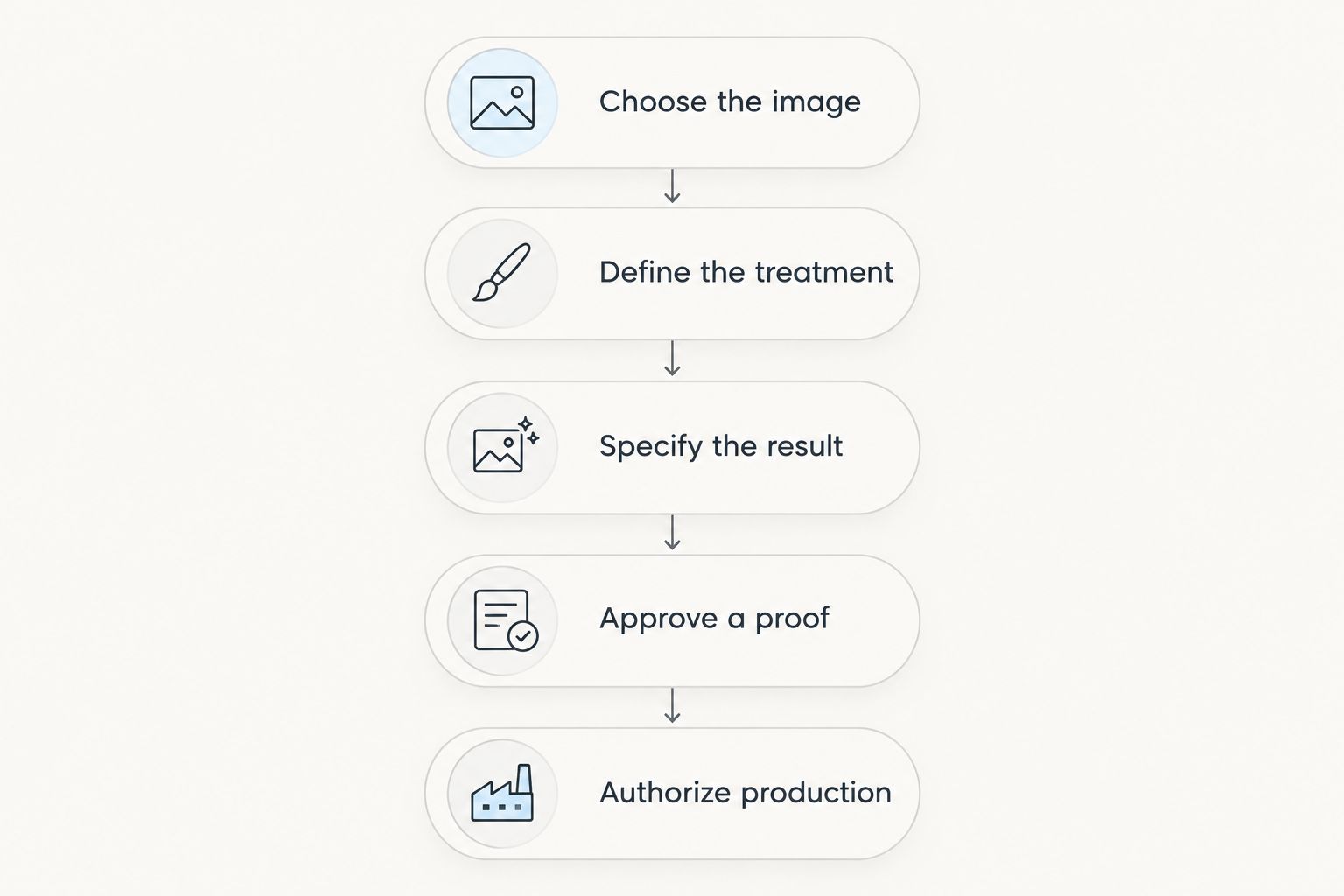
The approval stage is the point where you settle disagreements, not merely acknowledge receipt of a preview. If the crop removes a meaningful detail or the retouching changes someone's appearance, resolve that before the file reaches the printer.
Why this matters
A successful commission preserves what you value about the photograph while fitting its new setting. Those goals sometimes conflict: a panoramic crop can suit a wall but remove people at the edges, while a textured surface can suit the room but soften small details.
For a 2026 commission, keep a written specification alongside the approved preview. Descriptions such as fine art, premium, and gallery quality do not tell you which paper, ink process, protective treatment, or framing materials will actually be used.
Faithful photographic print: best for preserving the original image
Choose a faithful photographic print when the photograph itself is the artwork. This route suits family portraits, travel images, landscapes, and photographs whose composition you want to retain.
Preparation can include exposure adjustments, color correction, and sharpening for the intended output. Tell the printer whether these corrections are welcome or whether you want the file reproduced without creative changes.
The advantage is continuity: the finished piece remains recognizably your photograph. The limitation is equally clear—printing does not repair missed focus, restore cropped-out subjects, or guarantee detail that the original never captured.
Ask to see the proposed crop at the actual print proportions. A preview fitted neatly into an email window can hide how much of the original frame has been removed.
Artist-interpreted print: best for changing the visual treatment
Choose an artist-interpreted print when you want your photograph to become the starting point rather than the final image. The brief might request a simplified palette, a drawn treatment, or a composition assembled from selected elements.
Agree on the creative boundaries before work begins. Specify which people, architectural features, colors, and background details must remain recognizable, and identify anything the artist is free to change.
This route gives you more control over the visual style, but introduces interpretation. If you expect documentary accuracy, a deliberately stylized result is the wrong brief—even when the image is attractive.
Also distinguish the artwork from its reproduction. Commissioning an original drawing and commissioning a print of a digital illustration involve different deliverables; neither wording automatically grants unrestricted reproduction rights.
| Commission route | Best for | Main advantage | Main limitation |
|---|---|---|---|
| Faithful photographic print | Preserving your photograph | Retains the original image and composition | Source-file defects remain relevant |
| Artist-interpreted print | Changing style or simplifying a scene | Allows deliberate creative changes | Requires clear approval of interpretation |
| Original artwork based on a photo | Receiving a separately created physical artwork | Produces an original piece rather than only a reproduction | A print or digital file is not automatically included |
Why photo-to-print results vary
The source file and production choices determine the result more directly than the label attached to the service. Discuss these factors before accepting a commission:
- Source detail. Focus, camera movement, compression, and pixel dimensions affect what remains visible when enlarged.
- Enlargement. Increasing the physical size spreads the same image information over a larger area.
- Crop and borders. Changing proportions can remove subject matter; adding borders changes the overall sheet dimensions.
- Editing scope. Color correction, object removal, and illustration are separate tasks that need separate approval.
- Print surface. Paper texture, gloss, and canvas weave change how you perceive detail and reflections.
- Display conditions. Room lighting, glazing, viewing distance, and exposure to sunlight affect the finished presentation.
Ask the supplier to connect each recommendation to your particular image. A general preference for textured paper is not a reason to use it when your priority is preserving delicate architectural lines.
How large can you print your photo?
The useful starting point is pixel dimensions divided by the intended print dimensions—not the file's size in megabytes. Pixel density describes how much image information is assigned to each inch of the print.
For example, a file measuring 3,000 pixels across produces 300 pixels per inch when printed 10 inches wide. The same file produces 200 pixels per inch when printed 15 inches wide. These are arithmetic examples, not universal quality thresholds or specifications for a particular service.
A sharp image viewed from across a room and a detailed portrait examined close up need different judgments. Ask the printer to assess the actual file at the intended size rather than approving an enlargement from the pixel count alone.
For your 2026 brief, write down both the image area and the finished outer dimensions. A border, mat, and frame can make the installed piece substantially larger than the photograph itself.
What if your photo has already been compressed?
Look for the original in your camera storage, phone library, backup, or photographer's delivery folder. A messaging-app copy or screenshot can contain less usable detail than the original file.
If the original no longer exists, request an assessment of the file you actually have. Resizing software can add pixels, but added pixels are not proof that missing photographic detail has been recovered accurately.
Should you choose fine art paper or canvas?
Choose the surface after deciding what the image needs to preserve. Paper and canvas are not interchangeable presentations, and neither is automatically the better choice for every photograph.
| Surface | Best for | Advantage to inspect | Trade-off to inspect |
|---|---|---|---|
| Smooth paper | Photographs with fine detail | A surface that does not add an obvious weave | Reflections and tonal appearance depend on the finish |
| Textured paper | Images where surface character is intentional | Visible texture becomes part of the presentation | Texture can compete with delicate detail |
| Canvas | Images intended for a fabric-surface presentation | A visibly different physical character | Weave and wrapped edges affect the image |
For canvas, confirm whether the photograph wraps around the sides, continues through mirrored edges, or stops at the front. A face near an edge deserves special attention because wrapping can move important content away from the visible front.
For paper, ask whether the stated dimensions describe the image or the whole sheet. If the distinction between formats is still unclear, the guide to fine art prints on canvas addresses that choice separately.
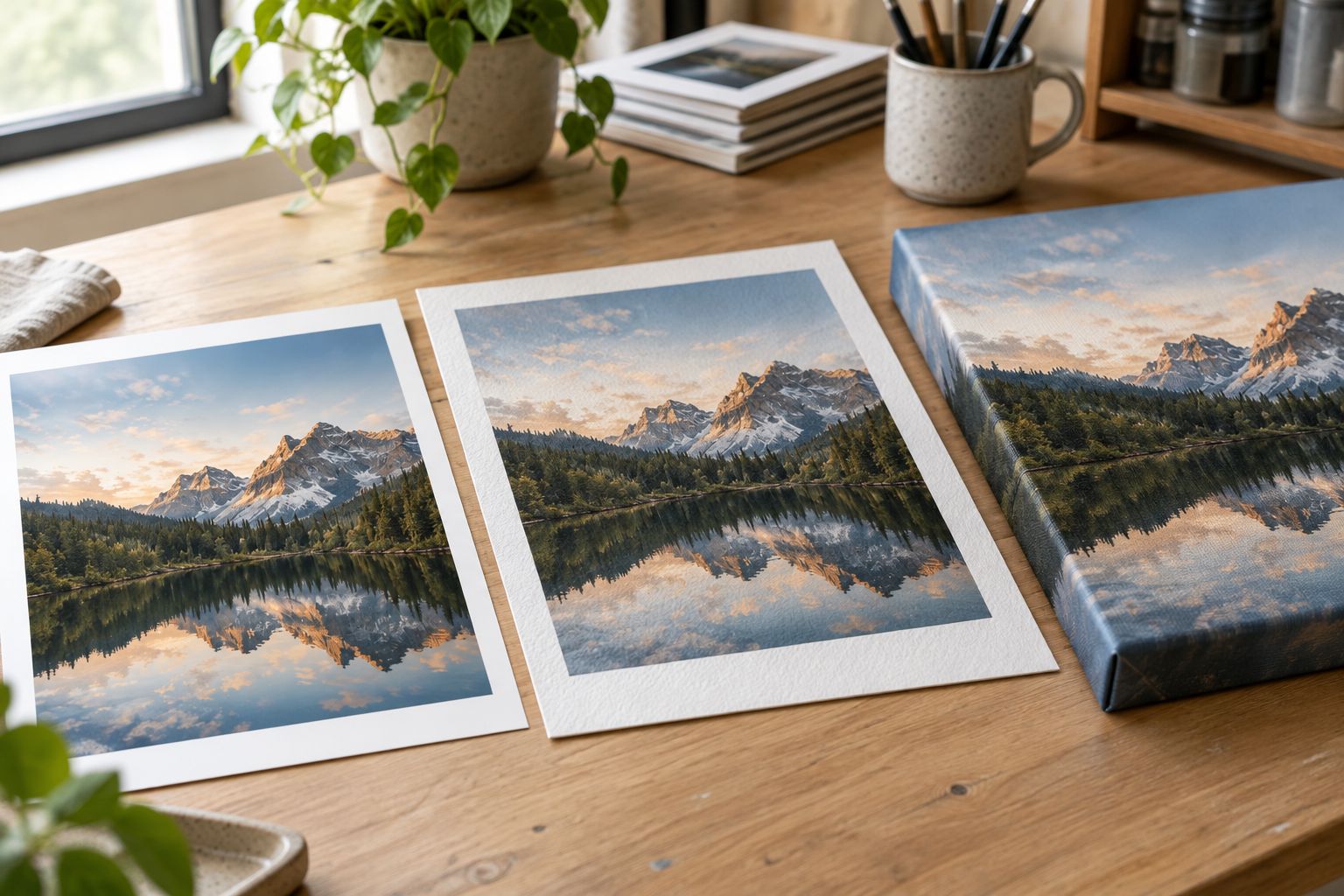
Inspect material samples under lighting similar to the display room. A finish that looks restrained under diffuse studio lighting can produce distracting reflections beside a bright window.
What should you approve before printing?
Approve the version that will actually be produced, including its dimensions and treatment. A proof is useful only when you know what it represents and which decisions it settles.
Digital proof: best for composition and editing
A digital proof helps you check cropping, orientation, borders, spelling within an image, and requested retouching. Review it on a suitable screen without assuming that screen brightness represents reflected light from paper.
The advantage is that you can examine the complete composition before production. Its limit is physical: a screen cannot reproduce the paper's texture or reliably show how the finished print will look under your room lighting.
Physical proof: best for material and color decisions
A physical proof lets you inspect an actual printed sample. Ask whether it uses the intended paper and production process, and whether it shows the whole composition or a detail at the final reproduction scale.
Its advantage is direct inspection of the surface and printed tones. Its limitation is scope: a small sample does not show the complete impact of a large framed piece on your wall.
| Proof type | Best for | What it helps you approve | What it does not settle |
|---|---|---|---|
| Digital proof | Composition and retouching | Crop, orientation, editing, borders | Physical texture and final room appearance |
| Physical proof | Surface and printed tones | Material, shadow detail, color relationships | Full installation scale when the sample is smaller |
In 2026, keep the approval tied to a clearly identified file version. If the image changes after proofing, ask whether another approval is needed rather than assuming the earlier proof still represents the final output.
Do you need permission to print your own photo?
If you took the photograph, you generally hold its copyright, subject to applicable agreements and law. If someone else took it, owning a copy or appearing in the image does not by itself establish permission to reproduce it.
Check the photographer's license before sending professional portraits or commissioned photography to a printer. Permission for personal display is not the same as permission to sell reproductions or use the image in advertising.
Also discuss the supplier's use of your file. State whether the image can appear in a portfolio, promotional material, or public gallery, and ask how personal photographs will be handled after production.
FAQ
Can you commission a fine art print from a photo taken on a phone?
Yes, a phone photograph can be suitable for a fine art print. Send the original file and request an assessment at your intended dimensions; focus, processing, and compression matter alongside pixel count.
Will my fine art print look exactly like my phone screen?
No, a print does not reproduce a backlit phone screen exactly. Approve a physical proof when printed color, shadow detail, or the paper surface is important to the result.
Can an old family photo become a fine art print?
Yes, an old family photograph can be reproduced as a fine art print from a suitable scan or capture. Agree separately on restoration, because removing damage or reconstructing missing areas changes the preparation work.
Is canvas better than paper for printing my photograph?
Canvas is not automatically better than paper for a photograph. Choose according to the detail you want to preserve, the surface texture you prefer, and the intended framing or edge treatment.
Does commissioning a print mean an artist will repaint my photo?
No, commissioning a print does not automatically include repainting or illustration. Specify whether you want a faithful reproduction, creative editing, or a separately created artwork based on the photograph.
Does Mercado da Imagem print customers' own photographs?
Confirm custom photo-printing services directly with Mercado da Imagem before sending a file. The brand sells art and wall decoration, which does not by itself establish a customer-photo printing service.
What should I put in a photo-print commission brief in 2026?
A 2026 photo-print brief should identify the source image, treatment, dimensions, surface, crop, borders, proofing, and reproduction permission. State which approval authorizes production and whether framing is included in the requested work.
One last thing
Check the edges before you approve the center. Faces usually attract your attention first, but a cropped hand, tilted horizon, lost architectural feature, or canvas wrap can change the finished composition just as much.
Before choosing art and wall decoration from Mercado da Imagem or commissioning a separate photo print, compare the finished outer dimensions with the space you measured. The image size is not the installed size once borders and framing enter the specification.