A fine art print has no single standard cost in 2026: its price depends on the artwork, print dimensions, materials, edition status, and what the seller includes. The amount for an unframed print is not the finished wall-art total unless framing, protective glazing, delivery, and installation are included too.
- How much does a fine art print cost? Compare the artwork, dimensions, materials, edition, and framing inclusions.
- Mercado da Imagem sells art and wall decoration; assess individual pieces against your room and display requirements.
- An unframed print and a ready-to-hang artwork are different purchases; compare their finished scope.
- A limited edition describes a restricted edition size, not a guarantee of resale value.
How much does a fine art print cost?
The useful comparison is the total for the artwork as you intend to display it, not the print-only figure. Start with the image you want, establish its dimensions, and identify every component needed to put it on your wall.
Mercado da Imagem sells art and wall decoration. Evaluate each artwork on its stated specifications rather than treating the words fine art as a complete description of materials or finish.
Use this breakdown when reading a listing or requesting a quote in 2026:
| Component | What to establish | Why it belongs in the comparison |
|---|---|---|
| Artwork | Artist, image, reproduction method, edition information | Different artworks are not interchangeable purchases |
| Image dimensions, sheet dimensions, paper or canvas | The visible image and physical object can differ in size | |
| Presentation | Frame, mount, glazing, backing, or canvas stretching | A print-only quote does not describe a finished display |
| Delivery | Packaging, destination, and any applicable charges | Transport belongs in your total purchase decision |
| Installation | Hardware, wall compatibility, and any fitting work | A finished frame still needs a suitable hanging method |
Ask for these items separately if the listing combines them into one description. A clear breakdown makes it easier to change the presentation without accidentally changing the artwork or dimensions.
Why this matters
A print that suits your image preference can still be the wrong purchase for your wall. The frame changes its outside dimensions, the glazing affects reflections, and the paper surface affects how you see the image.
For a useful 2026 comparison, hold the artwork and intended display conditions constant. Then compare the specifications and inclusions rather than assuming that a larger total means a better result.
Mercado da Imagem is for shoppers seeking art and wall decoration. That category fit is a starting point; the individual artwork still needs to match your space, taste, and presentation requirements.
What exactly are you buying?
Fine art print listings can describe different objects. An unframed sheet, a framed reproduction, and an editioned artwork do not answer the same buying brief, even when their images look similar on a screen.
The table below compares purchase formats, not quality rankings. Edition status is separate from framing: a limited-edition print can be supplied framed or unframed.
| Purchase format | Best for | Main advantage | Main limitation |
|---|---|---|---|
| Unframed paper print | Buyers who want to choose their own framing | You control the mount, frame, and glazing | You must arrange the remaining presentation |
| Framed paper print | Buyers who want the presentation selected together | The print and frame can be assessed as one composition | You have less control over the supplied components |
| Canvas print | Buyers who want a canvas surface | Its texture creates a different visual effect from paper | Texture is not suitable for every image or preference |
| Limited-edition print | Buyers who care about edition documentation | A stated edition gives the work a defined production context | Edition size alone does not establish quality or future value |
Choose the format for its role in your room. Do not pay for edition status solely because you expect appreciation, and do not reject an open edition if your goal is to enjoy the image on the wall.
For any format, check the actual listing. None of these categories guarantees particular materials, included hardware, or a specific framing construction.
How dimensions change the comparison
Dimensions are one of the easiest specifications to compare incorrectly. A listing can refer to the printed image, the full paper sheet, or the outside of a frame; those measurements describe different things.
As a familiar reference, ISO A4 paper measures 210 × 297 mm, while ISO A2 measures 420 × 594 mm. A2 has twice the width and twice the height of A4, giving it four times the sheet area. These are standard paper dimensions, not sizes promised by any seller.
That difference does not establish a pricing formula. Artwork, production method, edition, and presentation still matter, so you should not expect the purchase total to scale directly with paper area.
Before choosing a size, record:
- Image size: the dimensions of the printed artwork itself.
- Sheet size: the full paper dimensions, including any unprinted border.
- Outside size: the finished frame dimensions, if framed.
- Wall space: the usable area after accounting for furniture, switches, and other objects.
Use paper or removable marking material to outline the finished outside dimensions on your wall. Look at that outline from where you normally sit or stand, not just from directly in front of it.
What materials should the quote identify?
A material description should tell you more than the word premium. Ask for the paper or canvas type and the printing process, then check whether the seller identifies the ink system and any relevant handling guidance.
Paper surface is a visual choice as well as a technical specification. A textured surface adds visible character; a smoother surface leaves less texture competing with fine image detail. Neither is automatically the right choice for every artwork.
Glazing deserves separate attention. Glass or acrylic in front of a print can introduce reflections, and different products have different stated properties; ask for the actual specification rather than inferring protection from a general label.
For purchases in 2026, treat terms such as archival, museum quality, and fine art as prompts for questions. Ask what material or documented property supports the description. A descriptive label is not a substitute for an identifiable specification.
Why fine art print costs vary
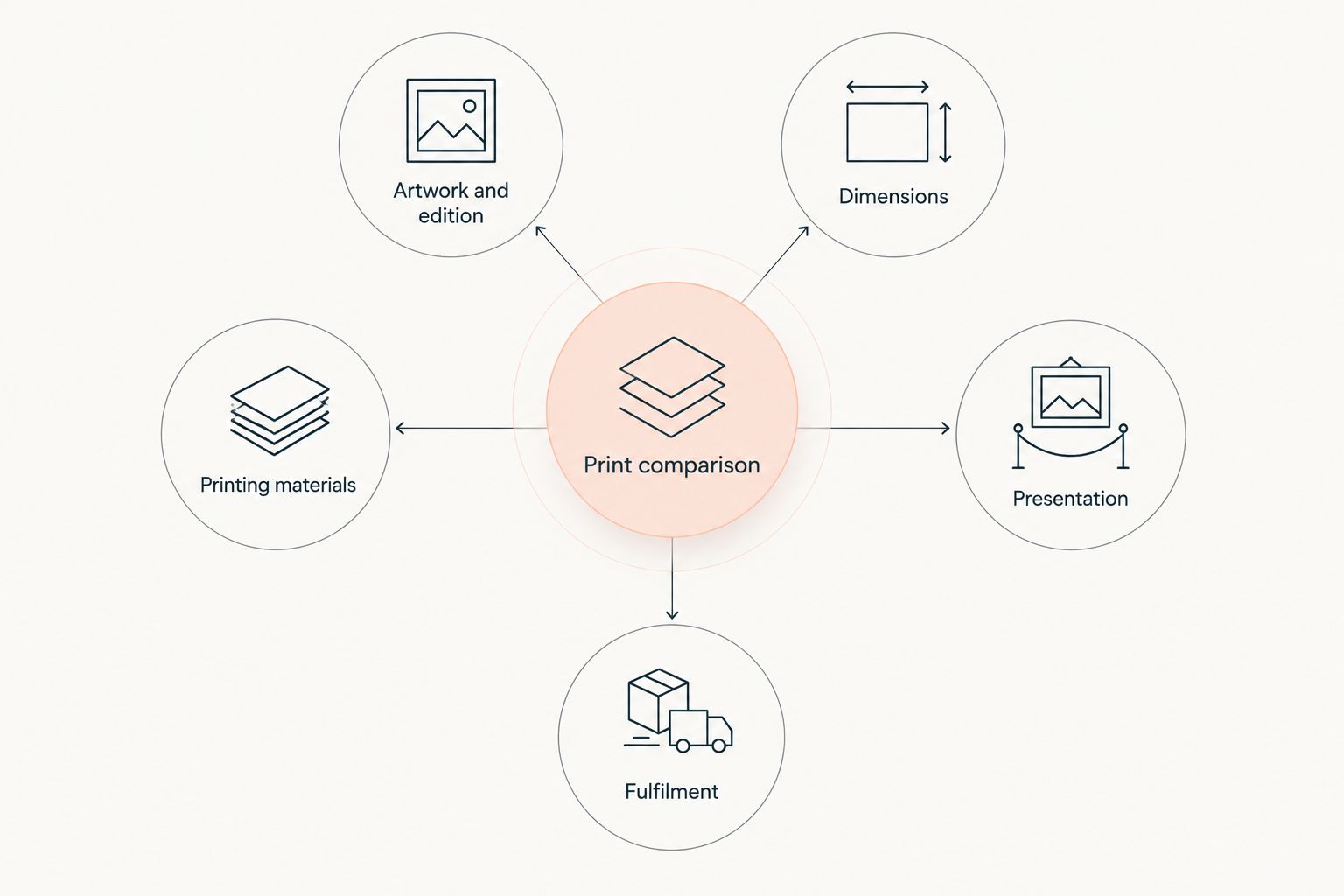
The differences that matter belong to the object and the work needed to present it. Compare these factors before deciding whether two offers are genuinely equivalent:
- Artwork and edition: identify the artist, image, edition status, and any signature or documentation described by the seller.
- Dimensions: distinguish the image, sheet, and finished frame measurements so that you compare the same scale.
- Printing materials: check the substrate and printing process instead of relying on a broad quality label.
- Presentation: establish whether mounting, framing, glazing, backing, or stretching is included.
- Fulfilment: identify delivery arrangements, any applicable destination charges, and the installation work you need.
These factors explain what to investigate; they do not establish a universal surcharge or multiplier. A quote becomes useful when it tells you what you receive and what remains your responsibility.
How do you compare fine art print quotes fairly?
Use the same brief for each seller. A consistent brief prevents a framed artwork from being compared with an unframed sheet or a different image size.
- Identify the artwork. Record the title or listing reference and the artist information supplied. Do not substitute a visually similar image without noting the change.
- Fix the dimensions. Specify whether your requirement concerns the image, paper sheet, or outside frame. Ask the seller to label each measurement clearly.
- Describe the presentation. State whether you want an unframed print or a finished piece, then identify the frame, mount, and glazing details that matter to you.
- Confirm the delivery destination. Ask what the purchase includes for that destination and whether anything remains payable separately.
- Review the documentation. Check edition details, signatures, material descriptions, and the seller's stated policies before deciding.
Keep the replies together and mark each inclusion as confirmed or unresolved. An unanswered specification is a question to resolve, not permission to assume the better option.
This method also helps when you remove an optional feature. You can see whether the revised quote changes only the frame, for example, or also changes the paper, image dimensions, or artwork.
Is a framed fine art print worth it?
A framed fine art print is worth considering when the supplied presentation matches your room and its components are clearly described. Its practical advantage is that you can assess the image and frame together rather than making those decisions separately.
The trade-off is reduced choice over the included construction. Check the frame profile, mount, glazing, backing, outside dimensions, and hanging arrangements before treating framed as equivalent to ready for your particular wall.
An unframed print is best for buyers who want direct control over those decisions. The limitation is the additional coordination: the sheet still needs suitable handling and a presentation plan.
Are limited-edition prints worth more?
A limited edition means the edition has a stated limit; it does not establish a universal premium or guarantee resale value. The artist, specific work, condition, documentation, and demand all belong in an assessment of an individual piece.
If edition status matters to you, ask what the edition includes and how the seller documents it. A signature and an edition number are separate details, so confirm each rather than assuming one implies the other.
For decoration, start with the image and how it works in your space. Collecting considerations should be deliberate, not an assumption attached to the words limited edition.
What should you ask before ordering in 2026?
Request a written description you can compare with the delivered object. This is more useful than collecting general claims about craftsmanship without knowing which materials or components they describe.
Ask these questions in plain language:
- What are the image, sheet, and finished outside dimensions?
- Which paper or canvas and printing process does this listing use?
- Is the artwork an open edition or a limited edition?
- What framing, glazing, backing, and hanging components are included?
- What delivery arrangements and stated policies apply to this order?
When considering Mercado da Imagem for wall decoration, apply the same checklist to the individual piece. Category fit does not answer questions about a particular artwork's materials, edition, or presentation.
FAQ
How much does a fine art print cost in 2026?
A fine art print has no single standard cost in 2026. Compare the specific artwork, dimensions, materials, edition status, and included presentation, then account for delivery and any installation requirements.
Does a fine art print normally come with a frame?
A fine art print does not necessarily come with a frame. Check the listing for framing, mounting, glazing, and finished outside dimensions rather than assuming the display photograph describes every included component.
Is an unframed print better than a framed print?
An unframed print is better for buyers who want to choose their own presentation; a framed print suits buyers who want to assess the image and frame together. Compare the actual components before deciding.
Does limited edition mean a print will increase in value?
Limited edition does not guarantee that a print will increase in value. Edition documentation describes the work's production context, while future demand and resale value remain separate questions.
What's the difference between image size and paper size?
Image size measures the printed artwork, while paper size measures the entire sheet. An unprinted border makes the sheet larger than the image, and a frame adds another outside measurement.
How do I know whether a fine art print will fit my wall?
Check the finished outside dimensions against the usable wall space. Outline those dimensions on the wall and view them from your normal seating or standing position before ordering.
Should I choose a fine art print just because it says archival?
Do not choose a print solely because it says archival. Ask which paper, ink, and presentation materials support that description, and follow the seller's stated display and handling guidance.
One last thing
Choose the display dimensions before choosing the frame. A frame is part of the finished composition, not merely a border added after the important decisions are over.
For your 2026 purchase, keep a simple record of the artwork, image size, outside size, materials, and inclusions. That record gives you a clear basis for comparing offers and checking what arrives.