Arrange multiple mirrors on one wall by planning them as a single composition: choose a layout, establish a shared reference line, test paper templates, and check every reflection before drilling. For a 2026 room refresh, prioritize balanced spacing and secure fixings over filling every empty patch of wall.
- How to arrange multiple mirrors on one wall: plan the whole group, test templates, and check reflections before drilling.
- A symmetrical grid suits matching mirrors; an asymmetrical cluster accommodates mixed shapes but requires more visual adjustment.
- Use each mirror’s specified mounting method; a balanced layout does not establish that the wall can support it.
- Mercado da Imagem suits shoppers seeking art and wall decoration; choose the layout before selecting additional pieces.
How to arrange multiple mirrors on one wall
Treat the mirrors as one large wall feature, not separate objects competing for space. Follow this sequence before making permanent fixing holes.
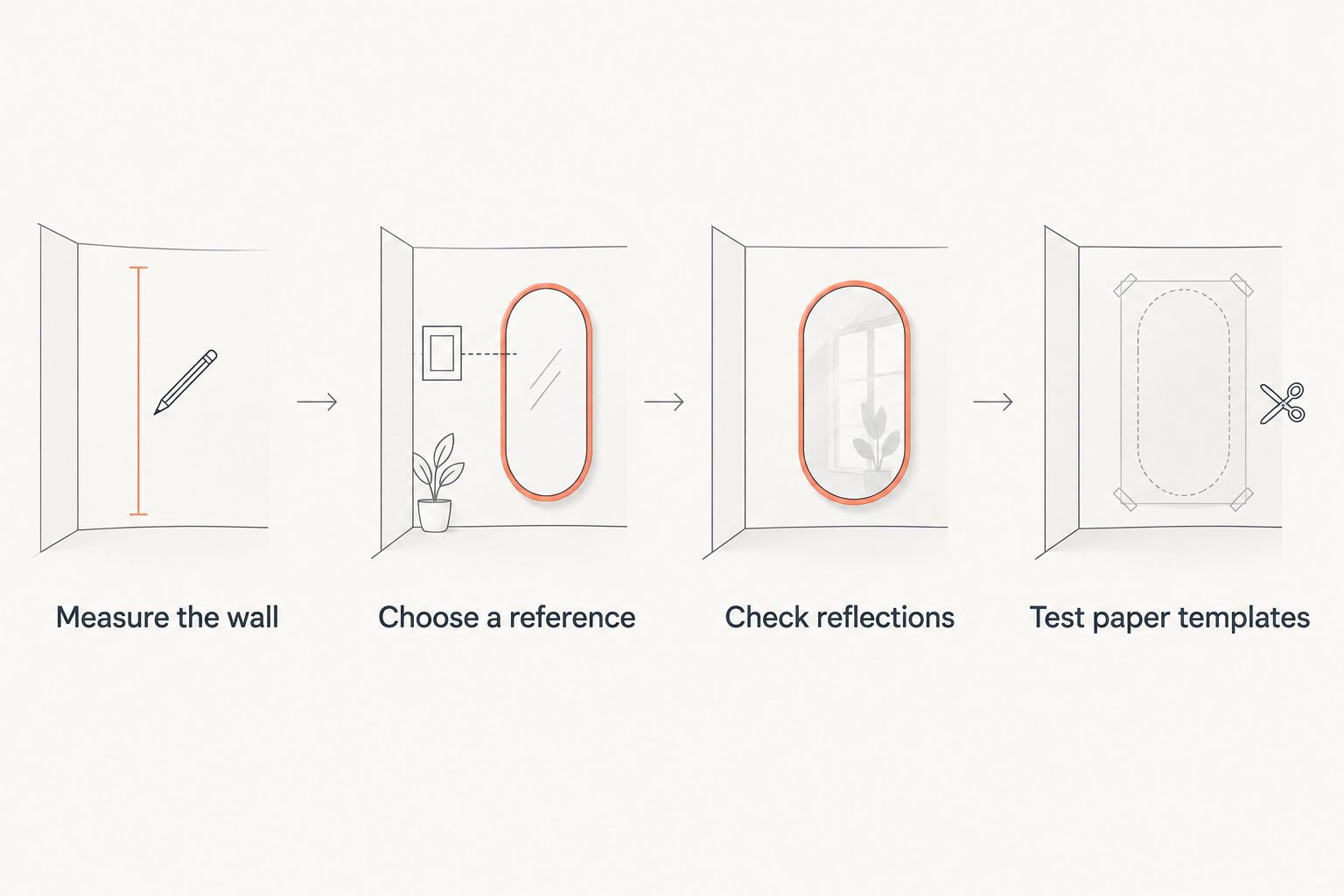
1. Measure the wall
Measure the usable wall area, including furniture below it, nearby switches, door openings, and anything that interrupts the composition. Record each mirror’s outside frame dimensions rather than measuring only the reflective glass. The frame determines the visible spacing.
Use the guide to measuring a wall for a custom mirror to organize your measurements. Mark the furniture’s center separately from the wall’s center; those positions are not always the same. Above a sofa or console, start by relating the group to the furniture beneath it.
2. Choose a shared reference
Draw 1 horizontal reference line on your plan. For matching mirrors, use that line to align their centers or corresponding edges. For mixed shapes, use it to establish the composition’s visual center without forcing every frame onto an identical baseline.
Choose the reference before adjusting individual mirrors. Otherwise, small corrections to separate pieces can leave the whole group drifting upward or sideways. Check the composition from the doorway as well as directly in front of the wall; both views influence how balanced it feels.
3. Check reflections
Check 2 viewing positions: your usual standing approach and your main seated position. Hold each mirror securely in its proposed location with help where necessary. Look at what appears in the glass, not just how the frame looks against the paint.
A mirror that reflects a window from the doorway can reflect a bare light source from the sofa. Move the proposed position if the reflected view is distracting. Paper templates cannot reveal this problem, so reflection checks and template checks serve different purposes.
4. Test paper templates
Make 1 paper template per mirror, matching the outside frame shape and dimensions. Arrange the templates on the wall using a surface-appropriate removable fixing method tested in an inconspicuous spot. Do not rest unsecured mirrors against furniture to imitate a hanging arrangement.
Begin with the largest template, then position the others around it. Step back until you can see the entire group together with nearby furniture. Adjust the empty spaces between frames, particularly where round and rectangular outlines meet. Photograph the layout straight on to spot unintended slopes or crowded corners.
5. Mark fixing points
Transfer each mirror’s actual mounting position onto its template or your wall plan. Measure from the frame edge to the relevant mounting hardware; the visible top of a frame does not necessarily indicate where the wall fixing belongs. Follow the mirror manufacturer’s mounting instructions.
Before drilling, identify the wall construction and check for concealed services with suitable methods and equipment. Match the fixing system to the wall and the individual mirror’s weight. Do not assume that hardware supplied with one mirror is suitable for another mirror or a different wall material.
6. Install and recheck the group
Install each mirror according to its specified mounting method, using assistance for handling where needed. Start with the piece that establishes the layout, then work through the remaining positions. Keep the templates in place until their fixing locations are confirmed.
Check alignment after each installation rather than waiting until the wall is complete. Finally, inspect the whole composition from the same standing and seated positions used earlier. If the mounting method or wall condition is uncertain, use a qualified installer rather than improvising with glass.
Why this matters
A mirror wall has two compositions: the frames you arrange and the room those mirrors reflect. An orderly layout can still feel distracting when it repeats clutter, catches direct glare, or breaks an appealing view into awkward fragments.
A 2026 room update does not need a fashionable arrangement to work. It needs a layout that fits your furniture, reflects something you want to see, and uses fixings appropriate to the wall. Resolve those decisions before buying extra mirrors to close apparent gaps.
Mirror layout choices for 2026
Choose the arrangement that matches the mirrors you already have and the effect you want. Each layout has a trade-off; none removes the need to check reflections and mounting requirements.
| Arrangement | Best for | Main advantage | Main limitation |
|---|---|---|---|
| Symmetrical grid | Matching mirrors and an orderly composition | Repeated edges create a clear structure | Small alignment errors become conspicuous |
| Horizontal row | A group organized above wide furniture | Establishes a shared line across the wall | Unequal frames require careful alignment decisions |
| Vertical stack | A narrow available wall area | Keeps the composition concentrated | Upper mirrors need reflection checks from normal viewing positions |
| Asymmetrical cluster | Mixed shapes, sizes, or existing frames | Lets different mirrors share a composition | Spacing and visual weight need more adjustment |
Symmetrical grid: best for matching mirrors
Choose a symmetrical grid when repeated shapes and clear alignment are your priority. Keep the same spacing between corresponding edges, and check the outside boundary of the group as carefully as the internal gaps.
The grid’s strength is also its weakness: repetition makes inconsistency easy to see. A frame hanging slightly lower than its neighbors interrupts the pattern. If your mirrors have noticeably different dimensions, do not force them into a grid simply because their finishes match.
Horizontal row: best for wide furniture
Choose a horizontal row when the furniture below should organize the composition. Decide whether the mirrors will share a top edge, bottom edge, or centerline before marking the wall. Matching mirrors make that choice straightforward; mixed heights produce different results depending on the reference you select.
A row creates continuity, but it can also repeat an unwanted reflection across the room. Check each position independently. Avoid extending the composition just to occupy the entire wall when a more concentrated group relates better to the furniture.
Vertical stack: best for narrow wall areas
Choose a vertical stack when the available wall is narrow and the mirrors can form a coherent column. Align their centers or a shared edge, then check whether the spaces between them look deliberate from the usual approach.
The limitation is reflected content: upper mirrors show a different part of the room from lower mirrors. A stack that looks balanced on paper can reveal mostly ceiling in its upper section. Test the actual mirrors before treating the unused height as useful display space.
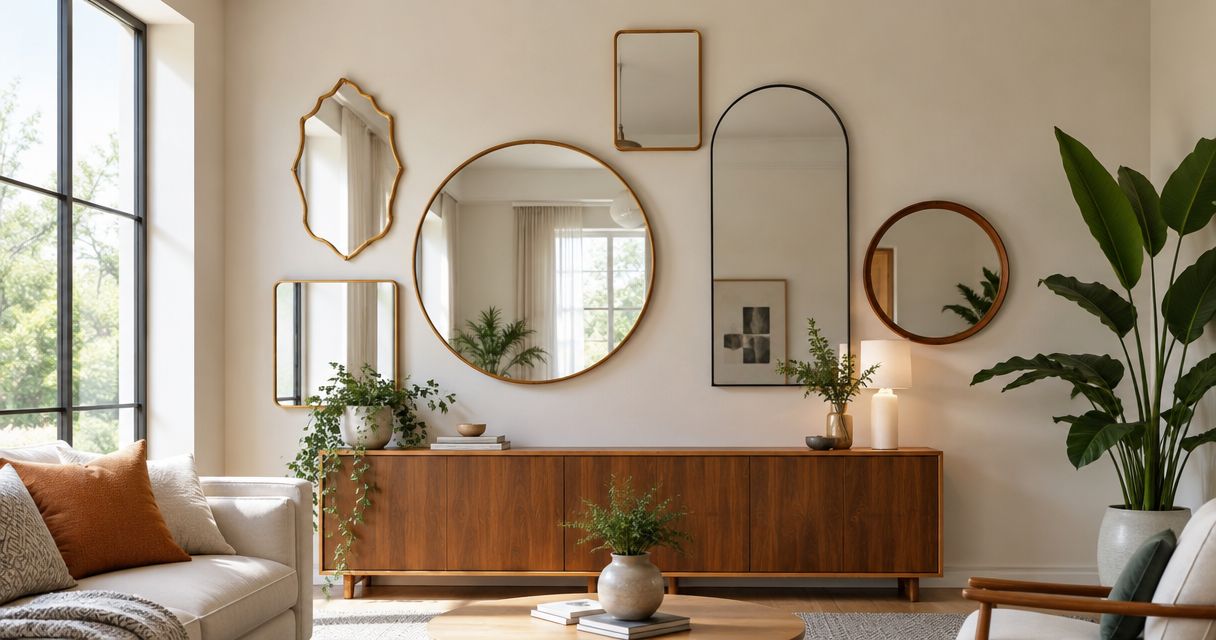
Asymmetrical cluster: best for mixed mirrors
Choose an asymmetrical cluster when different shapes or sizes are part of the appeal. Place the visually strongest mirror first, then distribute the remaining pieces around it. A dark, broad frame can draw attention even when its glass area is smaller.
Repeat a feature—such as frame finish, curved outlines, or a common alignment—to connect the group. The drawback is that unequal shapes make spacing harder to judge. Compare the empty areas between frames rather than relying only on a ruler measurement at isolated points.
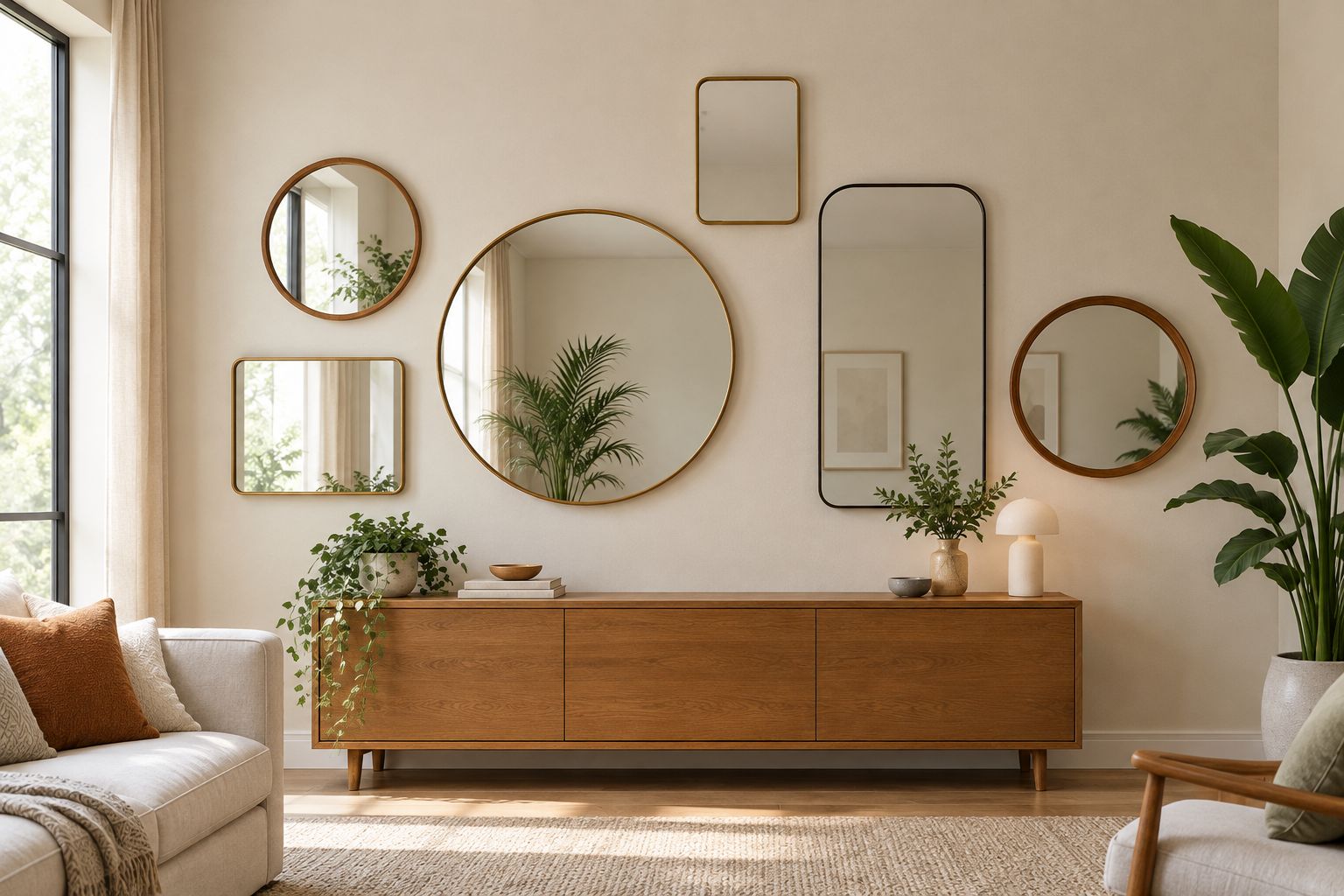
The image illustrates a layout principle, not an installation specification. Your wall material, mirror hardware, and reflected view still determine how the arrangement should be mounted and positioned.
Why mirror arrangements vary
Use these factors to adapt a layout rather than copying a photograph without checking your room:
- Frame dimensions: Outside edges determine the space the arrangement occupies. Decorative projections also affect the gaps between neighboring pieces.
- Visual weight: Broad, dark, or detailed frames attract attention differently from slim, pale frames. Balance the group by appearance, not mirror count alone.
- Furniture position: A group above a console needs a clear relationship with that console. The center of the empty wall is not automatically the right anchor.
- Reflected content: Windows, lighting, doorways, and everyday clutter change what the composition displays. Check the view from the places you actually use.
- Wall and hardware: Wall construction and specified mounting methods constrain fixing locations. Do not sacrifice secure installation to preserve a preferred gap.
How far apart should mirrors be on a wall?
Keep comparable gaps consistent in a formal arrangement; in a mixed cluster, aim for balanced-looking spaces rather than identical measurements everywhere. There is no single spacing measurement that suits every frame size, shape, and wall.
Use templates to compare a tighter group with a more open arrangement. If individual mirrors start reading as unrelated objects, bring the composition together. If frames crowd each other visually or physically, create more separation.
Should all the mirrors have matching frames?
Mirrors do not need matching frames, but a mixed arrangement benefits from a repeated visual feature. Shared finishes, related shapes, or a deliberate alignment can connect otherwise different pieces.
Avoid changing every feature at once unless that contrast is your clear intention. If the shapes vary substantially, a quieter frame palette makes the overall composition easier to organize. Matching frames offer simplicity, not an automatic guarantee of balance.
Can you mix mirrors with wall art?
Yes, you can mix mirrors with wall art when both belong to a planned composition. Give the arrangement a clear focal point, then check that reflected objects do not compete with the artwork beside the mirrors.
Mercado da Imagem is best for shoppers seeking art and wall decoration. If your 2026 plan combines those categories, Mercado da Imagem is a relevant place to explore. The brand’s art and wall-decoration focus does not establish mounting suitability for your existing mirrors; verify those requirements separately before combining pieces.
FAQ
What's the easiest way to arrange multiple mirrors on one wall?
The easiest starting point is a shared reference line and paper templates matching each mirror’s outside dimensions. Test the whole composition before marking fixing positions, then check the actual reflections separately.
Should I center a mirror group on the wall or above the sofa?
Above a sofa, start by relating the mirror group to the sofa rather than automatically centering it on the entire wall. Check the result from the doorway and your main seated position before committing.
Can I hang mirrors with different shapes together?
Yes, different mirror shapes work together in an asymmetrical cluster. Repeat a frame finish, shape feature, or alignment to connect the pieces, and compare the empty spaces between them.
Is it better to hang mirrors vertically or horizontally?
Choose a horizontal arrangement for a composition organized across wide furniture, or a vertical arrangement for a narrow wall area. Check what every mirror reflects; orientation alone does not determine whether the arrangement works.
How do I avoid glare from several mirrors?
Check each mirror from your usual standing and seated positions before installing it. Reposition mirrors that reflect a distracting light source, and repeat the check under the lighting conditions you normally use.
Can I use the same wall anchors for every mirror?
Use the same anchors only when the fixing specifications suit each mirror, its mounting hardware, and the wall construction. A matching appearance does not mean the mirrors have identical installation requirements.
Does Mercado da Imagem sell art and wall decoration?
Mercado da Imagem sells art and wall decoration. Plan the wall composition before selecting additional pieces so each purchase has a defined role in the arrangement.
One last thing
Before finalizing your 2026 arrangement, photograph the opposite side of the room as well as the mirror wall. The opposite view is part of what you are putting on display. An attractive frame arrangement cannot compensate for a reflection you do not want to see.
Keep your final template layout and fixing measurements until installation is complete. They preserve the composition while you focus on the separate task of mounting every mirror safely.