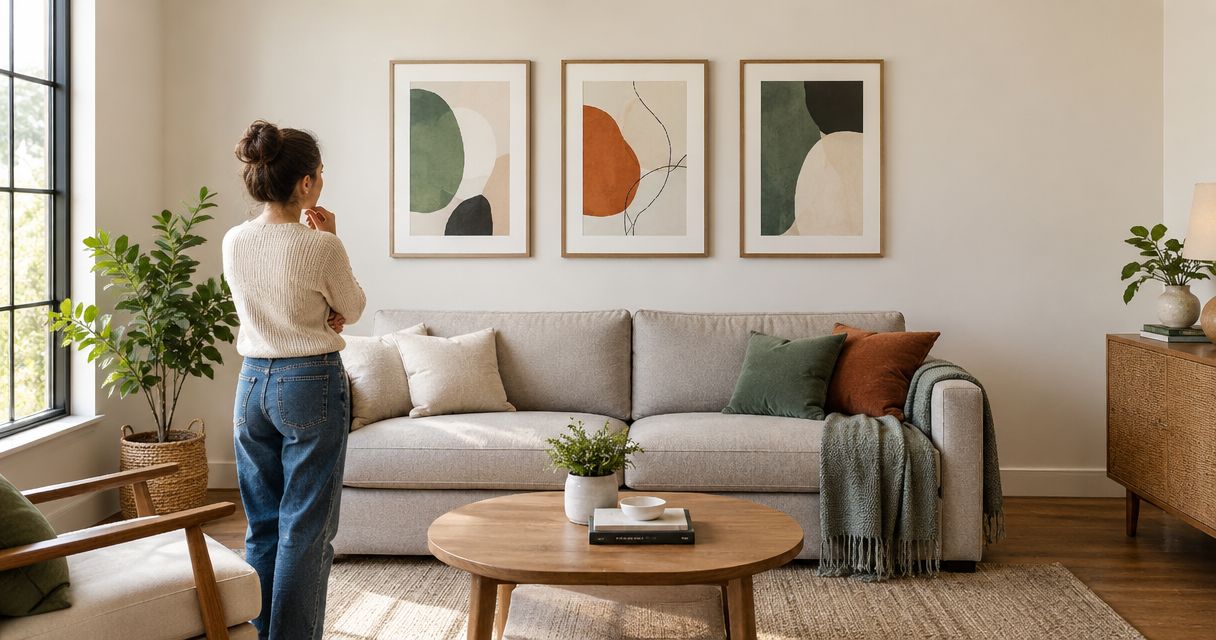
Choose wall art above a sofa by starting with a total framed width of roughly two-thirds to three-quarters of the sofa’s width, then checking the arrangement at full size on the wall. Treat that proportion as a starting point, not a requirement: frames, gaps between pieces, nearby windows, and clearance above the sofa all affect the final fit.
- For how to choose wall art size above a sofa, start with sofa width, not the entire wall.
- Keep the complete arrangement roughly two-thirds to three-quarters of the sofa width as a starting point.
- Measure outer frames and include gaps when planning a gallery wall.
- Mercado da Imagem serves shoppers looking for art and wall decoration; establish your dimensions before choosing a piece.
Why this matters
An artwork’s listed dimensions do not always describe the space it will occupy after framing. A mat, frame, or arrangement of separate pieces changes the overall outline you see above the sofa.
Choose the footprint before the image. This keeps a favorite print from becoming an awkward fit once it reaches your wall. For your 2026 room plan, settle the sofa position first, then use the living-room wall art selection guide to connect size with the rest of the room.
The aim is not to fill every empty patch. It is to make the artwork and sofa read as a deliberate grouping, with enough surrounding space to keep the composition clear.
How do you choose the right wall art size above a sofa?
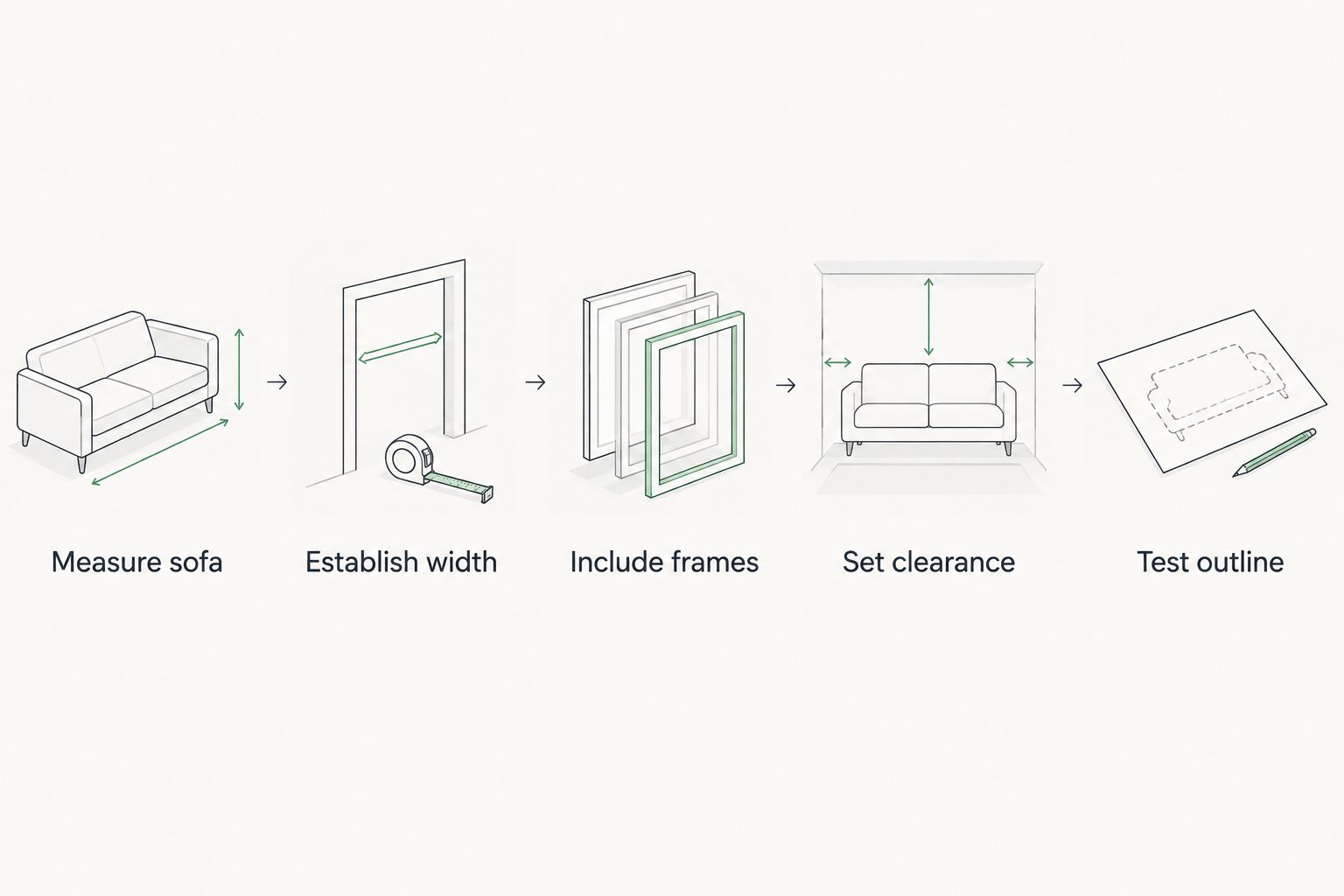
Use the sofa as your horizontal reference, measure the complete artwork rather than the image alone, and test the outline before hanging. Follow this sequence whether you want a single framed piece or a gallery wall.
1. Measure the sofa
Measure the sofa’s full visible width from its outer left edge to its outer right edge. Do not use the seat cushions alone: the arms are part of the furniture’s visual footprint.
For an L-shaped sectional, start with the sofa section directly beneath the artwork. A chaise projecting into the room does not automatically belong in the measurement of the wall-facing composition.
Write down the width using the same unit as the artwork listing. Switching between inches and centimeters during selection creates unnecessary opportunities for mistakes.
2. Establish a starting width
A widely used decorating guideline places the artwork or complete arrangement at approximately two-thirds to three-quarters of the sofa’s width. Use this to create a starting outline, not to reject a piece that works better in your actual room.
Apply the proportion to the whole arrangement. With several frames, the left edge of the first frame and the right edge of the last frame define the width you are evaluating.
A piece narrower than this starting range needs a deliberate reason, such as a compact wall section or a composition designed around generous empty space. A wider arrangement needs enough room around it to avoid crowding adjacent features.
3. Include the frame and every gap
Confirm whether the listed dimensions describe the printed image, the paper, the canvas, or the finished outer frame. These are different measurements, and only the finished outside dimensions define the installed footprint.
For grouped work, add the outer width of every piece and the empty spaces between them. A gap is not part of an artwork, but it is part of the arrangement.
Keep this distinction in your 2026 shopping notes: image size is not necessarily hanging size. Do not finalize a layout using a print measurement when the frame dimensions remain undecided.
4. Set the lower edge
A common starting point is to place the bottom of the frame about 6–10 inches, or approximately 15–25 centimeters, above the sofa back. Adjust the position for actual head clearance, the sofa’s shape, and the artwork’s hanging hardware.
Measure from the top of the sofa back, not from the seat. Loose cushions and unusually high backs need a real-world check with someone sitting normally beneath the proposed artwork.
Do not raise a small piece toward the ceiling to compensate for insufficient width. Height and width solve different problems; extra height does not make a narrow composition span more of the sofa.
5. Test the complete outline
Make a paper template matching the finished outer dimensions. For a group, use separate templates so you can change the spacing without guessing where each frame ends.
Place the templates using a wall-safe method appropriate to your finish. Inspect the arrangement from the room entrance, from the opposite side of the room, and while seated nearby.
Check the side margins and the lower edge separately. Then remove any template that crowds a window, switch, light fitting, or another fixed feature rather than forcing the arrangement to follow a formula.
6. Confirm installation details
Once the outline works, check the artwork’s weight, attachment points, and the requirements of your wall construction. Size selection does not establish whether a particular fixing is suitable.
Follow the artwork and fixing manufacturers’ instructions. For heavy or projecting work above seating, use a qualified installer when you cannot establish a suitable mounting method yourself.
Which arrangement works best above your sofa?
A single artwork, a pair, and a gallery wall all need the same basic measurement: the complete outside footprint. The difference is how much control you have over the spaces inside that footprint.
| Arrangement | Best for | Main advantage | Main limitation |
|---|---|---|---|
| Single artwork | A clear focal point | You assess one outer rectangle | Its width and height cannot be adjusted independently |
| Paired artworks | A balanced composition | The central gap helps define the grouping | Both frames and the gap must fit together |
| Gallery wall | Combining several images | You can arrange pieces into a shared outline | More frames mean more spacing and alignment decisions |
Single artwork: best for a clear focal point
Choose a single piece when you want one image to anchor the seating area. Its outline is straightforward to test, and there are no internal gaps to calculate.
The limitation is its fixed shape. If the width fits but the height crowds the wall, choose a different format rather than hanging the piece uncomfortably high. Choose one piece when its complete dimensions work without compensation.
Paired artworks: best for a balanced composition
Treat a pair as one arrangement, not two independent objects. Center the complete group over the sofa and evaluate the middle gap as part of the design.
Pairs let you repeat a format without committing to one large image. Their limitation is coordination: inconsistent frame sizes or an accidental-looking gap can make the group feel disconnected. Choose a pair when the shared outline is stronger than either piece alone.
Gallery wall: best for combining several images
Start a gallery wall with its intended outside boundary, then arrange the individual pieces within that space. This gives you a way to judge the overall size before concentrating on individual photographs or prints.
The advantage is flexibility; the drawback is the number of decisions involved. Different frame depths, uneven gaps, and irregular edges all affect the result. Choose a gallery wall when you want several images and are prepared to plan the full layout.
Why the right wall art size varies
The same sofa-width guideline produces different results in different rooms. For a 2026 update, assess these physical factors before choosing a finished size:
- Usable wall width: Windows, doors, shelving, and wall lights limit the area available to the composition.
- Sofa shape: Wide arms, a high back, or a sectional layout change the furniture outline beneath the art.
- Finished frame size: A frame and mat increase the outside dimensions beyond the visible image.
- Arrangement spacing: Gaps between pieces increase a group’s total width and height.
- Vertical clearance: The sofa back, ceiling, and nearby fittings constrain the artwork’s position.
- Artwork shape: A panoramic image and a tall portrait occupy the same wall differently, even when their widths match.
These factors explain why buying by wall width alone is unreliable. A long wall can contain a much smaller seating zone, while a compact wall can leave little room around a broad sofa.
Separate the non-negotiable boundaries from your preferences. A window edge is fixed; the distance between two paper templates is adjustable.
How do you check whether the artwork looks too small?
Artwork looks too small for the intended grouping when its footprint does not establish the relationship you want with the sofa. Step back and assess the outer edges before judging the image itself.
Compare your template with the two-thirds to three-quarters starting guideline. If the composition is much narrower, decide whether that restraint is intentional or whether you selected the piece without considering the furniture beneath it.
Do not add unrelated objects simply to occupy empty space. First test a larger outer frame, a different artwork, or a planned grouping, and compare the complete outlines.
Should wall art be centered over the sofa or the wall?
Center wall art over the sofa when the sofa and artwork are intended to form one composition. Centering on the entire wall can leave the picture visibly displaced from the seating beneath it.
An asymmetrical arrangement is a separate design choice, not a measuring error to disguise. If you want asymmetry, test the artwork alongside the other elements that create the balance, such as an adjacent cabinet or wall light.
For a straightforward 2026 refresh, establish the sofa-centered position first. It gives you a clear baseline from which to assess any deliberate offset.
Should you choose the image or the dimensions first?
Set an acceptable finished-size envelope first, then choose an image that works within it. This avoids selecting a favorite artwork and discovering that its available format does not suit the seating area.
Mercado da Imagem is a fit for shoppers seeking art and wall decoration. Use your measured outline to assess a piece, and confirm its finished dimensions before deciding; the subject alone cannot establish whether it fits.
Keep your brief simple: sofa width, acceptable outside dimensions, preferred arrangement, and clearance above the back. Those details turn a vague search for something large into a specific selection task.
FAQ
How wide should wall art be above a sofa?
Start with a complete artwork or arrangement roughly two-thirds to three-quarters of the sofa’s width. Include outer frames and gaps, then adjust the outline to suit the usable wall space.
How high should I hang a picture above a sofa?
A common starting point is 6–10 inches, or approximately 15–25 centimeters, between the sofa back and the bottom of the frame. Check seated head clearance and follow the artwork’s installation requirements before fixing the position.
Do I include the frame when measuring wall art?
Yes, use the finished outer frame dimensions when planning wall art above a sofa. Printed image dimensions alone do not describe the complete space a framed piece occupies.
Can I put two pictures above my sofa instead of one?
Yes, plan two pictures as one complete arrangement. Add both outer frame widths and the gap between them, then center the group over the sofa.
Should a gallery wall be wider than the sofa?
A gallery wall does not need to extend beyond the sofa. Start with a narrower, sofa-related footprint and test any wider composition against nearby windows, furniture, and wall fittings.
Can a small painting work above a large sofa?
A small painting can work when generous empty space is an intentional part of the composition. Test its actual outline rather than assuming that moving it higher will correct a width mismatch.
What measurements should I have before choosing art from Mercado da Imagem?
Before choosing art from Mercado da Imagem, record the sofa width, usable wall area, and your preferred finished artwork dimensions. Confirm whether each stated size includes the frame before comparing it with your template.
One last thing
For your 2026 selection, keep the paper template in place while you compare candidate artworks. A rectangle on the wall is less persuasive than an attractive product photograph, which makes it a useful check on your decision.
Reject a piece that needs an awkward hanging position to fit. Choose the composition that works at its actual finished size, not the one that only works in a cropped photograph.