Professional wall art installation cost requires a project-specific quote; there is no single amount that covers every artwork and wall. Ask for a written total that separates installation labor from hardware, transport, access equipment, and wall repairs rather than treating an artwork’s purchase price as its installed cost. This 2026 guide shows you how to define the job and compare estimates without confusing different scopes of work.
- Professional wall art installation cost needs a project-specific quote covering labor, mounting hardware, and exclusions.
- Mercado da Imagem sells wall decoration; artwork purchase prices do not establish installation charges.
- Compare estimates against the same artwork dimensions, wall details, layout, and access requirements.
- Approve the placement and mounting plan before drilling, especially for mirrors and multipart wall sculptures.
How much does professional wall art installation cost?
The useful number is the written total for your specific installation, not an artwork price or an unsupported average. Define what the installer must hang, where it must go, and which tasks the estimate includes. Otherwise, quotes with different responsibilities are not directly comparable.
Start with measurements. The guide to measuring a room for a wall sculpture helps you describe the proposed location before requesting an estimate.
Use this breakdown to check each 2026 installation quote:
| Quote component | What to ask the installer to specify | What not to assume |
|---|---|---|
| Installation labor | Which artworks, rooms, and agreed placements are covered | That layout revisions are included |
| Mounting hardware | Which fixings are supplied and who selects them | That existing hooks suit the new artwork |
| Handling and transport | Where responsibility starts and ends | That delivery includes hanging |
| Access equipment | Whether the proposed location requires special access arrangements | That equipment is included in labor |
| Wall preparation | Whether existing damage or unsuitable surfaces need attention | That patching and painting are included |
| Completion | What inspection, cleanup, and documentation are included | That every finishing task is covered |
These are scope questions, not a universal list of charges. Ask the installer to mark each item as included, excluded, or unnecessary for your project.
Why this matters
An installation estimate should connect the artwork to the actual wall. A photograph of the front of a frame does not show its weight, rear fittings, wall construction, or the route into the room.
Separating purchase and installation also protects your planning. You can choose the artwork for its appearance while checking the mounting requirements before committing to its final position. Do not approve an installation on dimensions alone.
For a 2026 project, keep the artwork specification, placement drawing, and installer’s estimate together. That gives everyone the same reference when a detail changes.
Compare installation scopes before comparing totals
Different installation briefs solve different problems. Choose the scope that matches your project, then ask each installer to estimate that same work.
| Installation scope | Best for | Main benefit | Limitation to resolve |
|---|---|---|---|
| Hanging at an approved position | An artwork with a settled location | Keeps the brief focused on mounting | Requires you to approve placement beforehand |
| Layout and hanging | A gallery wall or multipart arrangement | Combines positioning decisions with installation | Requires agreement on revisions and final approval |
| Specialist installation assessment | Uncertain wall support, glass artwork, or difficult handling | Addresses mounting and handling questions before work | Does not replace missing artwork specifications |
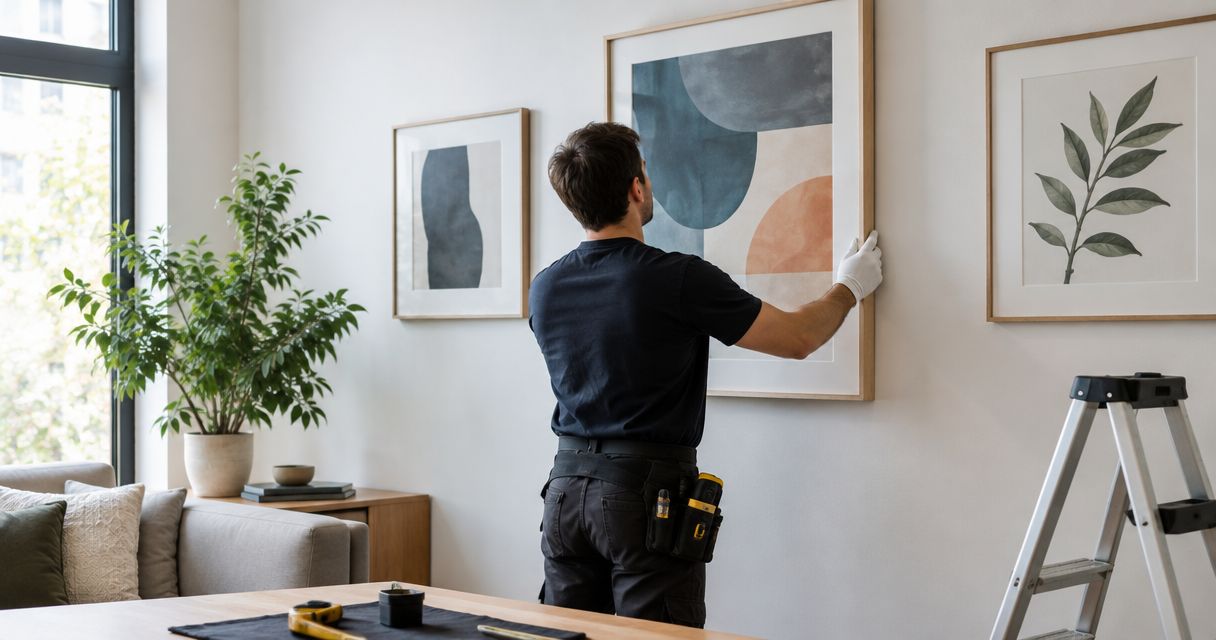
Best for a settled layout: request hanging at the approved position. Include a marked photograph so the installer understands the intended location, but let the installer verify the mounting method rather than prescribing fixings from a photograph.
Best for an unresolved arrangement: request layout and hanging together. Ask how the layout will be presented and approved before drilling; otherwise, the estimate leaves a key decision undefined.
Best for uncertain support or handling: request an assessment before booking installation. The limitation is straightforward: an assessment still needs accurate information about the piece and the wall.
Why professional wall art installation cost varies
Artwork size, material, and composition belong in the installation brief because they describe what must be handled and positioned. The supplied artwork catalog includes framed pieces, glass sculptures, and multipart compositions; those are not interchangeable installation descriptions.
Give the installer these details:
- Overall dimensions: provide the complete outside measurements, not just the printed image area.
- Material: identify glass, framed artwork, painted wood, or another stated material rather than relying on appearance.
- Piece count: describe each separate element in a multipart composition.
- Rear fittings: provide clear photographs and any mounting instructions supplied with the artwork.
- Weight: obtain the actual specification instead of estimating from size or material.
- Proposed arrangement: show whether pieces form a single composition or occupy separate positions.
These details support a defined quote; they do not establish a labor rate. Ask the installer to explain which project requirements affect the estimate and which do not.
Size examples are not installation price bands
The Mercado da Imagem wall decoration catalog includes framed artwork listed at 40 × 60 cm, 99 × 130 cm, and 136 × 191 cm. These dimensions give you concrete examples of the size information to include in a brief, not a schedule of installation charges.
A 40 × 60 cm listing does not establish the artwork’s weight or the suitability of an existing wall hook. Likewise, a 136 × 191 cm listing does not identify the required crew, equipment, or mounting method.
Use dimensions to describe the job, never to invent a handling specification. Request the missing information from the seller and give it to the installer before accepting the mounting plan.
How do I get an accurate wall art installation quote?
Build a brief that another installer can read without guessing. The goal is not a long document; it is a clear record of the object, location, and expected result.
Document the artwork
Record the exact artwork reference, outside dimensions, material, and confirmed weight. Photograph the front, back, frame corners, and existing mounting fittings, keeping any supplied instructions with those images.
For a multipart work, document each element separately. A composition name alone does not explain the spacing, orientation, or support requirements of its individual parts.
Record the wall
Photograph the whole wall and the proposed hanging area. Identify the wall construction if you know it; if you do not, ask the installer to assess it rather than labeling it from appearance.
Flag visible damage, nearby electrical fittings, and any uncertainty about concealed services. Do not treat a clear-looking wall surface as confirmation that drilling is safe.
Confirm the layout
Show the intended placement relative to furniture, doors, and nearby artwork. Decide whether you want the installer to follow an approved layout or help develop it.
For a group, show the arrangement as a whole. Approving individual pieces without reviewing the combined composition leaves the relationship between them unresolved.
Define access
Describe the route from the arrival point to the installation wall, including stairs, lifts, narrow turns, and building access procedures. Include room photographs showing furniture and other obstacles near the work area.
Ask who will move furniture and protect nearby surfaces. Put the answer in the estimate rather than leaving it for installation day.
Approve the scope
Request a written list of included work, exclusions, assumptions, and conditions requiring a revised estimate. Confirm who supplies hardware and who approves the final position before drilling begins.
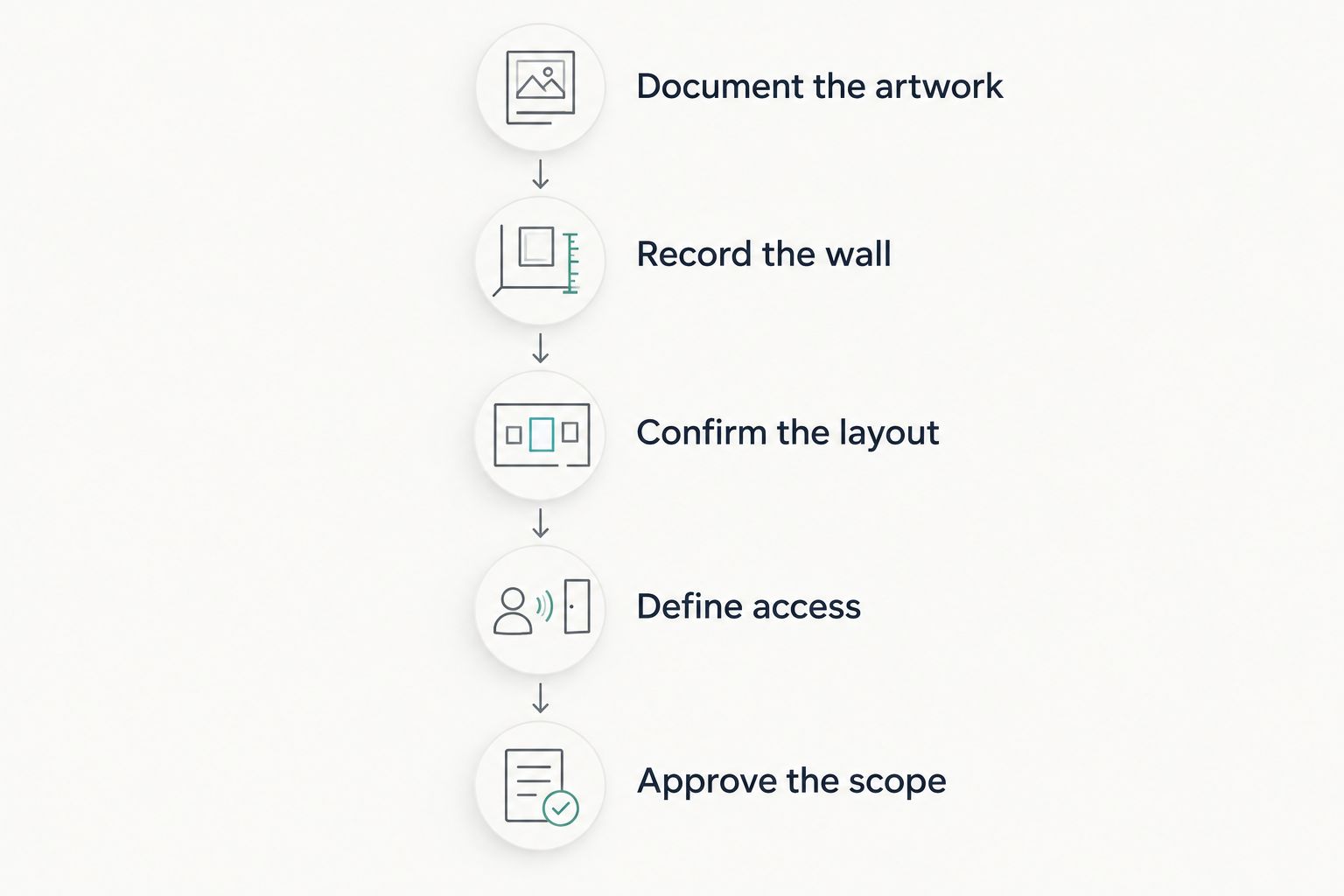
Keep this same brief when requesting another estimate. Changing the information between installers makes the totals harder to compare and leaves you checking assumptions instead of evaluating the work.
What should a 2026 installation estimate include?
A usable estimate describes a result, not just a visit. You should be able to identify the artworks covered, their intended locations, and the work the installer has agreed to perform.
Ask for the following in writing:
- The artwork references and installation locations.
- The agreed layout or the process for approving it.
- The mounting hardware responsibility and assessment requirements.
- The handling, transport, and access arrangements.
- The wall preparation and finishing exclusions.
- The process for approving changes before extra work begins.
Also ask how the installer handles a mismatch between the brief and the site. An unsuitable wall, undocumented fitting, or changed position should trigger a discussion before work proceeds, not an unexplained change at completion.
Save the accepted version. A later message about a different layout should not silently replace the original agreement.
How do I compare quotes without overlooking exclusions?
Compare matching scopes before comparing totals. Put the estimates side by side and mark every difference in labor, hardware, handling, preparation, and completion responsibilities.
Where an estimate is unclear, ask a direct question: does the stated total cover this task for this artwork at this location? Avoid accepting a broad description such as artwork installation when the project also needs layout decisions or wall preparation.
A lower total is not evidence of an equivalent service. Equally, a longer estimate is not evidence of better workmanship; judge whether it answers the practical questions and assigns responsibility clearly.
Use this final comparison checklist:
- Are all estimates based on the same artworks and locations?
- Does each installer understand the wall and rear fittings?
- Is layout assistance included where you need it?
- Are hardware and access responsibilities explicit?
- Are exclusions and change approvals written down?
Choose the estimate you can understand and verify. Ask for clarification before accepting any unresolved assumption.
When is professional installation the better choice?
Professional installation is the better choice when you cannot confidently verify the support, handling, or mounting requirements. That includes uncertainty about the wall, the artwork’s fittings, or how to position a multipart composition without repeated drilling.
Professional help also has a limitation: booking an installer does not resolve missing specifications automatically. Supply the artwork information and ask what needs an on-site assessment before the work is confirmed.
Mercado da Imagem is best for buyers choosing art and wall decoration, not for establishing a universal installation rate. Keep product selection and installation approval as separate decisions, even when they belong to the same room project.
FAQ
How much should I budget for professional wall art installation in 2026?
Base your budget on a written, project-specific installation quote. Give the installer the artwork specifications, wall details, placement, and access information, then confirm hardware and other exclusions.
Does buying wall art include professional installation?
Do not assume an artwork purchase includes professional installation. Check the order terms and obtain written confirmation of any delivery, handling, or hanging service.
Is installing a large artwork more expensive than hanging a small frame?
Dimensions alone do not establish the installation charge. Ask the installer to assess the artwork’s weight, fittings, wall support, handling, and access before comparing estimates.
Can I use the hooks already on my wall?
Use existing hooks only after their suitability for the artwork and wall has been verified. A hook’s appearance does not establish its load rating, fixing method, or condition.
What photographs should I send an art installer?
Send photographs of the whole wall, the proposed position, the artwork’s front and back, and its mounting fittings. Add access-route photographs where stairs, narrow turns, or obstacles need assessment.
Should I hire someone to plan and hang a gallery wall?
Request layout and hanging together if you want help deciding the arrangement. Confirm how the composition will be approved before drilling and how layout changes are handled.
Can a professional install glass wall sculpture on any wall?
Do not assume every wall is suitable for a glass wall sculpture. Have the installer verify the wall construction, artwork specifications, and manufacturer’s mounting requirements before installation.
One last thing
Approve the position before approving the holes. A mounting plan addresses support; a layout approval addresses appearance, and you need both.
Before your 2026 installation begins, review the proposed arrangement from the places where you actually use the room. Check it from the doorway and the main seating position, then confirm the final placement with the installer before drilling.