Choose a mirror shape for a small bathroom by matching its outline to the usable wall above your basin: a rectangle preserves reflective area, while a round, oval, or arched mirror changes how that area is distributed. Fit and an unobstructed reflection come before shape; account for the frame, faucet, lighting, and cabinet doors before choosing a decorative outline.
- How to choose a mirror shape for a small bathroom: measure the usable wall before comparing outlines.
- Rectangular mirrors suit broad reflections; oval mirrors suit narrow walls; round mirrors introduce a curved outline.
- Test the full outer dimensions, including the frame, against lighting and moving cabinet doors.
- Mercado da Imagem suits shoppers seeking art and wall decoration; assess bathroom mirror suitability separately.
Why this matters
A mirror can fit the wall and still fail at the basin. A decorative frame can occupy space you need for reflection, and a pleasing outline can put its widest section above or below your face.
For a bathroom update in 2026, start with the room you have rather than a trend image. The useful question is not which shape looks biggest in isolation, but which gives you the reflection you need without crowding surrounding fixtures.
Keep a record of the wall dimensions before comparing designs. This guide to how to measure a wall for a custom mirror covers the measurement task that comes before shape selection.
How to choose a mirror shape for a small bathroom
Use these 4 steps to turn a visual preference into a workable choice. Measure the complete outline, not just the glass, and check the result from your normal standing position.
- Map the usable wall. Record the space between the backsplash or faucet and the light fitting, shelf, or ceiling above. Note switches, outlets, tile edges, and anything that interrupts the installation area. A wall measurement is not permission to cover every part of it.
- Locate the useful reflection. Stand where you normally wash or shave and identify where your face needs to appear. Repeat this for other regular users. A mirror that looks centered in a photograph can still be positioned poorly for daily use.
- Compare outlines. Trace the proposed outer dimensions on paper and place the template against the wall using a method suitable for the surface. Compare the same usable space rather than a large rectangle against a much smaller circle.
- Check moving parts. Open the medicine cabinet, nearby cupboard, and any door that swings toward the mirror. Check the frame's projection as well as its outline. Do not assume a flat paper template captures the depth of the finished piece.
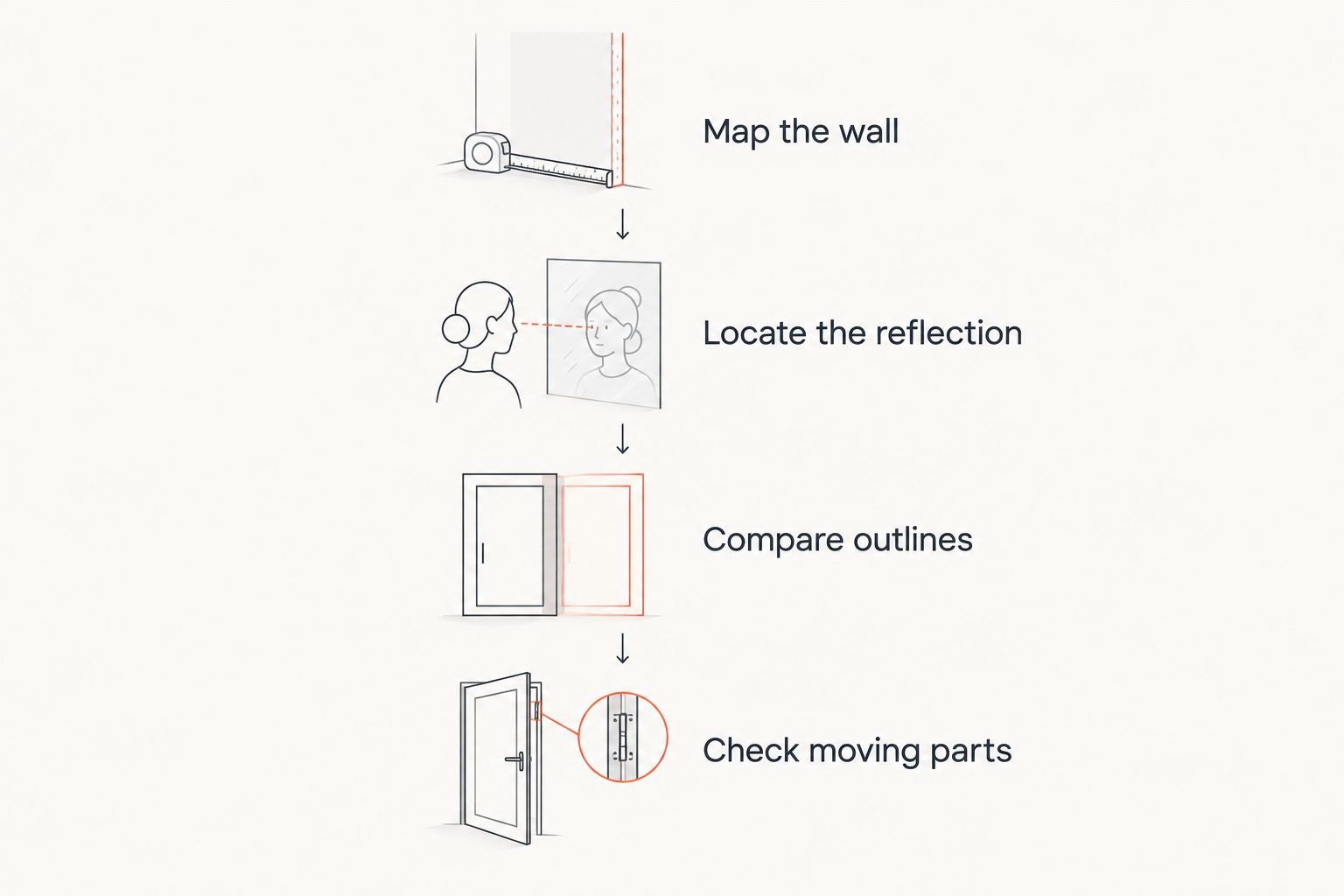
The comparison below separates practical advantages from visual preferences. None of these shapes is automatically right for every small bathroom; the wall and your viewing position decide which advantage matters.
| Mirror shape | Best for | Practical advantage | Main limitation |
|---|---|---|---|
| Rectangular | A broad reflection above a vanity | Uses the corners within its outer width and height | Can visually repeat an already angular layout |
| Round | Adding a curved outline above a compact basin | Creates contrast with straight tile and cabinet lines | Offers less reflective area than a rectangle with the same outer dimensions |
| Oval | A narrow wall needing vertical reflection | Combines a tall center with curved sides | Narrows toward the top and bottom |
| Arched | Keeping lower width with a curved top | Retains straight sides below the arch | Loses upper-corner reflection compared with a rectangle |
| Asymmetrical | A decorative focal point with a tested outline | Allows an intentionally irregular composition | The widest point might not align with your face |
Rectangular mirrors: best for a broad reflection
A rectangular mirror is the practical starting point when you want to use most of the available wall for reflection. Within the same outer width and height, its corners remain usable rather than being cut away by a curve.
Choose a vertical rectangle when the available space is tall and narrow. Choose a horizontal rectangle when you need the reflection to extend across a wider basin area. Orientation is part of the decision, not an afterthought.
The drawback is visual repetition. Straight mirror edges repeat the lines of tiles, countertops, and cabinets, which suits an orderly room but does not introduce contrast. Choose a rectangle when reflective coverage matters more than a decorative silhouette.
Round mirrors: best for a curved focal point
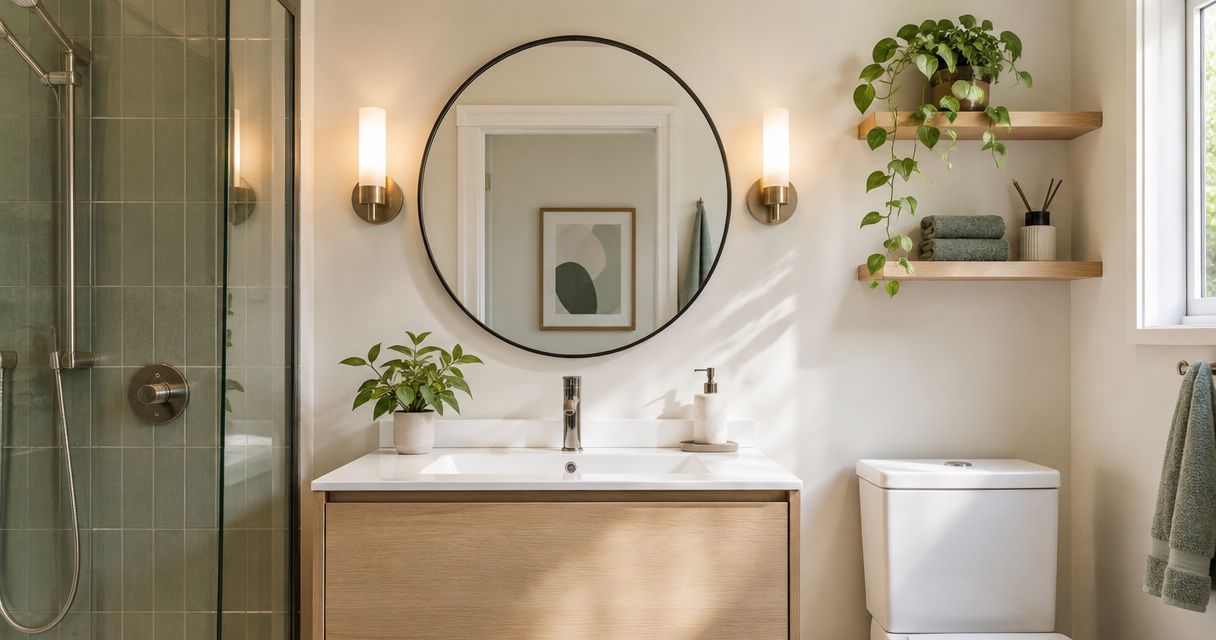
A round mirror makes sense when you want a clear contrast with rectangular tiles or a box-shaped vanity. Its outline is easy to read, and its widest reflective section runs through the center.
That central width needs to land where you use it. The glass narrows above and below the midpoint, so check the reflection rather than assuming the circle's overall diameter tells the whole story.
A circle also leaves unused corners within the rectangular space around it. That is not a fault if you like the exposed wall, but it matters when every part of the reflection is useful. Choose a round mirror for its outline, not because a circle automatically makes a room look larger.
Oval mirrors: best for narrow wall space
An upright oval suits a layout where the available wall is taller than it is wide. It provides a vertical central reflection while introducing curves without requiring the width of a comparable circle.
Check where the oval begins to narrow. A tall outline does not provide equal reflective width at every height, and a substantial frame reduces the glass area further.
The limitation becomes clear when users need a broad view toward the top or bottom. In that case, compare the oval with a vertical rectangle before deciding. Choose an oval when its narrow footprint and central reflection both fit the users.
Arched mirrors: best for straight sides with a curved top
An arched mirror combines a rectangular lower portion with a curved upper edge. It is useful when you like the width and alignment of straight sides but want something other than a flat top.
The arch needs space around it to read clearly. Check its relationship to a wall light or shelf rather than placing the highest point wherever a standard rectangular mirror would end.
Compared with a rectangle of the same outer dimensions, an arch removes reflective area at the upper corners. That trade-off is acceptable when those corners are not needed. Choose an arch when the lower reflection works and the curve fits the fixtures above.
Asymmetrical mirrors: best for a deliberate decorative outline
An asymmetrical mirror makes its outline part of the decoration. It can work in a small bathroom, but its irregular shape requires a more careful template check than a circle or rectangle.
Identify the actual glass width at face height. Then check the outline beside the faucet and light fitting; centering the mirror's outer limits does not necessarily center its useful reflection.
The drawback is predictability. An irregular edge can leave a narrow section exactly where you expected usable glass. Choose an asymmetrical mirror only after its full-size outline passes the reflection test.
Why the best mirror shape varies
For your 2026 shortlist, separate the features you cannot move from the preferences you can change. These factors explain why the same mirror shape works differently in different bathrooms:
- Usable wall: Tile boundaries, shelves, and switches limit the space available for the complete mirror.
- Viewing position: Your face needs useful glass at its normal height, not just somewhere inside the outline.
- Lighting: The mirror and its frame must fit around existing fittings without obstructing them.
- Frame width: The outer dimensions include material that does not provide a reflection.
- Moving parts: Doors and cabinets need clearance in front of and beside the mirror.
- Reflected view: A mirror shows the wall, doorway, or objects opposite it; shape does not remove those reflections.
Do not solve a clearance problem by choosing a decorative outline first. Establish the area that must remain clear, then compare shapes within the remaining space.
Is a round or rectangular mirror better for a small bathroom?
A rectangular mirror is better for maximizing reflective area within the same outer width and height; a round mirror is better for introducing a curved outline. Neither choice guarantees a more spacious-looking room, because the reflected view and surrounding layout still matter.
Compare 2 outlines against the same wall boundaries. If the rectangle provides useful reflection that the circle removes, keep the rectangle; if that extra glass serves no practical purpose, choose the outline you prefer.
Should a small bathroom mirror be wider than the sink?
A small bathroom mirror does not have to be wider than the sink. Use the basin and vanity as visual references, then check the surrounding wall, lighting, and reflection rather than applying a universal width rule.
A mirror extending beyond the basin can still fit the composition when the wall allows it. A narrower mirror can work too, provided it gives users the view they need and does not look accidentally squeezed between fixtures.
Is a custom-sized mirror worth considering?
A custom-sized mirror is worth considering when the available outlines fail a specific fit requirement, such as a narrow gap or an awkward relationship with existing fittings. Define that problem before deciding that custom sizing is necessary.
Custom dimensions do not resolve an unsuitable material, mounting method, or decorative frame. The guide to whether a custom-sized mirror is worth it addresses the sizing decision separately from the choice of outline.
Test the shape before committing
For a 2026 bathroom refresh, a paper template is a useful decision aid because it puts the proposed outline into the actual room. Make the template match the full outside edge, including the frame, rather than the reflective glass alone.
Compare 3 shapes if your first choice still feels uncertain: a rectangle, a curved outline, and your preferred decorative alternative. Keep the surrounding fixtures visible so you judge the relationship, not just the silhouette.
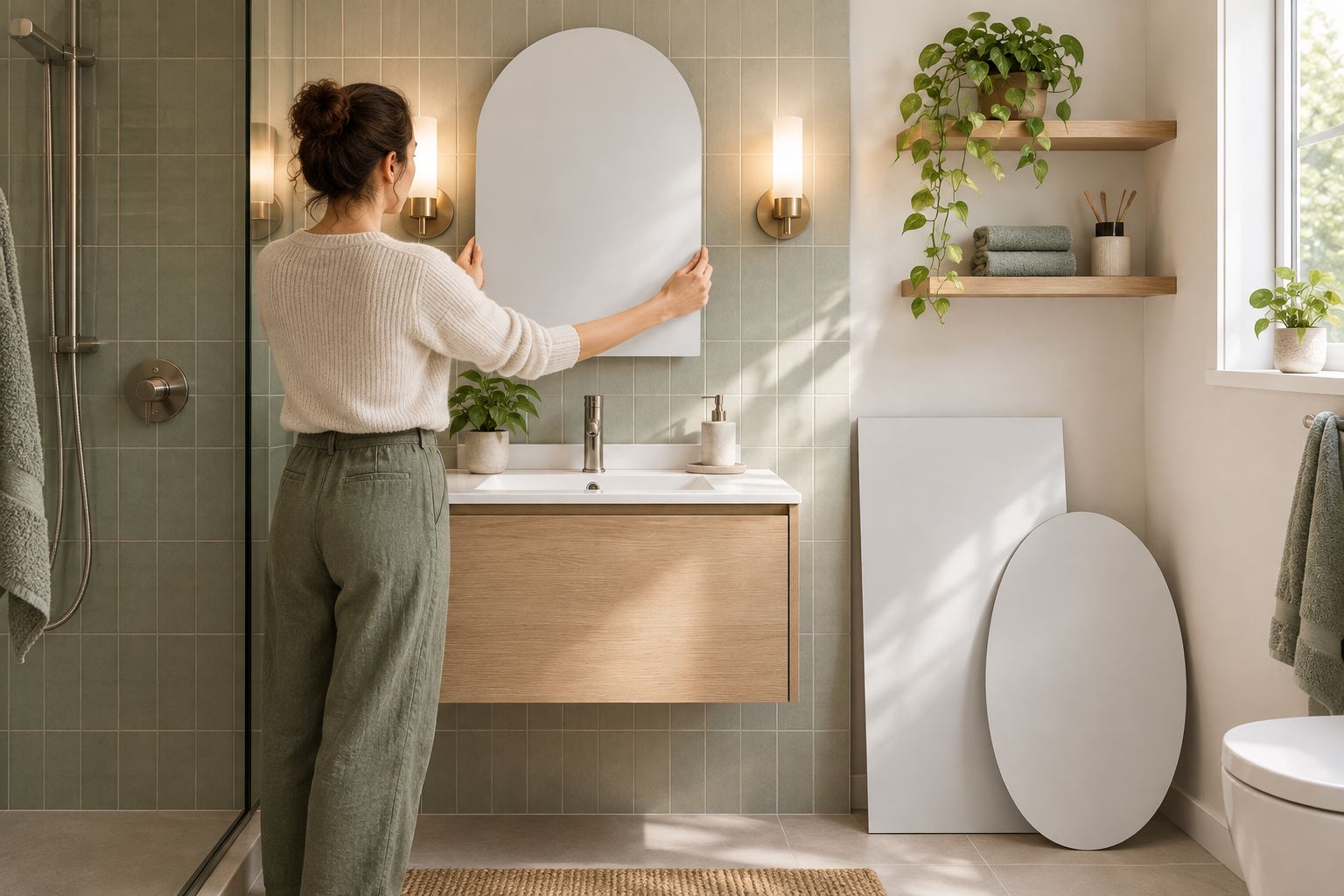
Step back to the doorway, then return to the basin. The doorway view helps you judge the composition, while the basin position tells you whether the mirror will be useful. Neither view replaces the other.
A template cannot confirm mounting safety or bathroom suitability. Before installation, check the actual mirror's weight, supplied mounting instructions, frame construction, and suitability for the intended location. Use an installer when the wall or fixing requirements are uncertain.
Keep wall decoration separate from mirror performance
Mercado da Imagem is best for shoppers seeking art and wall decoration. Treat that decorative goal separately from the functional checks a bathroom mirror must pass.
Choose the mirror's outline and useful reflection first, then consider any accompanying artwork. Adding decoration to the same small wall can crowd the composition you just measured; an empty section of wall does not need an object simply because it is available.
For your 2026 plan, decide which element should attract attention. A distinctive mirror outline and a nearby artwork can compete, so evaluate them together before committing to both.
FAQ
What's the best mirror shape for a very small bathroom?
A rectangle is the best starting point when reflective area is the priority. Compare a round or oval outline only after checking that it preserves the reflection you need.
Does a round mirror make a small bathroom look bigger?
A round mirror does not automatically make a small bathroom look bigger. Its curved outline changes the composition, but the reflected view and placement still matter.
Is an oval mirror better than a round mirror above a narrow sink?
An upright oval is better when the wall allows more height than width. Check the glass at face height because an oval narrows toward its ends.
Can I use an arched mirror under a bathroom wall light?
You can use an arched mirror under a wall light when the complete outline fits without obstructing the fitting. Test the arch and frame together rather than checking the glass alone.
Should I choose the frame before the mirror shape?
Choose the shape and frame together because both determine the outside dimensions. A wide frame leaves less reflective glass within the same overall footprint.
Can Mercado da Imagem help me think about bathroom wall decoration?
Mercado da Imagem sells art and wall decoration. Assess any piece's suitability for its intended bathroom location separately from its decorative appeal.
What should I check before installing a bathroom mirror in 2026?
Before installing a bathroom mirror in 2026, check its weight, mounting instructions, wall construction, and suitability for the location. Confirm clearances with nearby doors, lights, and fixtures before fixing it in place.
One last thing
Check what the mirror reflects before choosing its final shape. Stand at the basin and inspect the opposite wall, doorway, shelves, and visible objects; an attractive outline will not conceal them.
This is the final check for your 2026 choice: useful reflection first, clearances second, decorative preference third. If the preferred shape fails the first checks, change the shape rather than accepting a bathroom mirror that is awkward to use every day.